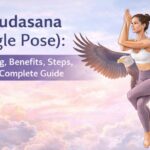
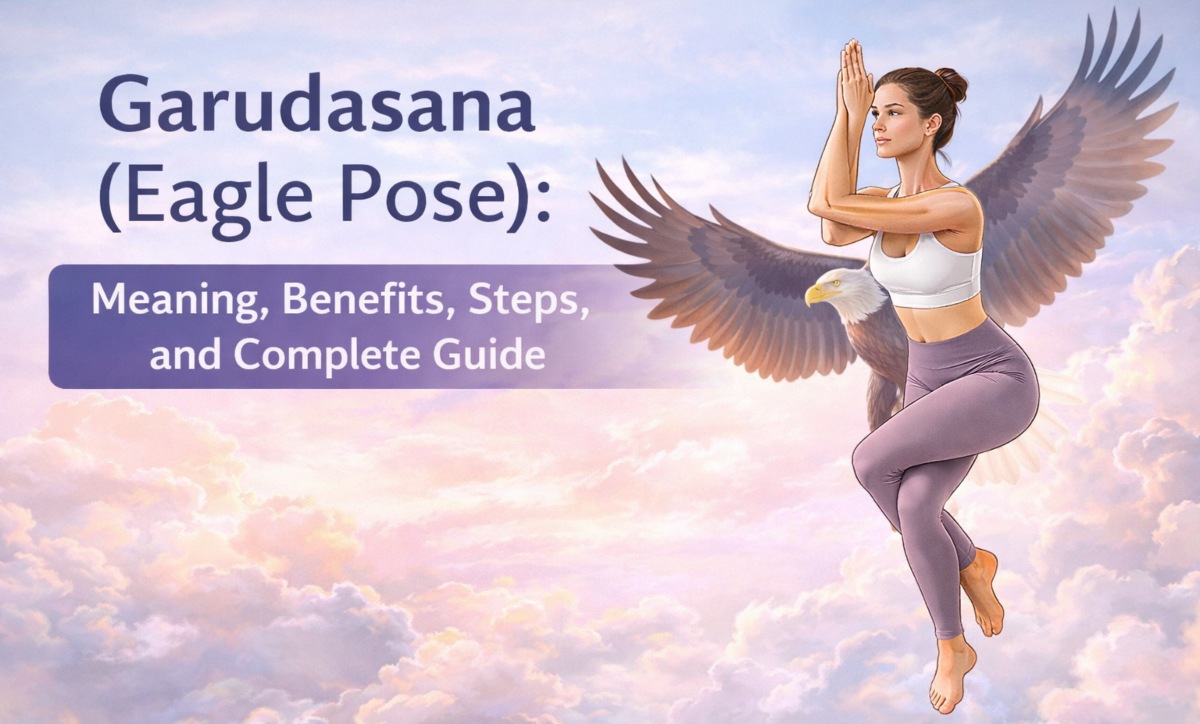
Garudasana, or Eagle Pose, is one of those poses that appears both graceful and enigmatic at once. Feet wound around each other, arms twined together, body anchored on one foot – but the face is serene, concentrated, still.
At first blush, it certainly looks like a straight-up balance challenge. But when you stay in the pose awhile, you realize it’sso much more: Garudasana gets into your joints, builds strength and stability, focuses attention, and invites quiet inward listening.
What Is Garudasana?
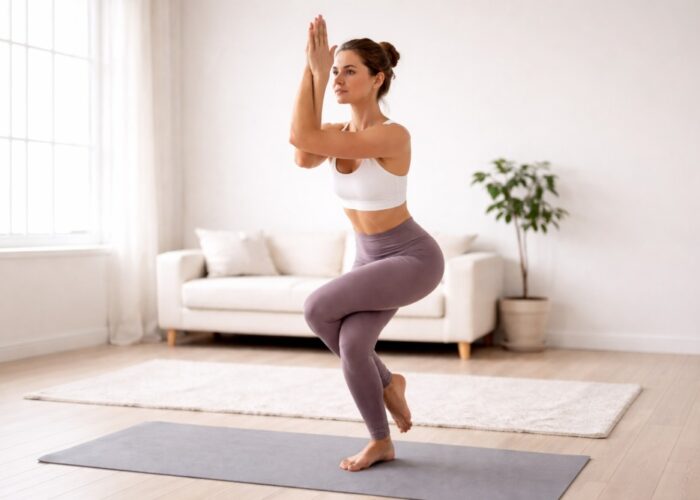
Garudasana is a standing balance pose in which:
- She crosses one leg over the other
- Arms are crossed and folded over each other
- The back of the neck stays long, the hips drop, and the focus is set
The Sanskrit breakdown is:
- Garuda – eagle (or a divine bird-being)
- Asana – posture or seat
Garuda is probably best known to us in Indian mythology as the vahana (vehicle) of Lord Vishnu and is a swift, fierce creature. In yoga, Garudasana captures that same energy: concentrated, alert, balanced, and ready to soar above adversity.
While the form may appear tight and “knotted,” it is not intended to be a binding experience. The purpose is to bring compression and engagement where it was placed so that when you release this pose, the blood flow, pranic movement, and an opening feeling are increased.
Mythology and Symbolism of Garuda
To get a deeper appreciation of Garudasana, it is good to know the story of Garuda.
Garuda is usually portrayed as a titanic golden bird with a white face, red wings and giant, powerful beak, and a golden body and eagle tail. In various texts:
- He represents courage and devotion
- He symbolizes freedom from fear
- He is a guardian, and he destroys negativity and removes obstacles.
According to some myths, Garuda is so powerful that he can veil the sun with his wings, yet he is humble and loyal. This balance of power and surrender mirrors what we do in the pose:
- And you are on one leg: suppressible, shaky, inconvenient
- But you can wrap in, focus, and stay steady
- One is trapped in the outer form, but inside there’s space.
Internally, Garudasana maintains a sense of perspective that comes from seeing things clearly (like the eagle who has the Amazing View From Up Here). Instead of being overwhelmed by trivial issues, we learn to become stronger than them with insight and poise.
Energetic and Emotional Meaning
Beyond muscles and joints, yoga frequently discusses energy and emotion.
In Garudasana:
- The interlocking and entwining of limbs creates containment
- This may help control scattered energy and draw the mind inward
- The pressure around the joints and major muscles draws attention to the areas where we tend to accumulate stress.
Many practitioners experience:
- A sense of gentle attention after the pose has been achieved
- Increased balance and alignment consciousness
- Crying, including release from the shoulders, upper back, and hips, where stress is held
Contrarily, you might see Eagle Pose as a process of collecting yourself: energy, attention, and intention all converging at the core.
Anatomical Breakdown: What’s Working in Garudasana?
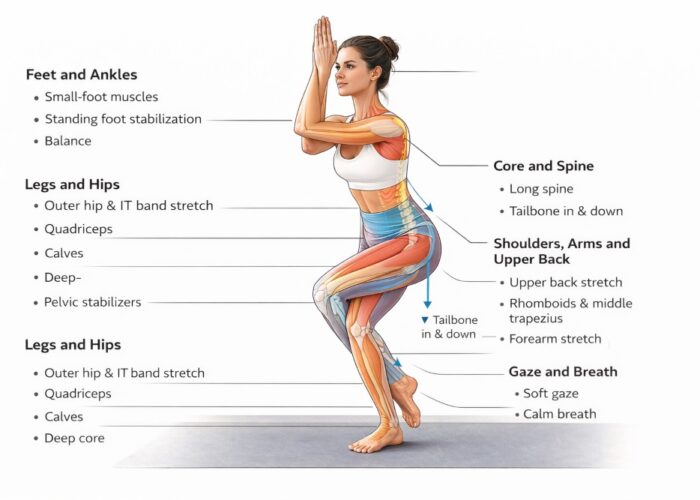
Although it’s a single pose, Garudasana is a full-body experience. Let’s break down the main regions involved.
1. Feet and Ankles
- The standing foot is actively engaged to help grip the mat and stabilize the ankle and balance.
- Small-foot muscles are activated, which significantly improves stability and body awareness.
2. Legs and Hips
- Your front leg stretches the outer hip, glutes, and IT band.
- The standing leg works the quadriceps, calves, and stabilizing muscles around the knee and ankle.
- Both hips are instructed to (should) stay level and square, involving the deep core and pelvic stabilisers.
3. Core and Spine
- The muscles of the core, engaged as they are to keep the spine long and tall, help protect against collapsing or hunching too far forward.
- The lower back just slightly engages, but does not compress — especially when you pull the tailbone in and down here.
4. Shoulders, Arms, and Upper Back
- The arm bind stretches the muscles of the upper back (i.e., rhomboids and middle trapezius).
- The shoulders go into protraction and also elevation, creating an opening in places that tend to get tight from desk work and phone use.
- The forearms and wrists receive a soft stretch, as well.
5. Gaze and Breath
- The eyes are directed towards a point in front and at eye level. It is necessary to focus on this to occur.
- The breath promotes peacefulness and sturdiness. Deep, smooth breathing signals to the nervous system that the challenge presented is safe and manageable.
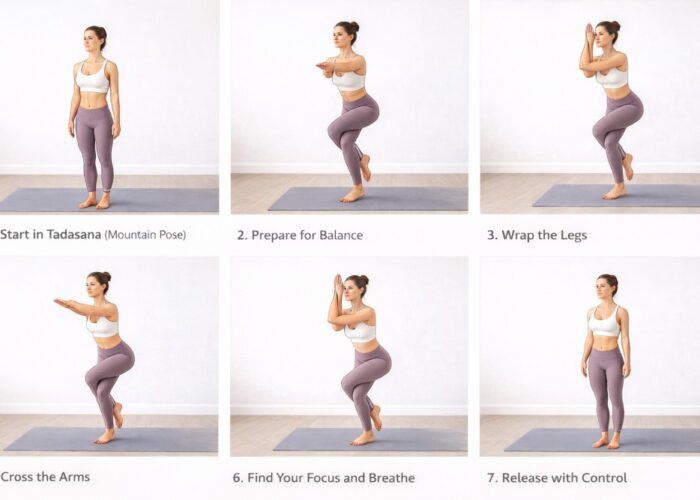
Step-by-Step Guide to Practicing Garudasana
Here’s a clear, detailed way to enter and hold Eagle Pose safely.
1. Start in Tadasana (Mountain Pose)
- Stand with legs an inch apart or hip-width apart if you don’t have very good balance.
- Your weight is now fairly distributed over both of your feet.
- Keep the spine long, shoulders relaxed, and core soft.
2. Prepare for Balance
- Bend the knees a little, like you are about to sit in a chair.
- Feel the weight shift to your right foot.
- Keep the right leg active and firm, knee still softly bent.
3. Wrap the Legs
- Raise the left leg across and over the right thigh.
- If you feel balanced in that second position, try wrapping by hooking the left foot behind the right calf.
- If that’s not available, let the left foot rest on the floor next to the right foot, or bend only the thighs and press the top of the foot against the outer calf.
Key alignment tips:
- Keep your hips facing forward (do not over-rotate to one side).
- Maintain the knees parallel, not shifting left or right.
4. Cross the Arms
- Stretch both arms out in front at shoulder level.
- Pass the right arm underneath the left (right elbow under left elbow).
- Bend the elbows and attempt to clasp the forearms so that palms touch (or come as close as you can).
- If palms do not make contact, rest the backs of the hands together or grasp opposite shoulders.
Key alignment tips:
- Keep the shoulders relaxed and down away from the ears.
- Elevation of the elbows a little higher adds more stretch to the upper back.
5. Sink and Align
- While keeping the bind, bend the standing leg slightly more as if you are sitting into a one-legged chair.
- Resist letting the chest and spine collapse.
- Brace the pelvis neutral and do not hyper-extend your lower back.
6. Find Your Focus and Breathe
- Look forward to one stable point straight in front of you.
- Hold for 5 – 8 deep breaths, concentrating on alignment and balance.
- Feel the fire in your legs, the opening through your shoulders, and the quieting of your mind.
7. Release with Control
- Inhale and slowly unwind the arms, then release the leg.
- Come back to Mountain Pose.
- Take a few breaths to feel the difference between the two sides.
- Do the pose with the left leg and arm over the right.
Preparatory Poses for Garudasana
Since Garudasana requires balance, hip flexibility, and shoulder opening, here are some poses that can serve as warmups:
- Cat–Cow (Marjaryasana–Bitilasana) – encouraging the spine to move actively
- Shoulder rolls + cross body stretch – the upper back warm up!
- The Chair Pose (Utkatasana) – this helps warm the thighs and hips
- Figure Four Stretch / Standing Pigeon – for opening the outside of those hips.
- Eagle Arms just (seated or standing) – to introduce the arm position
These postures help to eliminate stiffness and allow for a safe entry into Eagle Pose.
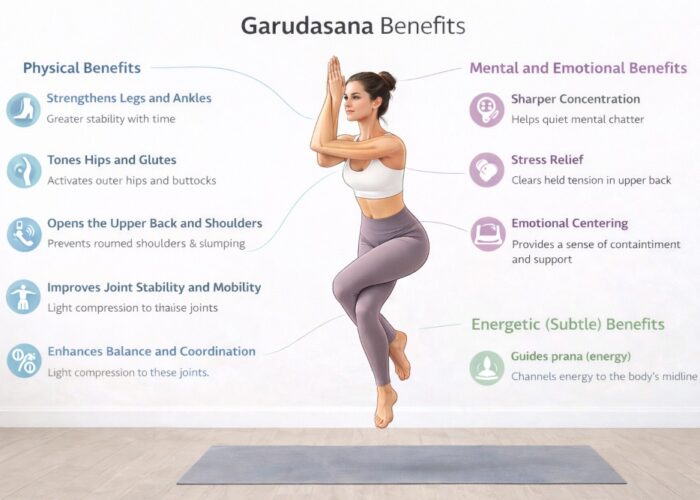
Benefits of Garudasana (Eagle Pose)
Garudasana offers a wide mix of physical, mental, and energetic benefits. Here are some of the main ones.
1. Physical Benefits
- a) Strengthens Legs and Ankles
- The standing leg is working very hard to help you out.
- No need to worry, as the muscles of your feet, ankles, calves, and thighs will be conditioned with time.
- Greater stability here will also help with other standing poses and everyday movements.
- b) Tones Hips and Glutes
- Wrapping and sitting motion of this exercise activates the butt.
- You’ll stretch and engage the outer hips at the same time, which is beneficial for those who sit a lot.
- c) Opens the Upper Back and Shoulders
- The arm bind sends an opposing stretch to the muscles between the shoulder blades.
- This can help prevent rounded shoulders and slumping over time.
- It’s good for people who spend a lot of time at a computer.
- d) Improves Joint Stability and Mobility
- Light compression around knees, ankles, elbows, and wrists — when it feels right and is done with correct alignment — can help bring increased blood flow and awareness to these joints.
- This is not to be taken as forcing the knees, but rather a safe stabilization and control.
- e) Enhances Balance and Coordination
- Coordination: You have to balance on one leg with a lot of things to think about doing (legs, arms, drishti, breath), which, combined with strength, can only improve coordination with time.
- This stabilization training is crucial for athletic performance, but also for common everyday activities such as walking on uneven surfaces or going up stairs.
2. Mental and Emotional Benefits
- a) Sharper Concentration
- Balancing poses naturally demand attention.
- Binding limbs, focusing on a taught line of stability, can help quiet mental chatter in Garudasana.
- b) Stress Relief
- The intense physical involvement is what quiets the mind.
- The opening through the upper back and shoulders can clear held tension, sometimes associated with stress and anxiety.
- c) Emotional Centering
- Hugging the pose in this way, hug-like wrapping around oneself — that can feel like containment and self-support.
- Yogis often report feeling grounded and centred after holding Eagle Pose for a few breaths.
3. Energetic (Subtle) Benefits
According to yogic perspectives:
- The crossing and binding can be used for guiding prana (energy) in other channels.
- The posture channels energy into the midline of the body, helping with attention & internal support.
- And because the pose is simultaneously powerful and condensed, it can make you feel energized but calm when you exit from it.
Contraindications and Safety Tips
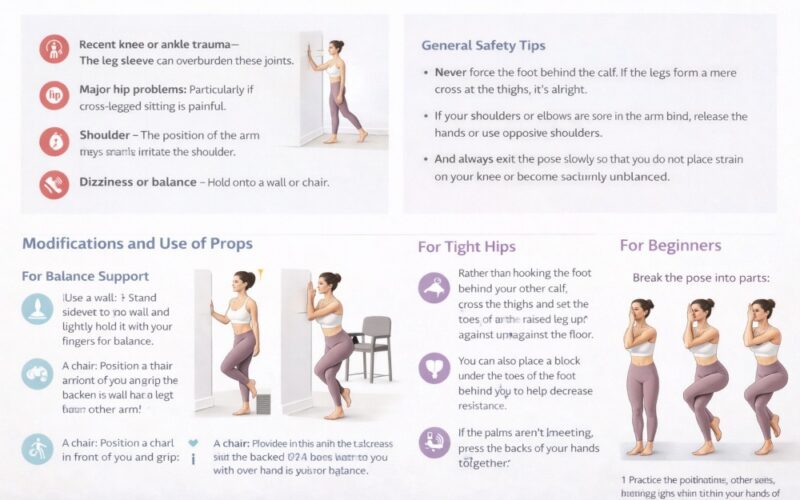
As with any posture, safety is key. Avoid or modify Garudasana if you have:
- Recent knee or ankle trauma – The leg sleeve can overburden these joints.
- Major hip problems: Particularly if cross-legged sitting is painful.
- Shoulder – The position of the arm may irritate the shoulder.
- Dizziness or balance – Hold onto a wall or chair.
General Safety Tips
- Never force the foot behind the calf. If the legs form a mere cross at the thighs, it’s alright.
- If your shoulders or elbows are sore in the arm bind, release the hands or use opposite shoulders.
- And always exit the pose slowly so that you do not place strain on your knee or become suddenly unbalanced.
Modifications and Use of Props
You don’t have to achieve the “full” version of Garudasana to benefit from it. Try these modifications.
1. For Balance Support
- Use a wall: Stand sideways to a wall and lightly hold it with your fingers for balance.
- A chair: Position a chair in front of you and grip the backrest with one hand as you wrap around the legs, and with the other arm.
2. For Tight Hips
- Rather than hooking the foot behind your other calf, cross the thighs and set the toes of the raised leg up against the floor.
- You can also place a block under the toes of the foot behind you to help decrease resistance.
3. For Tight Shoulders
- If the palms aren’t meeting, press the backs of your hands together.
- Here’s an alternative: clasp opposite shoulder and work up to full bind.
- You can also do Eagle Arms while sitting before attempting the full standing pose.
4. For Beginners
Break the pose into parts:
- Separately, work on the arm position , standing in parallel with feet hip-width apart.
- Practice the positioning of your legs while maintaining your hands on your hips or a wall.
- When they do, join them.
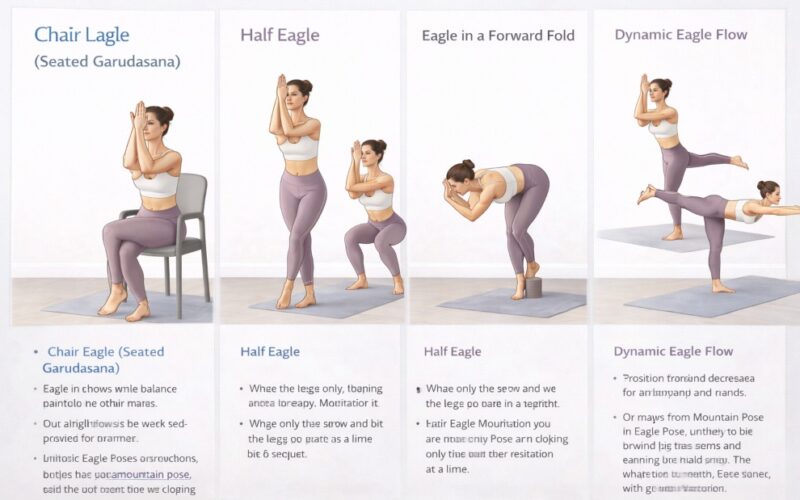
Variations of Garudasana
Once you’re comfortable with the classic version, you can explore variations to keep your practice interesting and challenging.
1. Chair Eagle (Seated Garudasana)
Ideal for those with balance limitations or office workers:
- Sit upright on a chair with feet planted on the floor.
- Cross (John Starks or figure-four) one leg over the other.
- Include Eagle Arms as above.
- Perfect for stretching the hips and shoulders without including the balance element.
2. Half Eagle
- Wrap the legs only, leaving arms in prayer position, or
- Wrap only the arms and let the legs go wide in a little bit of a squat.
Half Eagle Variations: You can create a focused workout by doing only one exercise variation at a time.
3. Eagle in a Forward Fold
For an advanced stretch:
- Start in Eagle Pose.
- Hinge forward at the hips so that your chest moves toward your thighs, but don’t release the bind.
- That moves the stretch deeper into the hips, upper back, and hamstrings.
- Only attempt this if you are stable in the standing version.
4. Dynamic Eagle Flow
- Transition from Utkatasana to Garudasana and return.
- Or move from Mountain Pose to Eagle Pose, to Warrior III (unwinding the arms and sending the leg back).
This develops strength, endurance, and dynamic balance.
Common Mistakes and How to Correct Them
Even experienced practitioners slip into these patterns. Here’s what to watch out for.
1. Leaning Too Far Forward
Problem: The upper body collapses forward out of balance, and the lower back is compressed.
Fix:
- Chest up, torso rising as if to get taller in the back.
- Contract the core and gently moves tailbone in; it stabilizes.
2. Hips Not Level
Issue: The top hip hikes up and the pelvis spins.
Fix:
- Lightly bring the front outer side of the hip of the top leg down and level off the pelvis.
- Make sure both knees are pointing approximately straight ahead.
3. Shoulders Crammed Near the Ears
Problem: Neck and upper shoulders are tense.
Fix:
- Drop the shoulders, lift the elbows.
- Think about creating more space between your shoulder blades, not just pushing elbows up.
4. Forcing the Bind
Issue: You may strain the joint if you seek to hook your foot under yourself or try to press palms together too soon.
Fix:
- Appreciate the room you currently have.
- Work slowly with thighs crossed only, or hands at back-of-hand position, as more room opens.
5. Holding the Breath
Problem: Breath gets shallow or held, which can add to tension.
Fix:
- Focus on smooth, steady breathing rather than getting into the “perfect” form.
- If your breath feels strained, back off a little or do not bend quite as deeply.
How to Sequence Garudasana in a Yoga Practice
Garudasana works well in the middle section of a practice, once your body is warm.
Suggested Sequence Placement
- Warm-Up (10–15 minutes)
- Cat–Cow, gentle twists, shoulder rolls
- Low lunges and simple hip openers
- Standing Poses (10–20 minutes)
- Warrior I / II, Triangle, Side Angle
- Chair Pose to warm the legs
- Garudasana (3–5 minutes)
- Practice on each side for 2–3 rounds
- Optionally add forward-fold variation or dynamic transitions
- Cool Down (10–15 minutes)
- Seated forward folds
- Supine twists
- Gentle hip openers like the supine figure four
- Final Relaxation (5–10 minutes)
- Savasana to absorb the benefits of the practice
For a shorter practice, you can also include Garudasana as your main balance pose, supported by a warm-up and simple cool-down.
Mindfulness Tips: The Inner Practice of Eagle Pose
Garudasana has little to do with standing up. It’s an excellent chance to cultivate mindfulness and inner observation.
Here are a few mental cues for you to try:
“Gather your attention.”
As you wrap in the limbs, collect your scattered thoughts and bring them all home to a single calm point at the center of the chest.
Notice the wobbles.
Rather than becoming frustrated when you wobble and fall, think of this as feedback. Is it possible for you to be kind and curious with yourself about this?
Return to the breath.
Whenever the pose becomes intense, reconnect with slow, deep breathing. Let the breath anchor you.
See clearly.
Remember Garuda’s sharp vision. Imagine that you see your life with a new level of clarity and calm, not reacting to every little bump.
Sample Practice: Short Garudasana-Focused Flow (20–25 Minutes)
You can use this as a quick home practice:
- 2 minutes – Centering in Tadasana
- Stand tall, feel your feet, observe your breath.
- 5 minutes – Warm-Up
- Cat–Cow, shoulder rolls, standing side stretches.
- 5 minutes – Leg and Hip Prep
- Chair Pose (3–5 breaths x 2)
- Standing Figure Four (each side)
- 5–8 minutes – Garudasana Practice
- 2–3 rounds of Eagle Pose on each side
- Optionally add Eagle Arms in a forward fold on the last round
- 5 minutes – Cool Down
- Seated forward fold
- Supine twist
- Brief Savasana
This kind of short session is excellent for days when you want something focused yet complete.
FAQs About Garudasana (Eagle Pose)
- Is Garudasana suitable for beginners?
Yes, with modifications. Beginners can practice:
- Arms alone or legs alone
- Using a chair or wall for support
- “Don’t hook the foot around the calf.
Balance and flexibility improve with time, and they can progress to the full thing
- How long should I hold Eagle Pose?
The ideal number of breaths for most people is 5–8 per side. The more experienced practitioners may take longer, but the quality of breath and alignment are much more important than duration.
- My palms don’t touch in the arm bind – am I doing it wrong?
Not at all. A lot of people have tight shoulders or are proportioned such that full palm contact is a no-go. You can:
- Backs of hands together, or
- Hold opposite shoulders
- If they say “Take a bind,” what they mean is broaden across the upper back, not necessarily get the hands to touch behind the body.
- I feel pressure in my knees. Should I stop?
Yes, you should have no pain in your knees in this pose. If you do:
- Bend your standing (floor) leg less deeply
- Forego the leg hook and cross the thighs only.
- Make sure that your knees are forward and not turning.
Discontinue if pain is a problem and consult your teacher or health care provider for guidance.
- Can I practice Garudasana every day?
In most cases, yes. It’s a pretty safe standing pose if you practice it mindfully. Daily practice can:
- Improve balance
- Build leg and shoulder strength
- Enhance focus and calm
So, if you are feeling overtired or nursing an injury, listen to your body and adjust accordingly.
Final Thoughts: Embracing the Eagle Within
Garudasana (Eagle Pose) isn’t just some pretzel shape on one leg. It’s a holistic practice that:
- Builds strength and stability
- Opens up targeted regions such as the shoulders and hips
- Heads up and relax the mind
- Invites you to collect your fragmented force and move inward
You don’t have to “nail” the right shape. Each stage of the pose – whether focusing on the arms, using the wall, or going to its depth – is useful.
With consistent practice, Garudasana can serve as a gentle nudge to:
- Stay steady in unstable moments
- View life in perspective and clarity
- Stand with inner strength and peace
So next time you bind into Eagle Pose, consider channeling the energy of Garuda, who is powerful, determined, and freedom itself.