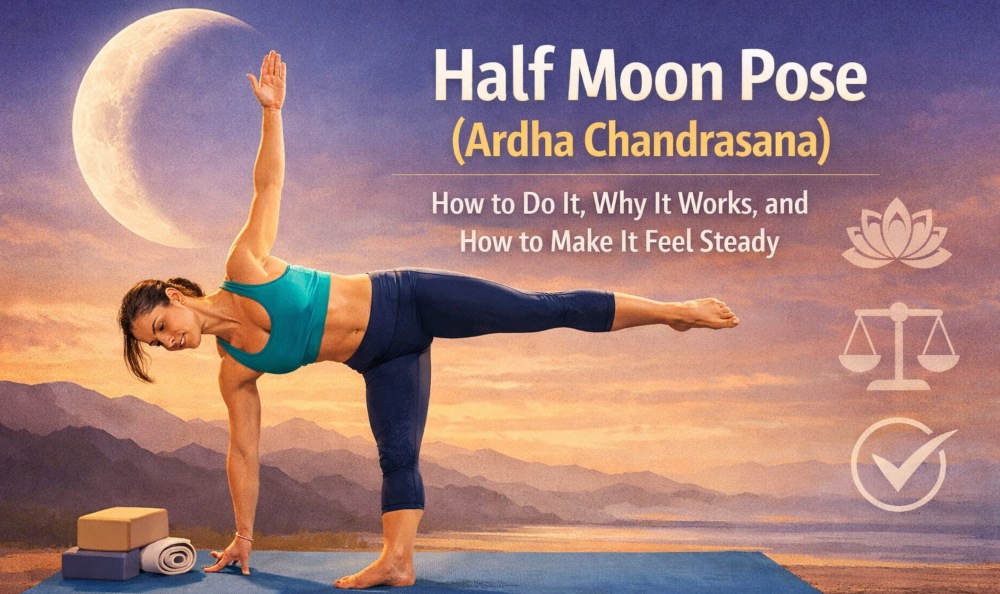
Ardha Chandrasana, Half Moon pose, is one of those yoga postures that appears like a frozen moment from nature: one hand grappling the earth, the other being offered to the sky, body curved into an ethereal crescent moon shape. In reality, it’s a potent cocktail of equilibrium, strength, and roominess – as well as an education in how to feel grounded when half your body is hanging out in the air.
Whether you’re new to the pose or want a deeper exploration of its alignment, my guide offers step – by – step technique, recommendations for props and modifications, common mistakes people make when they do it, and dumb ways in which they try to achieve it – as well as intelligent methods to work into the pose.
What is Half Moon Pose?
Sanskrit breakdown
- Ardha = half
- Chandra = moon
- Asana = pose
Type of pose: Balance + side bend.
Main actions: Anchor the standing leg, open through the pelvis and ribcage, extend arms, and crown of the head
Classic: From Triangle Pose (Trikonasana) or High Lunge
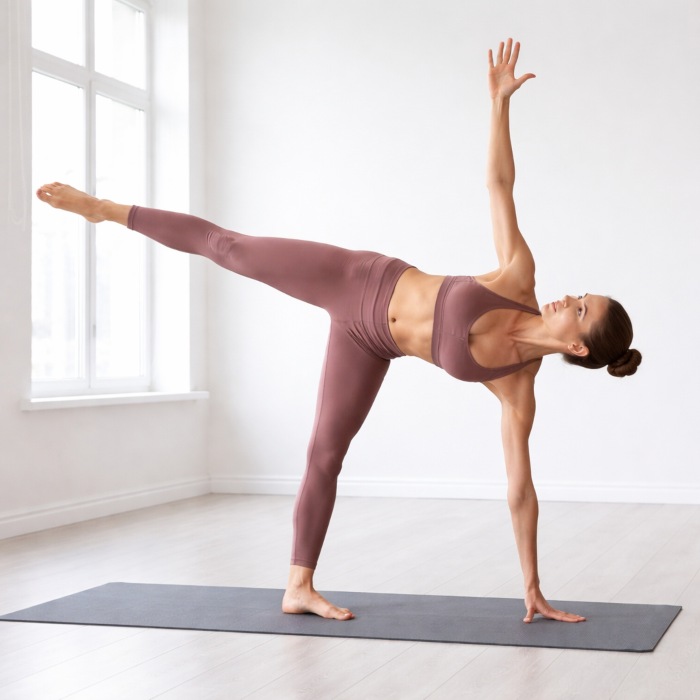
Half Moon Pose is, at its core, a one-legged, open-hip balance with an extended spine. You are training your body to do two things at once:
- Ground with stability and integrity through your standing leg.
- Open out freely from the pelvis, chest, and top arm.
Why Practice Ardha Chandrasana? Key Benefits
Half Moon Pose can be referred to as a “full-body pose” because it engages so many systems at the same time.
Physical benefits (commonly experienced)
- Enhances balance and coordination as it disrupts proprioception (sense of where your body’s part is in space).
- Works the standing leg (ankle, calf, hamstring, quadriceps); also strengthens glutes and core.
- Increases hip stability – and in particular the outer hip (glute medius) that helps maintain proper walking and running mechanics.
- Promotes awareness of the length and posture of the spine along the entire back line.
- Stacks and opens across the collarbones, opening the chest and shoulders.
- Lengthens side body (obliques, intercostals, lats), feel the ribs having room to expand.
Mental benefits
- Trains attention and calmness under stress
- Aids in developing a peaceful relationship with wobbling (a genuine yoga skill!)
One note on wobbling: In balance poses, wobbling often reflects muscles learning, not just failing.
Who Should Be Cautious?
Skip or Adjust Half Moon Pose with the following conditions:
- Recent injury to the ankle, knee, or hip
- Sharp and sudden pain in the lower back (during rotation)
- Vertigo/balance problems (use a wall, look down)
- Low blood pressure (as long as you move slowly and don’t linger for too long)
If you’re pregnant or postpartum, there are modified versions of it that you can still practice, but do it under the guidance of a knowledgeable teacher (one who cues pelvic and core strategies correctly), too.
As always, yoga is never a substitute for medical advice. If you feel pain (sharp, pinching, or nerve-like), take a breather and reach out to an expert.
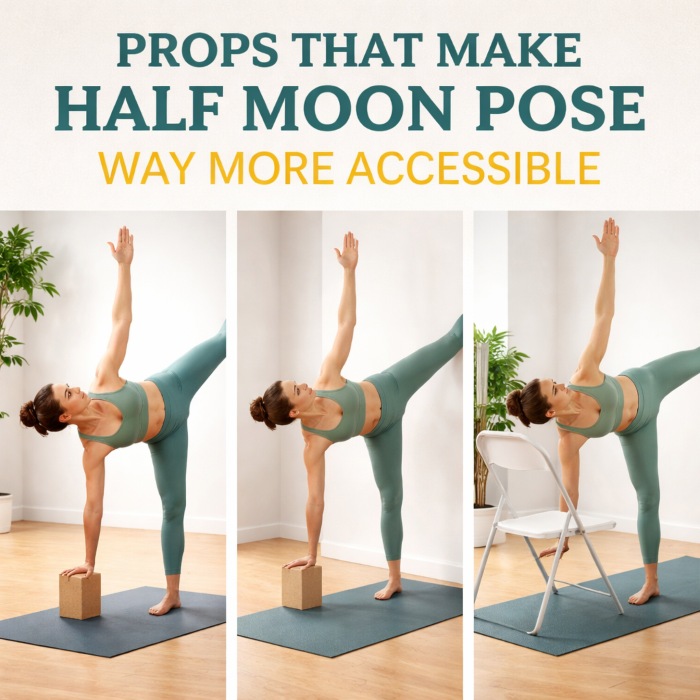
Props That Make Half Moon Pose Way More Accessible
Props don’t “make it easier” for the student – they make it more intelligent.
Best props for Ardha Chandrasana:
- A yoga block to support the bottom hand (most popular and recommended).
- A wall behind you for support and hip alignment.
- A chairto support your hand if the floor feels too far away.
Block tip: Keep the block on its tallest height to start. The better part of those who slide do so prematurely to the floor.
Step-by-Step: How to Do Half Moon Pose (From Triangle Pose)
This is the classic entry and a great way to learn clean alignment.
1) Set up Triangle Pose
- Begin in Triangle Pose with your right foot forward.
- Right hand to the floor (or on a block), left arm up.
- Take a breath to elongate the spine.
2) Prepare the launch
- Slightly bend your right knee.
- Place your left hand on your left hip (optional, but useful if you’re learning to stack your hips).
- Pour your weight into the right leg.
3) Walk your hand forward
- Slide your right hand 8-12 inches in front of you (in front of the right foot), down to the mat or a block.
- This creates a “kickstand” base.
4) Lift the back leg
- Contract your right buttock and outer hip.
- Float the left leg up to about parallel with the floor.
- Engage the left foot (toes push forward, not up).
5) Stack the hips (the heart of the pose)
- Spin your chest and pelvis open to the left.
- Think of your hips as headlights: Point the left headlight toward the side wall behind you.
6) Extend through the whole shape
- Hug the crown of your head forward.
- Reach your top arm (left) up.
- Keep the waist long on both sides — don’t crunch into your bottom ribs.
7) Choose a steady gaze
Options:
- On the floor (most stable)
- Forward (middle challenge)
- To the top hand (hardest)
8) Hold and breathe
- Hold for 3–6 slow breaths.
- Stay calm; micro-adjustments are normal.
9) Exit with control
- Bend the standing knee slightly.
- Lower the leg that was lifted, hovering to the triangle or stepping back into a lunge.
- Repeat on the other side.
Alignment Checkpoints (Quick Self-Assessment)
Use these cues to “debug” the pose:
Standing leg
- Knee is tracking toward the second/third toe (not caving inward)
- You’re feeling the outer hip working (we are engaging the glute medius)
- Foot is engaged: press through the big toe mound, pinky toe mound, and heel
Pelvis and torso
- Members with the Stack Hips (top hip not coming forward)
- Ribcage isn’t flaring widely enough to be an issue (save some core tone)
- Spine is long, not compressed
Arms and shoulders
- Bottom shoulder is not reaching to the ear – press the floor/block away
- Roll the top shoulder softly back to open the chest
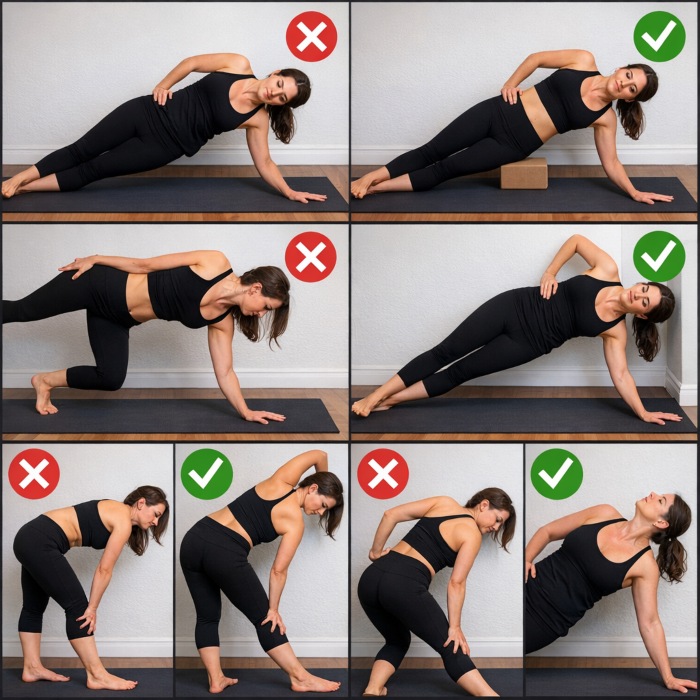
Common Mistakes and How to Fix Them
1) Collapsing into the bottom hand/shoulder
What it looks like: One shoulder pinches up, while the chest caves.
Correction: Lift up through the underside of the waist with a block and press into the floor to make it happen.
2) Coiling the top hip forward (and losing your “open” shape)
How it feels: It is like you are flipping into a tilted Warrior III.
Fix: Stow your top hand on your hip and work to stack. Use a wall behind you.
3) Locking the standing knee
What it does: Strain, wobble, or joint compression.
Fix: Maintain a micro-bend to your knees and tighten the thigh muscles to help stabilize the joint.
4) Over-arching the lower back
What it looks like: Ribs flare, belly drops, backpinches.
Fix: Pull the lower ribs in and maintain length through the tailbone.
5) Prematurely Dictating The Eyes Look Up.
Fix: Look down or forward till the pose feels stable.
Modifications for Beginners (That Still Feel Like the Real Pose)
Option A: Block under the bottom hand
This is the best and most popular hack.
- You can set a block 8 to 12 inches in front of the standing foot.
- Allow your bottom hand to remain on the block at its tallest height.
Option B: Wall-supported Half Moon
- Stand with your back 6–10 inches away from a wall.
- As you rise into Half Moon, your upper back/hip should graze the wall.
- It is hip stacking. But where you’re not fighting gravity.”
Option C: Chair-supported Half Moon
- Set up a chair in front of you.
- Lower your bottom hand to the chair seat for a higher base.
- Excellent for tight hamstrings or even balance-related work.
Progressions: How to Build Strength for Half Moon Pose
If Half Moon feels shaky, it’s often about hip stability and core integration, not “bad balance.”
Prep poses that help a lot:
- Triangle Pose (Trikonasana) – shows expansion + rotation
- Warrior II (Virabhadrasana II) – strengthen the legs and hips
- Extended Side Angle (Utthita Parsvakonasana) – tones the side of the body + legs
- Standing Split (Urdhva Prasarita Eka Padasana) – this is for the hamstrings + balance
- Tree Pose (Vrksasana) – the single-leg stability on which so much was built!
Strength drills (quick and effective):
- Side-lying leg raises (for activation of glute medius)
- SL deadlift pattern (hip hinge control)
Standing ‘hip airplanes’ (advanced) – open and close the pelvis whilst balancing.
Variations to Explore
Once your Half Moon is steady, these variations add new challenges:
1) Bound Half Moon
Reach the top arm behind your back and bind with your bottom hand (advanced).
2) Sugarcane Pose (Ardha Chandra Chapasana)
- Lift the knee, bend it, and reach back to that foot.
- This variation includes a backbend and more intense hip opening.
3) Revolved Half Moon (Parivrtta Ardha Chandrasana)
- Closed hips and a twist – it’s very difficult.
- Strengthens hamstrings, challenges core control, and spinal rotation.
Breathing Tips That Make the Pose Feel Better
Half Moon suddenly becomes a far better movie when you stop holding your fucking breath.
Try this:
Breathe in: extend the spine, open the ribs.
Exhale: pull the low belly in, and take your standing hip into neutral.
Keep the breathing smooth – if it gets choppy, reduce the hold or work a wall.
A Simple Half Moon Mini-Sequence (5–10 minutes)
If you’re ready to safely practice, here’s a seamless flow:
- Down Dog (5 breaths)
- Low Lunge (3 breaths on both sides)
- Warrior II (3 breaths each side)
- “Triangle Pose” (3 breaths per side)
- Half Moon (3 to 6 breaths on each side, with block)
- Wide-Leg Forward Fold (5 breaths)
- Child’s Pose (5 breaths)
Frequently Asked Questions
Why can’t I stack my hips?
Usually Tight hamstrings, fear of falling, or weak outer hips. Build up with a block + wall, but work on stacking slowly.
Where should my hand go – inside or outside the standing foot?
Slightly in front of the visiting place (and a little wide – especially if your hips are tight). The idea is to keep a steady enough foundation to open the chest.
Should the lifted foot point?
Not necessarily. A helpful hint is to lift the foot and flex it while pointing the toes forward (in other words, imagine smashing the sole against an invisible wall). This also allows the hips to stay in line.
How long should I hold it?
Begin with just 3 breaths – it is quality, not quantity! Work up to being able to hold for 5 – 8 breaths.
Final Thoughts: The Real Lesson of Half Moon Pose
Ardha Chandrasana: Half Moon is a posture of opposites:
- grounded and spacious
- strong and open
- focused and calm
If you do it as a practice in patience – using props, slowing down, and honoring alignment – it becomes less about “not falling” and more about building a body that can stabilize and expand at the same time.