If you’ve ever looked at Mountain Pose and thought, “It’s just standing,” you’re not alone – and one of the biggest myths in yoga is doing its job. Tadasana (Mountain Pose) seems to be easy, but it’s a master class in alignment, posture, body awareness, balance, and calm focus. It’s the model behind practically every standing pose, and it’s the foundation for a lot of flows (think Sun Salutations).
This exhaustive blog covers all that you need to know – what it is, why we practice this, and how you can practice the same step by step. muscle action, breath, common mistakes, modifications for beginners, contraindications, variations in shirshasana itself, and a good routine to help develop your capability.
What Is Mountain Pose (Tadasana)?
Tadasana, a foundational standing pose in yoga, is all about arranging your body from the ground up – feet up to the crown of your head – in such a way that you feel both steady (rooted) and tall (lifted).
- Sanskrit breakdown
-
- Tada = mountain
-
- Asana = posture/pose
- Theme of the pose
-
- Grounding, stability, stillness, presence
- Why is it called a “base pose”
It teaches the alignment of poses you see in standing postures like Warrior I/II, Triangle, Tree, Chair, and/or whatever is right.
Why Mountain Pose Matters (Even If It Looks Easy)
In the Mountain Pose, you practice:
- Stand with balanced weight distribution
- Develop postural prowess (especially if you sit a good deal of your day)
- Engage key muscles without over-tensing
- Coordinate breath + alignment
- Gain the body awareness that transfers into any other pose
In a lot of yoga disciplines, Tadasana is considered something of a “posture reset”—a time to return to neutral, check in, and start over on purpose.
Benefits of Tadasana (What It Can Support)
Mountain Pose may help you:
Physical benefits
- Strengthen posture and alignment (head, shoulders, pelvis, spine)
- Ground and wake up your feet, ankles, legs, and center!
- Increased balance, stability, and proprioception (your body’s awareness of where it is in space)
- Promote better standing mechanics and decrease slumping patterns
- Enjoy better breathing mechanics by expanding the ribcage and diaphragm
Mental & nervous-system benefits
- Promote calm focus
- Encourage grounding and steadiness
- Build mindful awareness through stillness
Note: Yoga is a good way to stay healthy, but it’s not a replacement for medical care. If you are dealing with pain, injuries, or health issues, consult a qualified instructor or clinician before practicing.
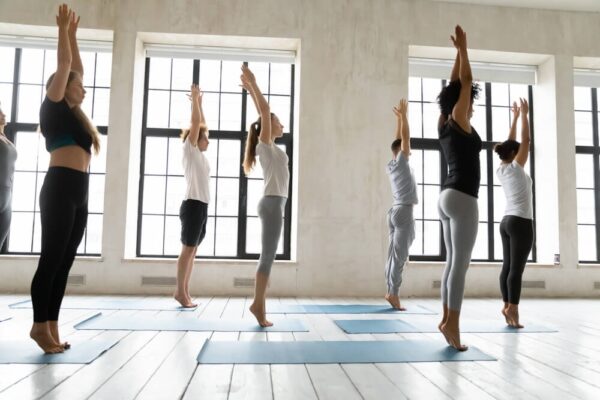
Mountain Pose Step-by-Step (Detailed Alignment Instructions)
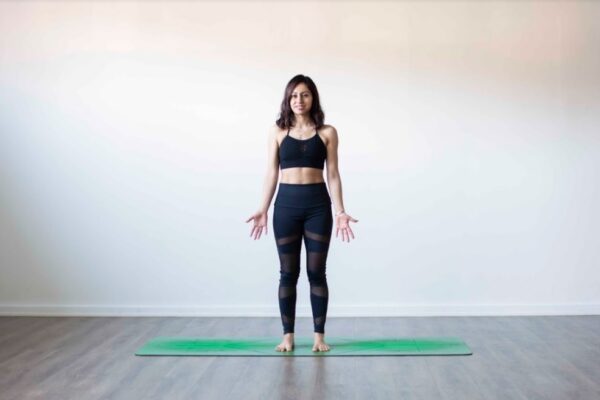
You can practice Tadasana with feet together (the traditional way) or feet hip-width apart (which often feels more stable). Pick what helps you feel balanced and in line.
1) Establish your foundation: How you place your feet
Stand tall with:
- Feet together (big toes can be touching, heels may be slightly apart), or
- Activates feet at hip distance (in addition to balance and pelvic alignment)
Point toes forward (or slightly turned out if that is the natural state of your hips — but not too much turned out).
Weight distribution check (very important):
Try to balance the weight between the “four corners” of your feet:
- Base of the big toe
- Base of the little toe
- Inner heel
- Outer heel
Avoid sinking into inner arches or rolling out to outer edges.
2) Activate your arches (without gripping your toes)
- Spread your toes.
- Root down through the four corners.
- Sense an inner arch lifting slightly.
Avoid: claw/grip with the toes (that can create tension in feet and throw off balance).
3) Align ankles and knees (micro-bend > locking)
- Stack ankles over heels.
- Keep those knees soft — think micro-bend, not hyperextension.
Common issue: hyperextending the knees, which can tilt the pelvis and compress the lower back.
4) Engage thighs and hips (stable but not rigid)
- Just a little tone in the Quads (front of thighs to assist knee alignment.
- Think about gently lifting the kneecaps (not jamming them back).
- Hips face forward, legs active.
Helpful cue:
“Hug the muscles to the bone.” (Activation without stiffness.)
5) Find neutral pelvis (the heart of posture)
- Bring awareness to your pelvis:
- Stay away from an excessive anterior tilt (butt or rib flare).
- Limit Excessive PPT (Tuck Hard, Flatten Low Back)
- Tailbone pointing down naturally, aiming for a neutral pelvis.
A great self-check:
- Place one hand on the low belly and one on the low back.
- Reach for balance: Not too arched, not too tucked.
Also Read: Standing Yoga Poses: The Complete Guide to Strength, Balance, and Alignment
6) Engage your core gently (support, not bracing)
- Gently pull the lower belly in and up (as if zipping up tight jeans).
- Continue to breathe freely—core engagement should not interfere with breathing.
Think: “Stable center, relaxed breath.”
7) Lengthen your spine (grow tall)
- Imagine your spine lengthening upward.
- And lift the crown of your head.
- Keep the chin level with the floor.
Avoid: lifting the chin or dropping it down. “Both put a strain on your neck after a while,” she says.
8) Open chest + place shoulders correctly
- elevator roll Roll shoulders up back and down—then relax.
- Keep shoulder blades flat against the back.
Avoid:
- Rib thrusting (over-arching the back)
- Shoulder shrugging (tension in neck)
9) Arms and hands (classic options)
Choose one:
- Arms along the body with palms facing inwards or slightly forward
- Anjali Mudra (Prayer Pose): Bring your hands into a prayer position in front of the heart center.
Keep fingers relaxed. Failure to over-straighten your arms can result in unnecessary tension.
10) Head, neck, and gaze
- Ears align over shoulders.
- Back of the neck long.
- Soft gaze straight ahead (Drishti).
Unclench your jaw, tongue, and forehead — I’m serious about this.
Breath in Tadasana (How to Breathe Properly)
Mountain Pose is a great place to work on slow, steady breathing.
Try this:
- Breathe in 4 counts (expand ribs/belly/back body)
- Breathe out 4 – 6 times (feel grounded in your feet)
Breath intention:
- Inhale: lengthen and lift
- Exhale: root and soften
You can also use soft Ujjayi breath if it’s in your practice — just let the breathing be smooth rather than forced.
How Long to Hold Mountain Pose?
Depending on your goal:
- Alignment check/reset: 3–5 breaths
- Mindfulness + posture training: 30–60 seconds
- Meditative standing practice: 1–3 minutes
If you feel dizzy or fatigued, step out, widen your stance, or sit down.
Common Mistakes in Mountain Pose (And How to Fix Them)
1) Locked knees
Fix: micro-bend, activate thighs, feel weight in the center (not pushed back through your heels).
2) Rib flaring / “Chest puffing.”
Fix: soften front ribs down, gently engage core, and lengthen tailbone downward.
3) Flat arches / Over pronation
Fix: press base of big toe and inner heel; lift inner arches without clenching toes.
4) Forward head posture
Fix: Pull chin slightly back (think of creating the double chin) and raise crown toward the ceiling.
5) Shoulders creeping up
Fix: breathe out; allow shoulders to drop and collarbones to peak out.
6) Tension everywhere
Fix: Toes up for active legs + soft face + easy breath.
Modifications and Props (Make It Work for Your Body)
If balance is challenging
- Position feet hip-width apart or a little wider.
- Do this practice close to a wall and lightly touch the wall with your fingers.
- Try gazing at a fixed point.
If you ever experience tight calves or ankles
- And hold your feet hip-width apart.
- Shift weight to equalize pressure on feet.
- Practice shorter holds at first.
If you sense the low back compression
- Look for rib flare and locked knee.
- Bring the pelvis to neutral.
- Engage the lower belly gently.
- Bend the knees a little, feeling space across the back.
Helpful props
- Wall: Heels Against Wall for Alignment Feedback (Buttocks a few Inches out of the wall)
- BLC (block between thighs): inner-leg engagement and pelvic stability.
- Blanket folded under heels: For super tight calves (and not to be overused or used mindfully)
Contraindications and Safety Notes
Mountain Pose is generally safe, but be mindful if you have:
- Vertigo or dizziness (especially when standing still)
- Low blood pressure or orthostatic hypotension (standing up quickly can cause lightheadedness)
- Acute foot, ankle, knee, or hip injuries
- Balance conditions (use a wall or chair support)
If you experience pain (sharp, pinching, or worsening discomfort), stop and adjust or consult a qualified professional.
Powerful Variations of Tadasana
These keep the essence of Mountain while changing focus:
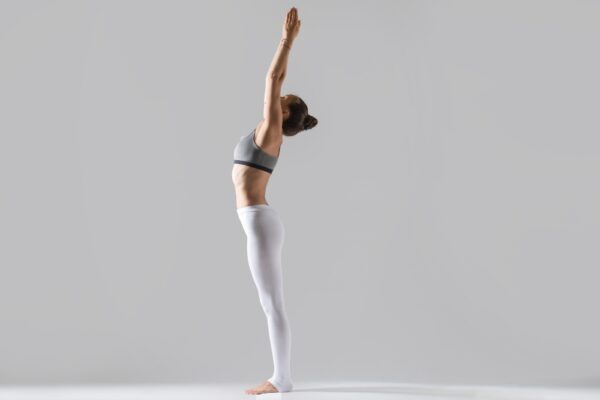
1) Mountain Pose with arms overhead (Upward Salute / Urdhva Hastasana)
- Inhale arms up, keep ribs soft and spine long.
- Great for posture and breath expansion.
2) Prayer Mountain (Anjali Mudra)
- Hands at heart center, shoulders relaxed.
- Great for grounding and intention setting.
3) Mountain Pose with interlaced fingers
- Interlace fingers, palms up overhead.
- Builds shoulder mobility and length through the side body.
4) Mountain Pose with hands behind back
- Clasp hands behind, open chest gently.
- Avoid forcing shoulders if tight.
5) Eyes-closed Mountain
- Close eyes for 3–5 breaths.
- Reveals imbalance patterns and deepens proprioception (use a wall if needed).
6) Toe-lift Mountain
- Lift and spread toes, then place them down gently.
- Excellent for rebuilding foot awareness.
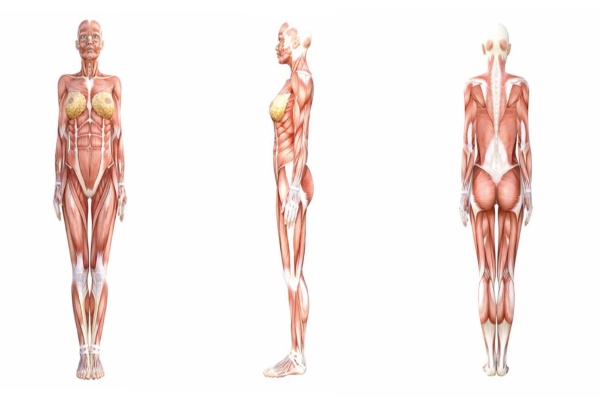
Anatomy: What Muscles Are Working in Tadasana?
Even though it looks still, Mountain Pose is an active posture.
Feet & ankles
- Intrinsic foot muscles. Arch support provided by the.
- Tibialis anterior/posterior, peroneals stabilize the ankle
- Calves (gastrocnemius/soleus) are involved to a small extent in maintaining balance
Legs
- Quadriceps support knee alignment
- Adequate tone of hamstrings and adductors.
- Glute med/min helps stabilize the pelvis
Core & spine
- Transverse abdominis and obliques. The transverse abdominis and obliques maintain trunk stability.
- Erector spinae maintains spinal length
- PF may be passively activated as part of upright stability.
Upper back & shoulders
- The lower trapezius and the serratus anterior assist in helping the shoulder blades sit well
- The rotator cuff stabilizes the shoulder when the arm is raised
Neck
- If properly aligned, the deep neck flexor works as a counteracting force to forward head posture
Energetic and Yogic Perspective (Optional but Traditional)
In yoga, Tadasana is linked with:
- Grounding energy and stability
- Related to first or Muladhara (root) chakra themes: safety, steadiness, presence
- A firm position in which to perform pranayama and meditation
You don’t need to buy into the energetic framework for the pose to feel potent — but many practitioners find it resonant.
How to Use Tadasana in a Yoga Sequence
Mountain Pose works beautifully as:
- A starting posture
Come to a standing position in Tadasana and establish Sankalpa.
- A “reset” between poses
Go back to the Mountain in standing sequences to re-return into alignment.
- A bridge into Sun Salutations
Tadasana →Upward Salute→Forward Fold→Half Lift→Plank …
- A finishing posture
Before lying down for savasana, come into Mountain and take a few breaths to integrate the practice.
Teaching Cues (If You’re Guiding Others or Self-Cueing)
Try these clear, effective cues:
- “Ground through your feet to rise through your spine.”
- “Feel your feet becoming the four corners of a square – steady and even.”
- “Bend your knees; lift your legs.”
- “Neutral pelvis – tailbone heavy, ribs soft.”
- “Shoulders melt away from ears.”
- “Crown of the head lifts; jaw is soft; breath is smooth.”
Quick Self-Check: A 20-Second Tadasana Scan
- Are my feet grounded evenly?
- Are my knees bent (not locked)?
- Do I have a neutral pelvis (not dump down into the low back)?
- Are my ribs over the pelvis?
- Is his head stacked on top of his body? Are your shoulders loose?
If you say “no” to any of those, just tailor — this is practice.
Frequently Asked Questions
1. Feet together or hip-width?
Together feet: traditional, helps develop awareness of the inner line
Hip width: sometimes preferable for more stability and a neutral pelvis (especially with beginners)
2. Why do I get tired in Mountain Pose?
Because it’s an active posture. It exposes weak points in posture (feet, core, glutes, and upper back.) This improves with practice.
3. Is it possible to do Tadasana daily?
Yes. 1–2 minutes a day can help support posture awareness and grounding.
4. Is Mountain Pose for beginners?
Absolutely — probably the best place to begin.
Conclusion: The “Still” Pose That Builds Your Whole Practice
Mountain Pose is where yoga becomes more than shapes. It teaches you how to stand well, breathe well, and focus—skills that follow you off the mat into everyday life.
If you practice Tadasana with attention, it becomes a powerful ritual:
- Root
- Align
- Lift
- Soften
- Breathe