
Practice teaching in yoga teacher training is the supervised process through which trainees learn to plan, explain, lead, and adapt yoga lessons. Students begin with manageable teaching tasks, receive feedback, and gradually take responsibility for longer portions of a class. The purpose is to demonstrate teaching competence, rather than simply remember poses or complete course hours.
A familiar posture can feel very different when you have to explain it to someone else. You need to choose a starting position, make the instructions understandable, notice whether the learner can follow, and explain how to leave the position. Meanwhile, you are managing your voice, the clock, and your own nerves. Practice teaching gives these responsibilities a place in the learning process.
This article explains what teaching practice can involve, how students develop classroom skills, and what to look for in a training programme. It includes practical examples, a sample class plan and an assessment framework. Those tools are illustrative recommendations, not a universal syllabus or a promise about any particular school.
What practice teaching means in a yoga teacher training course
Practice teaching may be called teaching practicum, peer teaching, practice teaching, supervised teaching, or teaching methodology in action. These labels overlap, but they do not always describe the same allocation of time. A practicum session might include teaching, observation, planning, and discussion. Prospective students should ask which activities they will actually perform.
Consider four distinct roles. During personal practice, you experience the lesson. During observation, you study another teacher. During assistance, you support a teacher who remains responsible for the class. During practice teaching, you take responsibility for explaining and guiding an agreed portion yourself. All four contribute to learning, but only the last provides direct experience of leading.
The difference matters when comparing courses. A programme might advertise many practicum hours while individual students receive limited teaching time. Ask how much teaching each trainee completes, who observes it, and whether feedback leads to another attempt. A clear answer tells you more than a photograph of a large training group.
The practical question is whether you leave with evidence that you can teach the material. A useful practicum produces lesson plans, observation notes, feedback records, and revised teaching attempts.
Before choosing a course, check these essentials:
- Teaching time: How often will you lead a class?
- Expert guidance: Who will observe and evaluate your teaching?
- Constructive feedback: Will you get opportunities to improve?
- Practical experience: Will you teach independently or mainly observe?
Why personal yoga experience does not automatically become teaching skill
Personal practice provides valuable familiarity with movement, breathing, effort, and attention. However, another learner cannot access your internal experience. They need clear instructions and choices that fit their body and the setting.
For example, you may enter a standing posture almost automatically. A beginner may need to know which direction to face, how far apart to place the feet, where support is available, and whether the movement should feel comfortable. Teaching makes you notice decisions that personal habits can hide.
You also need to separate what works for you from what is appropriate for the group. Your own preferred pace may be too fast for a first-time student. Your comfortable range may be unavailable to someone else. Your familiarity with Sanskrit may not be shared by the class. A practicum is a place to discover those gaps before you take on greater responsibility.
This does not mean you must perform advanced postures to become a useful teacher. For a foundational lesson, clear communication and sound judgement are more relevant than demonstrating the most difficult variation. A trainee who recognises their limits and provides understandable instruction has a stronger starting point than one who assumes physical ability is enough.
What current teacher training standards tell students
Yoga Alliance is one influential credentialing organisation, but its framework is not a worldwide law governing every yoga course. Its published RYS 200 standards place sequencing, pacing, environment, cueing and class management within teaching methodology. The practicum section asks how trainees demonstrate competencies and receive mentorship, apprenticeship or feedback.
These requirements support the importance of application. They do not establish one class length, examination script or practice-teaching timetable for every school. A school should explain how its curriculum becomes observable teaching behaviour and how it assesses that behaviour.
Actual providers also describe different approaches. Yogaville explains that trainees learn to teach portions of an Integral Yoga Level I class and offer modifications. Kripalu describes technical preparation alongside student choice and self-awareness. These are examples of programme descriptions, not evidence that all courses use identical methods or achieve identical outcomes.
When you read an advertised hour breakdown, establish which standard and course version it represents. Separate the total training duration from your individual teaching opportunities. Ask for the assessment policy, rather than assuming a registration logo answers every question about training quality.
How teaching practice can progress through a course
A useful progression starts with a small task and adds complexity when the trainee can manage it. The stages below are an illustrative learning pathway. A residential intensive, weekend programme and online course may organise them differently.
Observing a lesson with a specific question
Observation becomes more useful when you know what you are looking for. Instead of writing “the teacher was confident,” note how the opening established the lesson, when the teacher demonstrated, how students were offered support, and how the class ended on time.
Choose one focus for each observation. You might track transitions in one class and voice pacing in another. Notice what students do after an instruction, because the success of a cue depends on whether it communicates the intended action. Avoid judging a class only by whether you personally enjoyed its style.
Cornell University describes classroom observation as an opportunity for a subsequent conversation about strengths and possible changes. Applying that principle to yoga training means discussing what was observed and what the trainee could try, rather than merely counting attendance.
Explaining one posture or one short practice
An early assignment can be as small as introducing one familiar posture. The trainee explains the starting position, gives a manageable instruction, offers an option, and guides the exit. The trainer can then identify whether the explanation is accurate and understandable.
A short task keeps the learning problem visible. If the learner is confused about the starting position, adding ten more poses will not solve it. Repeating the same small segment with a clearer instruction can be a more productive next step.
Teaching a partner or a small group
Pair work introduces the experience of being followed. One trainee teaches while the other listens and practises within their comfort. The learner can explain which instruction helped and where they had to guess. Roles then reverse, giving both students experience of delivery and reception.
Small groups add attention demands. The trainee must decide where to stand, whether everyone can see a demonstration, and when to pause. A trainer should remain available so peers are not expected to supervise safety issues beyond their own competence.
Leading a connected class segment
The next challenge is connecting actions. A warm-up, a standing sequence, or a closing practice requires transitions and a sense of timing. Students learn that a list of postures becomes a lesson only when the movement between them is also teachable.
Segment teaching also makes co-teaching possible. One person leads the opening, another the main practice, and another the closing. The group needs an agreed plan so students don’t get repeated introductions, contradictory instructions, or an abrupt change in intensity.
Leading a complete supervised class
A full class asks the trainee to combine planning, communication, observation, and adaptation. The trainer assesses how those elements work together, including the response to an unexpected question or a shorter available time.
Completing a full class does not end the learning process. The most useful next step is often another attempt after feedback. A student who has identified a problem needs an opportunity to show that they can change the relevant teaching behaviour.
How students learn to plan a yoga class
A class plan begins with the people and the purpose. Before choosing postures, identify who the lesson is for, what experience they have, what setting is available, and what the lesson should help them understand or practise.
“A beginner class” is still broad. A class for adults comfortable moving between standing and the floor differs from a chair-based session. A short workplace lesson differs from an energetic studio class. The plan should state its assumptions so the trainer can assess whether the content matches them.
Write a teachable objective
A useful objective describes something the learner can experience or recognise during the lesson. For example, “Explore supported standing balance and identify an available support option” gives the teacher a basis for choosing material. “Transform everybody’s life” does not guide a 60-minute plan.
The objective also helps you decide what to omit. If supported balance is the focus, a complicated inversion may distract from it and require preparation outside the lesson’s scope. Restraint is part of planning, especially while you are learning to teach.
Organise the lesson into phases
Plan an opening, suitable preparation, a main section, and a closing. The content depends on the yoga style and audience, but the transitions between phases need attention. How do students move from standing to the floor? When do they collect props? How do they return from relaxation?
Allocate time for instructions and choices, not just time in a posture. A sequence that fits into your own practice may run longer when beginners need explanations. Rehearsing with a clock makes that difference visible.
Prepare an alternative plan
Identify material you can remove if the lesson is running late. Preserve enough time for a considered ending instead of rushing through every planned activity. Also prepare an option if a prop is unavailable or the room arrangement changes.
The alternative should simplify the class without undermining its objective. If you need to shorten a balance lesson, you might reduce the number of variations while retaining support choices and an unhurried exit. This is more useful than improvising unfamiliar material because you feel under pressure.
An illustrative plan for a 60-minute teaching assessment
The following outline is a planning example for a supervised, general beginner lesson with adults who are comfortable transitioning between standing and floor positions. It is not an individual exercise prescription, a universal sequence, or a substitute for trainer approval. Participants who need different access should have a separately adapted plan.
0–5 Minutes: Welcome and Orientation
- State the focus of the session.
- Explain the available practice options.
- Introduce the props required for the session.
5–12 Minutes: Comfortable Arrival and Preparation
- Provide simple and clear instructions.
- Help participants settle into a comfortable position.
- Check that everyone can follow the instructions.
12–22 Minutes: Gradual Movement Preparation
- Introduce gentle preparatory movements.
- Demonstrate safe entries and exits from postures.
- Guide transitions at an appropriate pace.
22–38 Minutes: Main Standing Practice
- Guide participants through standing postures.
- Practise both sides of the body where appropriate.
- Offer support and modifications as needed.
- Observe participants’ responses and adjust instructions accordingly.
38–48 Minutes: Suitable Seated or Floor Practice
- Introduce appropriate seated or floor-based postures.
- Guide participants through accessible transitions.
- Provide alternative positions to accommodate different abilities.
48–57 Minutes: Rest and Quiet Attention
- Guide participants into a comfortable resting position.
- Offer suitable positioning options.
- Allow adequate time for relaxation and quiet attention.
57–60 Minutes: Return and Close
- Guide participants gently back to a seated or comfortable position.
- Conclude the session within the allotted time.
- Invite relevant questions and provide brief clarifications.
This outline totals 60 minutes. It intentionally leaves the specific postures to the trainee and trainer, because suitability depends on the actual group and teaching method.
A rehearsal might reveal that the standing section takes longer than expected. The trainee can then simplify that section before assessment. The lesson becomes more reliable through testing, rather than through adding detail to an untested script.
For assessment, annotate the plan with three things: where you will check the time, which section can be shortened, and which transitions require a demonstration. This makes the written plan a usable teaching aid rather than a document you cannot consult quickly.
How trainees learn to give clear verbal cues
A cue is an instruction that helps a student understand what to do or notice. Its quality depends on the audience and moment. A detailed explanation may be useful during a workshop but distracting during a simple transition.
Start with concrete actions and familiar terms. “Place your hands on the chair” gives a student an immediate task. If a Sanskrit name is used, connect it with an explanation rather than assuming the name is sufficient. Anatomical terminology should clarify the action, not display how much the trainee has studied.
Teach in a sequence the listener can follow
An effective starting pattern is to establish position, explain the next movement, offer relevant support, and allow time to respond. Add another cue when the first action is understood. This pattern is an editorial teaching recommendation, not a rigid formula for every posture.
If you give a student the exit before they understand the entry, they may lose track. If you give four alignment instructions without a pause, they may remember only the last. Practice teaching lets you hear and see the effect of your ordering.
Compare unclear language with actionable language
Make the perfect shape.
- Choose a comfortable range of movement and use the suggested support if helpful.
Everyone must go lower.
- Stay in your current position or explore a smaller movement that remains comfortable.
You know what to do next.
- Return to a standing position before we change sides.
Relax everything immediately.
- Find a comfortable resting position and allow your breathing to remain natural and easy.
These examples illustrate communication choices. They do not provide complete posture instructions or imply that one sentence suits every student.
Notice when more words are making the task harder
A trainee may keep talking because silence feels uncomfortable. The result can be a class that never has time to process an instruction. Rehearsing a short segment with deliberate pauses helps distinguish a useful explanation from nervous commentary.
Ask a peer to identify one cue they could act on immediately and one that required interpretation. Rewrite the confusing cue, then teach the segment again. This small revision can be more useful than memorising an extensive list of impressive phrases.
Learning to demonstrate while still observing students
Demonstration can help students understand a movement, but it also changes what the teacher can see. If you remain inside your own posture for the whole lesson, you may miss students who are confused or need another option.
A practicum can separate demonstration from observation. Show the relevant action when needed, return to a position from which you can see the group, and continue guiding. Some teaching traditions use more continuous demonstration, so discuss the intended method with the trainer rather than assuming one approach is universal.
Consider sightlines. Can students at the back see your hands? Does everyone face the same direction during the demonstration? Will a student need to turn their head awkwardly to look at you while holding a position? These practical details are part of teaching a room.
You do not need to demonstrate a movement beyond your own comfortable ability. Ask the trainer how to use verbal explanation, a suitable variation, or an agreed assistant demonstration. A responsible lesson should not depend on the teacher ignoring their own limitations.
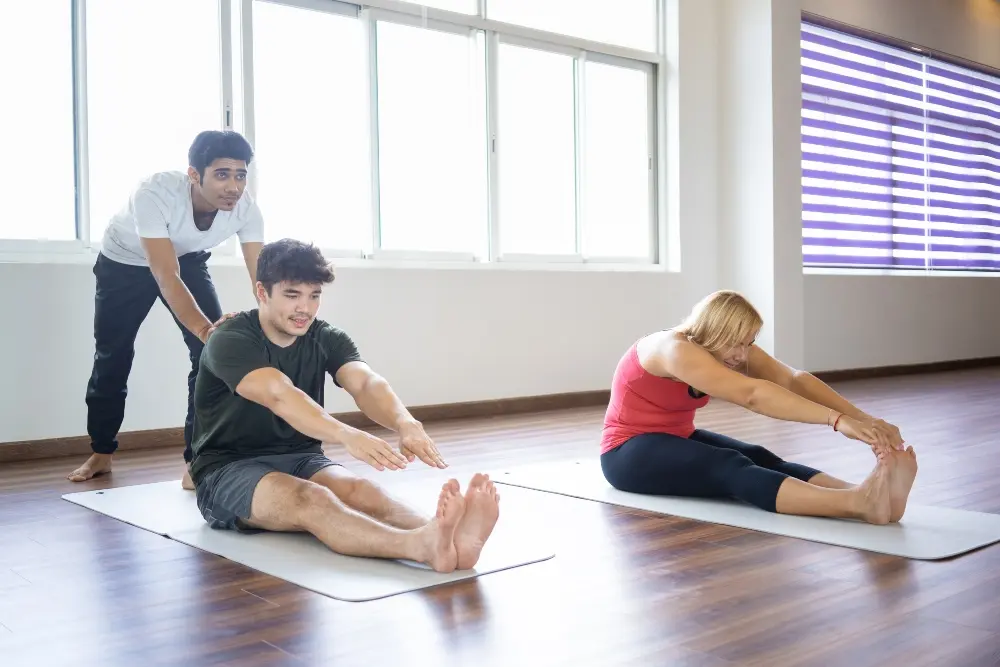
Voice pacing and class presence
Teaching presence is often described vaguely as confidence. In practice, it includes audible speech, clear pauses, appropriate pace and a calm way of making decisions. These behaviours can be rehearsed even when the trainee still feels nervous.
Try delivering the opening from the far side of the training room. Ask a peer whether they can hear without strain. If music is used, check that instructions remain intelligible. Avoid assuming that a soft voice is always soothing or that a loud voice is always effective.
Pace includes how quickly you speak, how long students have to respond, and how much time is available between movements. A class can feel rushed even when it contains few poses if every instruction arrives before the previous one has been understood.
Presence also includes making a correction without a long apology. If you mix up right and left, state the correct direction and continue. If a planned transition is unsuitable, use the simpler option you prepared. The group needs the next clear instruction more than a detailed explanation of your embarrassment.
Adapting a lesson for different learners
Peers in a training cohort may be experienced practitioners. That can hide problems in an explanation because classmates know the sequence and fill in missing steps. Practicum assignments should therefore include discussion of how the same lesson would change for less familiar learners.
Adaptation begins with the intended task. If the task is exploring balance, support from a wall or chair may preserve the learning objective. If the task is quiet attention, sitting can be an option instead of lying on the floor. The trainer should help students choose adaptations that fit the actual person and practice.
Offer choices without ranking the students who use them. Describing a prop as something “only weak people need” can discourage its use. Neutral language keeps the decision focused on access and comfort rather than status.
Avoid assuming needs from appearance. Ask relevant questions respectfully and allow students to share personal information privately. A group lesson is not the place to invite public disclosure of detailed medical histories.
NCCIH notes that people who are pregnant, older, or living with health conditions may need modifications and should discuss individual needs with healthcare providers and instructors. It also cautions beginners against extreme practices and forceful breathing. A trainee should recognise when the proposed lesson exceeds their preparation and seek supervision rather than improvising specialist advice.
Consent and professional boundaries during practice teaching
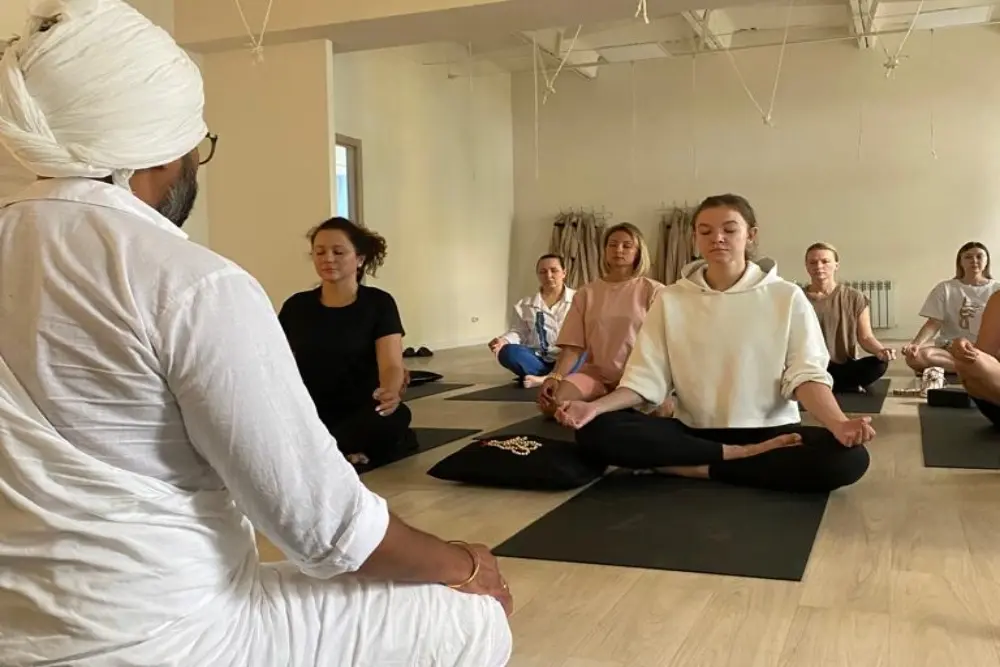
Practice teaching must respect the participants’ agency even when everyone is a trainee. Being part of a course does not automatically mean agreeing to hands-on contact, public discussion of health information, or recording for promotional use.
Yoga Alliance’s Code of Conduct requires explicit and informed consent for physical adjustments and describes consent as an ongoing process. Silence or lack of resistance does not demonstrate permission, and previous consent does not establish future permission.
An introductory practicum can be entirely verbal and visual. If a school teaches physical assistance, the trainer needs to explain the purpose, technique, limits, and consent process before trainees attempt it. A trainee should not use touch merely because their verbal instruction was unclear.
Boundaries also apply to advice. A student may ask whether yoga can cure a symptom or whether they should change prescribed treatment. Yoga Alliance Scope of Practice requires teaching within the instructor’s credentials and competence. A suitable response acknowledges the question, avoids diagnosis, and refers the person to an appropriate professional when needed.
The goal is not to give every trainee a rehearsed answer for every possible condition. It is to teach recognition of the limits of their role and a respectful way to respond.
How peer feedback improves teaching practice
Feedback is useful when it describes observable behaviour and offers a next step. “You were amazing” may encourage a trainee but does not explain what to repeat. “You are not a natural teacher” turns one attempt into a judgement about identity.
Cornell’s peer-assessment guidance recommends clear criteria, examples of constructive feedback, and support in learning how to apply a rubric. A yoga practicum can use those principles by showing peers what to observe before asking them to comment.
A practical feedback conversation can start with the trainee’s own reflection. Then the observer describes one specific strength, one important difficulty, and a manageable revision. The trainee repeats the relevant segment so the revision can be tested.
For example, “You explained the chair option before the balance began, so I could choose it without stopping” identifies a useful action. “I could not tell when we changed sides; name the change before giving the next movement” identifies an actionable problem. Neither comment requires guessing the teacher’s intentions.
Peers can describe their experience of following the lesson, but they should not certify clinical safety or resolve complex anatomical questions beyond their training. The trainer remains responsible for interpreting feedback and correcting inaccurate suggestions.
An example of feedback followed by another teaching attempt

Imagine a trainee leading a ten-minute standing segment. The class reaches the first posture, but three people hesitate at the next transition. The trainee continues speaking quickly and demonstrates while facing away from the group.
During discussion, the observer avoids “your transitions are bad.” Instead, they describe the moment of hesitation and ask the trainee what they noticed. The trainee identifies that the instruction combined turning, stepping, and arm movement in one sentence.
The next attempt uses a simpler sequence: return to a stable starting position, explain the direction change, demonstrate the next action, then pause. A peer follows only the words, without relying on prior knowledge. The observer checks whether the group now understands the transition.
This is an illustrative scenario, not a reported training outcome. It shows how practice teaching can turn a broad complaint into a specific experiment. Improvement is assessed by what changes in the lesson, rather than by whether the trainee feels more impressive.
Reflective journals and video review
A short reflective record helps connect one attempt to the next. Record the lesson focus, what you observed, the feedback you received, and one change you will test. A useful entry might read, “The opening took longer than planned because I explained every prop. Next time I will introduce only the props needed in the first section.”
The record should remain specific enough to guide rehearsal. “Be better next time” offers little help. Equally, a page of self-criticism can distract from the one change that matters most.
Video can reveal rushed speech, repeated phrases, or demonstrations that are difficult to see. Use it only with agreed consent and clear rules about who can access the recording, where it is stored, and when it is deleted. Training footage should not automatically become marketing material.
Watch a short segment with a defined question. Counting how often you interrupt a movement with another instruction may be useful; analysing every facial expression usually is not. The purpose is to improve teaching, not to train a camera performance or compare appearances.
What trainers can assess in a practical teaching demonstration
A fair assessment makes expectations visible before the demonstration. Students should understand which skills they need to show and what happens if a skill needs more work. The following rubric is an illustrative framework for discussion with a school, not a validated assessment instrument or an official Yoga Alliance scoring system.
Planning
- Evidence to look for: The lesson has a clearly defined audience, purpose, and realistic timing.
- Next step if unclear: Revise the lesson plan and rehearse a shorter version.
Communication
- Evidence to look for: Instructions are clear, understandable, and delivered in a logical sequence.
- Next step if unclear: Rewrite and practise the confusing segment.
Observation
- Evidence to look for: The teacher notices participants’ responses and checks their understanding.
- Next step if unclear: Practise observing participants between demonstrations.
Adaptation
- Evidence to look for: Appropriate practice options are available without judgement or pressure.
- Next step if unclear: Rehearse an approved alternative that achieves the same learning objective.
Boundaries
- Evidence to look for: Participant consent is respected, and teaching remains within the teacher’s scope of practice.
- Next step if unclear: Discuss the situation with the trainer before continuing the practice.
Integration
- Evidence to look for: The class has a coherent structure connecting the opening, main practice, and closing.
- Next step if unclear: Review transitions between sections and ensure sufficient time for the closing.
Assessment should distinguish a minor delivery error from a serious concern about judgement or boundaries. Forgetting a Sanskrit name is different from ignoring a participant’s request to stop. A system that treats every issue as an equivalent point deduction can obscure what needs immediate attention.
Ask whether the assessment includes written knowledge, practical delivery, reflection, or more than one observed attempt. Attendance records and practical competence answer different questions. Students need the course’s own written policy to understand graduation expectations.
Managing nerves before teaching a class
Nervousness does not mean you are unsuited to teaching. A first practicum introduces unfamiliar responsibilities, and the presence of an assessor can make ordinary speech feel difficult. The preparation task is to reduce unnecessary uncertainty.
Rehearse the first few sentences, the key transitions, and the closing. Keep notes brief enough to consult without losing your place. Check the room, props, and timing before students arrive. Familiarity with these details leaves more attention available for the class.
Avoid responding to nerves by overcomplicating the lesson. A clear, familiar plan gives you a better basis for observation than a collection of techniques you have barely practised. Discuss persistent anxiety with the trainer so rehearsal tasks can be adjusted appropriately.
During the lesson, return to the next understandable instruction. A moment of silence can give students time to respond and give you time to orient yourself. If you lose the sequence, use the agreed simple reset rather than pretending the group should know what you meant.
Confidence can then be tied to evidence: you have taught the segment, received feedback, and successfully repeated it. That is more dependable than waiting to feel completely fearless before you begin.
Common teaching mistakes and how trainees can address them
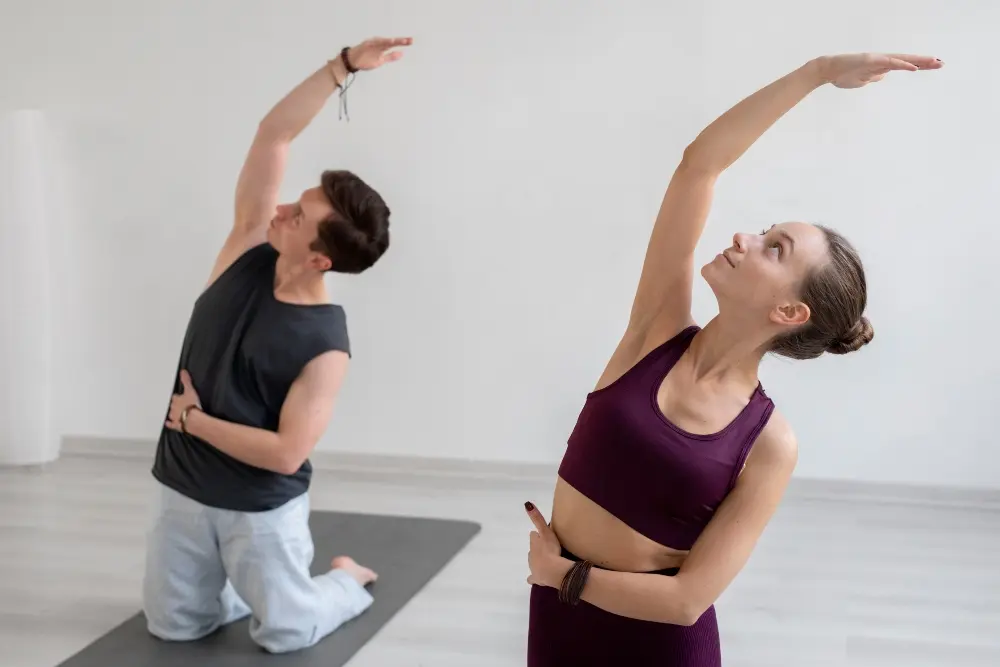
Trying to include everything learned. A course contains more material than one class needs. Choose content that serves the stated objective and audience. Save additional detail for another lesson or an appropriate workshop.
Assuming classmates understand every cue. Ask a peer to follow the words literally and identify missing steps. This reveals where shared experience has been doing the teaching for you.
Rushing transitions. Rehearse the movement between postures as a separate teaching task. Explain the starting point and destination before layering on refinements.
Demonstrating continuously. Discuss when demonstration is needed and when observation should take priority. Rehearse returning to a position that lets you see the group.
Treating options as failures. Use neutral language and introduce relevant choices before a participant struggles. Make the option part of the lesson rather than an embarrassing interruption.
Using unsupported health claims. Distinguish a traditional teaching, a personal observation, and a research finding. Do not turn general wellbeing language into a promise to treat a condition.
Running out of closing time. Identify optional material in advance. Practise shortening the main section so the return and closing remain considered.
Receiving feedback without testing it. Convert one comment into a changed action and teach again. Revision needs an opportunity to be demonstrated.
How online and in-person practice teaching differ
Both formats can include planning, live delivery, observation and feedback. Their practical limitations differ, so the delivery mode alone does not tell you how much supported teaching a student receives.
In person, the trainer can observe more of the room and help trainees work with spacing, props and group movement. The trainee still needs an individual opportunity to teach; a large group can reduce speaking time if the practicum is poorly organised.
Online, camera framing, audio quality and the visibility of participants become teaching considerations. A trainee should not claim to see a whole posture when only part of the student is visible. The plan needs to account for limited observation and the learner’s actual practice space.
A recorded assignment can demonstrate preparation and delivery but may reveal less about real-time adaptation. A live session can show how a trainee responds to questions, pauses, or confusion. Ask the provider what combination is used and how feedback is delivered.
For either format, establish what happens if a participant becomes unwell or loses connection. Trainees should know the programme’s procedures and their own responsibilities, rather than inventing an emergency response in the middle of assessment.
Questions to ask a school about its teaching practicum
Before enrolling, ask for concrete descriptions of the learning process:
- How much time does each trainee spend actively leading, separate from observation and discussion?
- When does teaching practice begin, and how do assignments become more demanding?
- Who observes individual attempts and provides feedback?
- Can students repeat a segment after feedback?
- What audience and yoga style does the foundational course prepare students to teach?
- How are adaptations, consent, and professional boundaries taught and assessed?
- What are the graduation criteria and options for further support or reassessment?
- How are recordings, participant information, and private feedback handled?
Listen for examples. “You will teach a short opening, receive trainer comments, and revise it before the next assignment” describes a process. “You will become completely confident” describes a hoped-for feeling without showing how it is developed.
If the course is in Rishikesh, another residential destination, or your home city, apply the same questions. Location and atmosphere can matter to the experience, but they do not establish how much teaching you will perform or how carefully it will be assessed.
What to do after the training certificate

Graduation is a foundation for further learning. Start with classes that match the material, audience, and responsibilities you have actually been prepared to manage. Seek mentoring and observe experienced teachers with specific questions in mind.
A training certificate and Yoga Alliance registration are separate steps. Yoga Alliance describes completing training at a Registered Yoga School, then applying for a teacher credential with the training certificate. Do not describe course completion as automatic registration or as permission to practise another profession.
Before offering public lessons, check the requirements that apply to your setting, including organisational policies, insurance and emergency arrangements. These vary, so the article does not provide a universal legal checklist.
Continue collecting evidence about your teaching. After a class, note one thing students understood and one point you need to clarify. Arrange occasional observations and discuss decisions you found difficult. Continuing development should respond to real teaching needs rather than simply accumulate certificates.
Frequently asked questions about practice teaching in yoga teacher training
Do students teach real classes during yoga teacher training?
Some programmes use peer classes, supervised public classes, or a combination. Others assess recorded lessons or shorter segments. Ask who the participants are, who supervises, and how much active teaching each trainee completes. A practicum label alone does not answer those questions.
How much practice teaching should a course include?
There is no single figure in this article that applies to every course and credentialing system. Look at the school’s current syllabus and distinguish active teaching from observation, planning, and feedback. Repeated opportunities with individual supervision are more informative than a total that does not identify the trainee’s role.
Can beginners learn to teach during a 200 hour course?
A foundational course can introduce teaching skills, but entry requirements and individual readiness differ. Ask about prerequisites and the level of class graduates are prepared to lead. Course completion should not be interpreted as expertise in every style, population, or health condition.
Do I need advanced flexibility to teach yoga?
Advanced flexibility is not a substitute for communication or judgement. The relevant question is whether you can explain and responsibly teach the course’s material, including appropriate choices. Discuss any limitations affecting demonstration with the trainer before assessment.
What if I forget the sequence during my assessment?
Use the simple reset or alternative agreed with your trainer. Give a clear instruction, consult brief notes if permitted, and continue without rushing. Afterwards, identify why the sequence was lost and rehearse that transition. Check the school’s assessment rules about notes in advance.
Do trainees have to give hands-on adjustments?
There is no universal requirement established here. A school should explain its approach. Verbal and visual teaching can be practised without touch, and physical assistance needs appropriate preparation and informed consent. Declining contact should not be treated as permission to pressure a participant.
How is a teaching practice assessed?
Schools use their own assessment methods. They may look at planning, instructions, observation, adaptations, boundaries, and the integration of a lesson. Ask for the rubric and reassessment policy before the final demonstration so you know what evidence is expected.
Is online teaching practice enough to become confident?
Confidence depends on the tasks, feedback, and opportunities to revise, not simply the delivery mode. Online practice should address camera limits, audible instructions, and real-time responses where available. In-person teaching also needs supervision and sufficient individual participation.
What is the difference between teaching methodology and practicum?
Teaching methodology examines how lessons are planned and delivered. Practicum applies those ideas through actual teaching and related reflection. The subjects may be integrated in a course. Ask how much of the programme requires you to lead learners rather than only discuss techniques.
Can I teach specialist classes immediately after graduation?
Match your teaching to your preparation and competence. A general foundational qualification does not automatically establish readiness for every specialist population or clinical setting. Seek relevant training and supervision, and follow the requirements of the organisation where you intend to teach.
Learning to teach through supported practice
Practice teaching makes the responsibilities of a yoga teacher visible. Students learn to turn knowledge into understandable instructions, observe how those instructions are received, and revise a lesson when something is unclear or unsuitable.
A useful training experience provides individual teaching opportunities, specific feedback, and time to apply that feedback. It also teaches the boundaries of the role. When you compare courses or prepare your own practicum, look for those concrete features. They provide a stronger basis for development than expecting confidence to appear automatically at graduation.