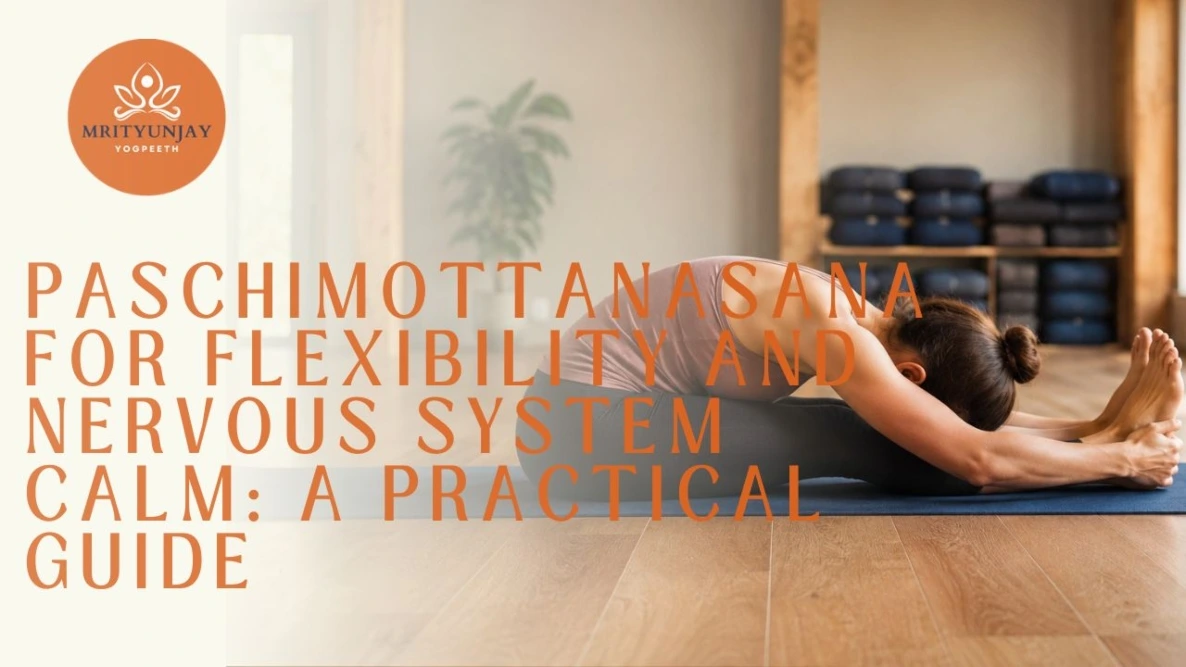
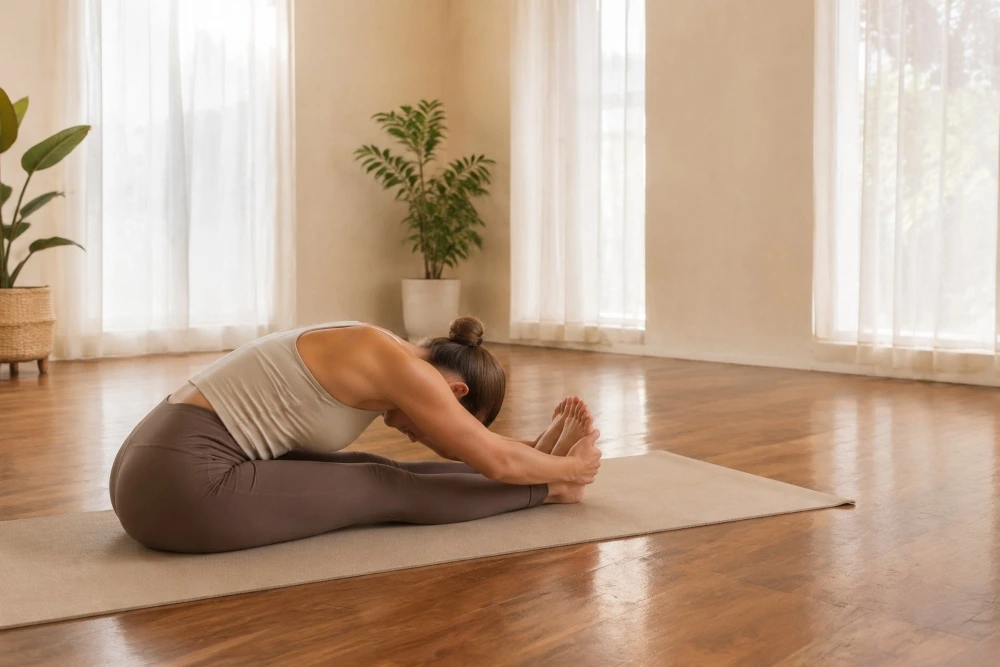
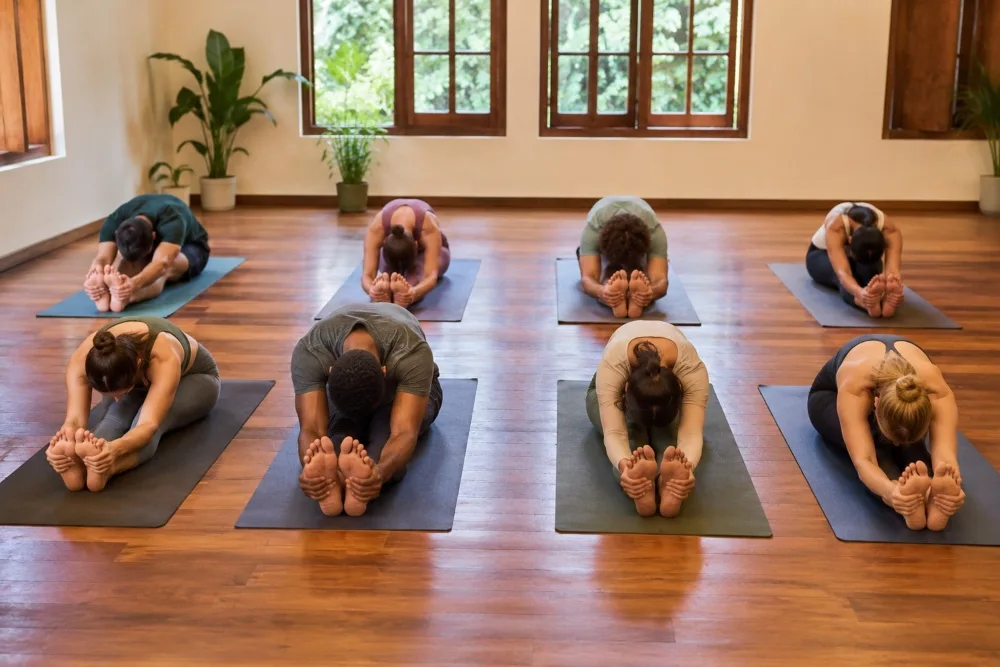
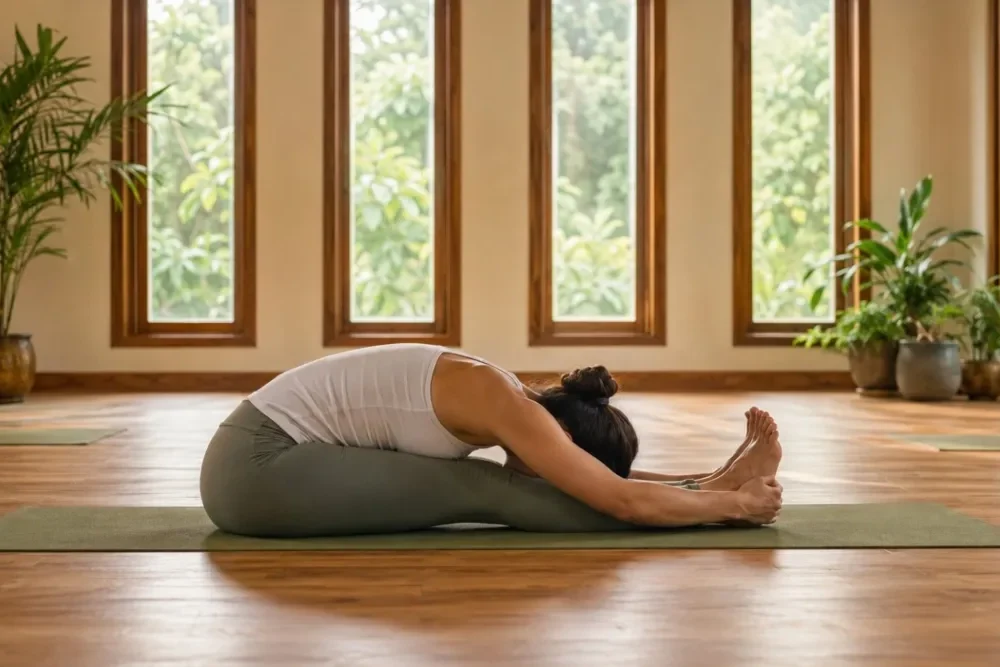
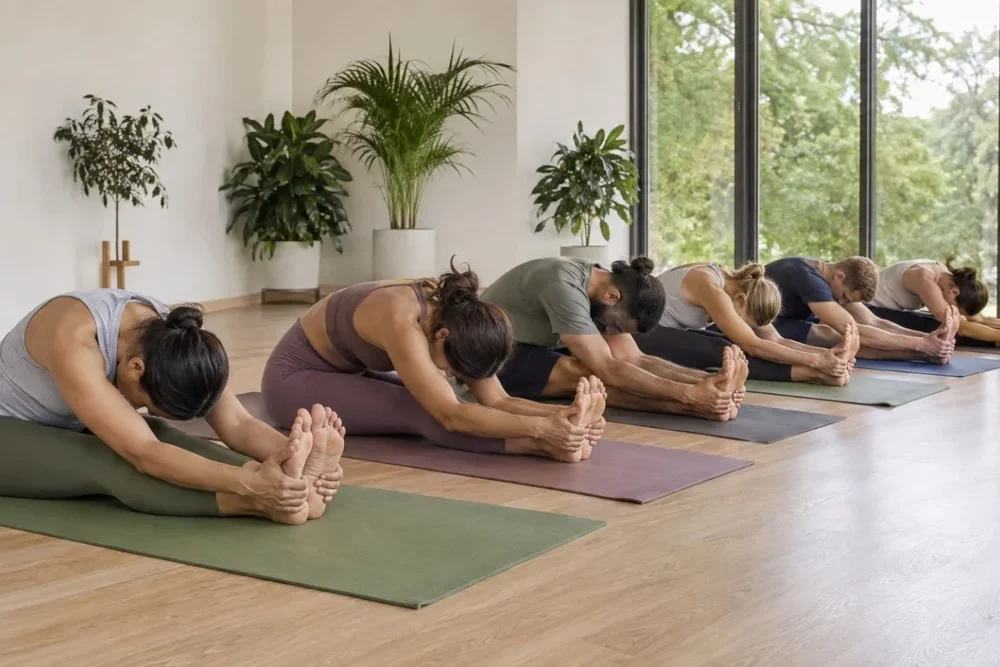
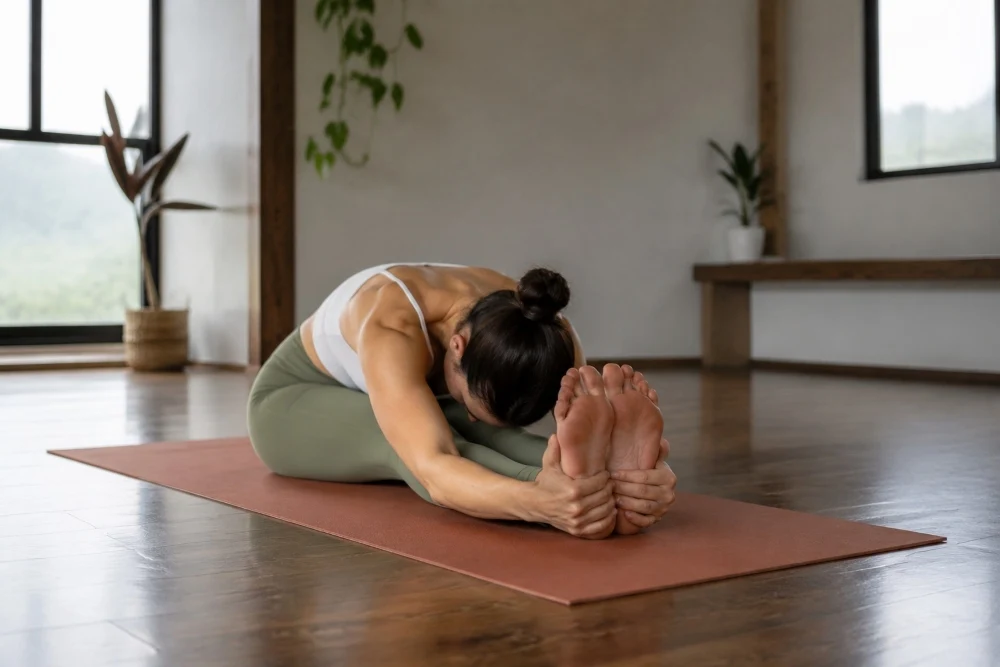
Paschimottanasana – often called Seated Forward Bend – is a foundational seated forward fold. Practised with bent knees, appropriate support, and unforced breathing, it can train tolerance to a posterior-chain stretch and create conditions that many people experience as settling. It should feel spacious and sustainable, not like a contest to touch the toes.
TL;DR
- Paschimottanasana is a seated forward bend performed from Dandasana, with the torso moving over the legs.
- Its most defensible physical benefit is exposure to a sustained stretch across the back of the body – especially the hamstrings with possible gains in range of motion when practised consistently.
- You do not need straight knees, a flat torso on the thighs or hands around the feet. Those are shapes, not measures of success.
- For most beginners, the safest useful option is to sit on a folded blanket, bend the knees and hold a strap around the feet or rest the torso on a bolster.
- Start the fold from the hip joints. Let the spine respond naturally, but do not yank the torso deeper or force a rounded lower back.
- An active version is better suited to mobility work; a supported, quieter version is usually better when the intention is rest.
- A gentle, slow breath may contribute more to a calm experience than the depth of the pose. Never strain, hold the breath, or chase a prescribed breath count.
- Research supports flexibility improvements from repeated static stretching and suggests that yoga and slow-breathing practices can influence stress and autonomic measures. Direct research on Paschimottanasana alone is too limited to claim that the pose activates the vagus nerve, lowers cortisol, or treats anxiety.
- Avoid or obtain individual guidance during an acute back or hamstring injury, new radiating pain, recent abdominal or spinal surgery, or a condition for which forward flexion or abdominal compression is restricted.
- Pregnancy does not automatically rule out yoga, but this narrow forward fold usually needs substantial modification to avoid abdominal compression. Use prenatal guidance and medical clearance where appropriate.
- Stop for sharp, electric or escalating pain; numbness or tingling; dizziness; visual disturbance; chest or abdominal pressure; or difficulty breathing.
What is Paschimottanasana?
Paschimottanasana is a seated, symmetrical forward-bending posture. The name is commonly parsed from Sanskrit terms referring to the west or back of the body, an intense stretch, and a posture. English teaching names include Seated Forward Bend, Seated Forward Fold, and Intense Stretch of the West.
The traditional name carries history; it does not prescribe one universal modern alignment. Different Hatha, Iyengar, Ashtanga, therapeutic, and contemporary schools may vary in how actively the legs work, when the spine rounds, how the feet are held, and how long the posture is maintained.
This guide uses a functional aim: create a tolerable, controllable forward fold without pain, breath restriction, or coercion.
The short answer: does it improve flexibility and calm the nervous system?
Flexibility: plausible and trainable
Paschimottanasana places the hips into flexion while the knees are extended to the degree chosen by the practitioner. That commonly creates a stretch sensation through the hamstrings and sometimes the calves, gluteal region, or spinal tissues.
The broader stretching evidence is strong enough to say that static stretching can improve range of motion. A 2025 systematic review and meta-analysis of 189 studies and 6,654 adults found both immediate and longer-term flexibility gains from static stretching. It also found no additional average benefit beyond about four cumulative minutes in one session or ten minutes per week for chronic gains. That is a population-level finding, not a requirement to hold this pose for four minutes. Ingram et al., *Sports Medicine*
Yoga programs may also improve flexibility, although studies usually combine several postures, breathing and other practices. A systematic review in older adults found a modest improvement in flexibility, while noting heterogeneity and limited evidence for several psychological outcomes. Systematic review and meta-analysis
The honest conclusion is that Paschimottanasana can be one useful part of a flexibility programme. The research does not establish it as uniquely effective or necessary.
Nervous-system calm: possible experience, not a guaranteed switch
A supported forward fold can reduce movement, narrow visual stimulation, and give attention a simple anchor. A slow, comfortable breath may reduce the sense of effort. Together, those conditions can feel quieting.
Research on broader yoga, meditation, and breathing practices is encouraging. A systematic review of single sessions found that many included studies reported reduced physiological or psychological stress reactivity, although interventions and methods varied. Pascoe et al., *Stress and Health*
A separate systematic review linked voluntary slow breathing with changes in heart-rate variability, respiratory sinus arrhythmia, brain activity and reported relaxation. The authors also described limitations in a small and varied evidence base. Zaccaro et al., *Frontiers in Human Neuroscience*
Those findings do not prove that Paschimottanasana itself stimulates the vagus nerve, “switches on” the parasympathetic nervous system or treats anxiety. The outcome may depend on the entire practice: position, support, breath, attention, expectation, environment and individual response.
If the pose makes you brace, hold the breath, or feel trapped, it is not calming for you in that form. Change the form or choose another posture.
What does the pose stretch?
The felt stretch differs from person to person because body proportions, joint structure, previous activity, neural sensitivity, and technique all matter.
| Area | Why you may feel it | Useful adjustment |
|---|---|---|
| Hamstrings | Hip flexion lengthens muscles crossing the back of the hip and knee, especially as the knees straighten | Bend the knees; keep the sensation broad rather than sharp near the sitting bone |
| Calves | Ankle dorsiflexion and straight knees can increase tension through the back of the lower leg | Soften the knees and keep the ankles neutral instead of forcefully pulling the toes back |
| Gluteal region | Pelvic position and hip flexion can create tension across the back of the hip | Sit higher and reduce depth; avoid forcing the pelvis under |
| Back | The spine may flex as the torso comes forward | Initiate at the hips; support the torso; avoid pulling hard with the arms |
| Behind the knee | Hamstrings, calf, or neural structures may contribute | Reduce intensity immediately; bend the knees and do not press them down |
A stretch is not automatically better because it is stronger. Use a sensation that is clear but non-threatening – often around 3 to 5 on a personal 10-point intensity scale. There should be no sharpness, burning, electric sensation, or loss of normal breathing.
How to do Paschimottanasana safely
What you need
Have a folded blanket or firm cushion, a yoga strap or belt, and optionally a bolster, pillows, or a chair. Props are not remedial. They let you select the load and purpose of the pose.
Step-by-step instructions
- Begin in Dandasana. Sit with both legs forward. Place the hands beside the hips and find an upright position that does not require strain.
- Elevate the pelvis if needed. If the pelvis rolls backward or the lower back collapses immediately, sit near the front edge of one or more folded blankets. The height should make upright sitting easier.
- Bend the knees. Use as much bend as needed. Place a rolled blanket beneath the knees if holding them softly bent takes effort.
- Set the feet without rigidity. Point the knees and toes roughly upward. Keep the ankles comfortably active or neutral; avoid aggressive flexing.
- Lengthen before moving. On an easy inhalation, allow the spine to grow tall and the front of the torso to lengthen.
- Fold from the hips. On an exhalation, tip the pelvis and torso forward as one unit. Stop before the breath becomes restricted or the pelvis rolls heavily backward.
- Place the hands. Hold the shins, rest the hands on the floor, or loop a strap around the feet. Keep the elbows soft. Do not use the arms as a winch.
- Choose the version. For an active mobility version, keep the torso long and the legs gently engaged. For a quieter version, place a bolster, stacked pillows, or a chair under the chest and head.
- Breathe normally. Let inhalations create room and exhalations soften unnecessary effort. A slightly longer exhalation is optional only if it stays easy.
- Exit gradually. Release any strong pull, place the hands beside the hips, and roll or hinge up slowly. Pause upright before standing.
How long should you hold it?
For a first practice, try 20 to 30 seconds for one or two rounds. Over time, an active version may be held for 30 to 60 seconds. A well-supported restorative version may be comfortable for one to three minutes.
Duration is subordinate to quality. Come out sooner if the stretch intensifies continuously, the breath shortens, the jaw tightens, or you feel you must endure the pose.
Active and supported versions serve different goals
| Goal | Setup | Effort | Suggested starting dose |
|---|---|---|---|
| Learn the hip hinge | Sit on a blanket, knees bent, hands on thighs or blocks | Light abdominal and spinal support | 3–5 slow repetitions |
| Improve stretch tolerance | Strap around feet, mild knee bend, torso long | Gentle leg and trunk activity | 20–45 seconds × 2 |
| Quiet practice | Torso and head fully supported on bolster, pillows or chair | Minimal; no pulling | 1–3 minutes if comfortable |
| Sensitive lower back | Sit higher, bend knees more, remain relatively upright | Low and controlled | 15–30 seconds; consider individual guidance |
| Very tight hamstrings | Blanket under pelvis, roll under knees, strap long | Mild | 20–30 seconds × 2 |
The supported form is not simply a deeper version. Its purpose is to make effort optional. If the head hangs or the abdomen is compressed, add height or come more upright.
How to use props
Folded blanket under the pelvis
Sit on the front third of the support so the pelvis can tip forward. Too little height may not change the fold; excessive height can feel unstable. Use enough to sit tall without gripping the hip flexors.
Strap around the feet.
Hold one end in each hand with elbows soft. The strap extends reach; it should not pull the torso down. If your shoulders lift or the back rounds abruptly, lengthen the strap.
Never wrap the strap around the hands. You should be able to release it instantly.
Bolster or pillows under the torso.
Build the support high enough that the abdomen, ribs, and head can rest. If the forehead is supported but the chest hangs, add another pillow. Turn the head only if the neck remains comfortable, and change sides midway; forehead support is often more neutral.
Chair version
Place a chair seat in front of the legs and rest the forearms or forehead on folded blankets on the seat. This is useful when the floor bolster is too low or getting down is impractical. Make sure the chair cannot slide.
Bent-knee version
This is often the most intelligent starting point. Bending the knees reduces demand on the hamstrings and may allow more movement at the hips. Over weeks, straighten only as far as the fold remains steady and pain-free.
A 10-minute practical sequence
Use this after a few minutes of general movement or on its own at a gentle pace.
1. Constructive rest or easy sitting — 1 minute
Notice contact with the floor and let the breath settle. Do not manipulate it yet.
2. Cat–Cow or seated pelvic tilts — 1 minute
Move the pelvis and spine through a comfortable range. The aim is awareness, not maximum motion.
3. Low lunge — 1 minute each side
Use padding under the rear knee. Keep the range modest and the breath easy.
4. Half split or supported hamstring glide — 1 minute each side
From a kneeling lunge, shift the hips back while the front knee partially straightens. Move in and out rather than holding at maximum range.
5. Dandasana setup — 1 minute
Choose blanket height, knee bend and strap length. Practise two or three small hip hinges.
6. Paschimottanasana — 2 minutes total
Hold for 30 to 45 seconds, come upright, rest, then repeat. Alternatively, use one fully supported 60- to 90-second hold.
7. Neutral finish — 1 minute
Return upright, place the hands behind you and bend the knees, or lie down. Notice the effect without judging whether it was “deep enough.”
A four-week progression for beginners
| Week | Practice | Focus | Progress only when… |
|---|---|---|---|
| 1 | 2–3 sessions; 2 × 20–30 seconds | Find prop height and pain-free range | Breath stays normal, and sensation settles rather than escalates |
| 2 | 3 sessions; 2 × 30–40 seconds | Repeat the same reliable setup | No next-day focal pain at the hamstring attachment or lower back |
| 3 | 3 sessions; 2 × 40–60 seconds | Slightly reduce knee bend or strap length—not both | Pelvis still tips forward and shoulders remain relaxed |
| 4 | 3 sessions; up to 2–3 total minutes | Choose active or supported goal | You can exit smoothly and feel no need to force the shape |
This is an example, not a rehabilitation prescription. Some bodies need slower progression; others will use less volume because the pose appears within a larger sequence. Consistency matters more than daily maximum effort.
How to breathe for a calming practice
Use the breath as feedback first and a technique second.
- Start with natural nasal breathing if the nose is clear and that feels comfortable.
- Let the inhale be unforced and the exhale quiet.
- If it feels pleasant, make the exhale slightly longer—for example, inhale for about four counts and exhale for five or six.
- Drop the count immediately if it creates air hunger, dizziness, or anxiety.
- Do not add breath retention to a beginner relaxation practice.
- If nasal breathing is obstructed, breathe in the way that allows ease; the pose does not depend on perfect technique.
Slow breathing research supports possible autonomic and psychological effects, but a rigidly slow rate is not appropriate for everyone. “Calming” breathing should feel calm while you do it.
Common mistakes and how to fix them
Mistake 1: measuring success by the toes
What happens: Reaching becomes the objective, so the shoulders round and the arms pull.
Fix: Hold a strap, shins, or the floor. Measure success by steady breath, tolerable sensation, and control.
Mistake 2: locking or pressing down the knees
What happens: The back of the knees feels sharp, or the pelvis cannot move.
Fix: Keep a small bend and support it with a rolled blanket. Straighten gradually without forcing.
Mistake 3: pulling with the arms
What happens: The stretch becomes aggressive and the neck and lower back brace.
Fix: Soften the elbows. Imagine the hands are anchors, not levers.
Mistake 4: insisting on a perfectly straight spine
What happens: The practitioner strains to stay upright or assumes any spinal flexion is wrong.
Fix: Begin with a hip hinge and avoid abrupt loaded rounding. A healthy spine can flex; the appropriate amount depends on the person, goal, and condition.
Mistake 5: Collapsing to look “relaxed”
What happens: The head hangs, breathing is compressed, and the pose becomes work.
Fix: Bring support up to the torso and head. Restorative means supported.
Mistake 6: Forcing dorsiflexion
What happens: Pulling the toes strongly toward the face increases calf or neural tension.
Fix: Keep the ankles neutral or only gently active.
Mistake 7: staying because the timer says so
What happens: A manageable stretch becomes pain or numbness.
Fix: Treat the timer as a ceiling, not a target. Exit when quality declines.
When to avoid, modify or seek advice
Yoga is generally considered safe for healthy people when practised appropriately, but strains and sprains can occur. The US National Center for Complementary and Integrative Health recommends qualified instruction, especially for beginners, and advises people who are pregnant, older or living with health conditions to discuss appropriate modifications. NCCIH yoga safety guidance
This section is a screening guide, not a diagnosis.
Pause and obtain individual guidance.
- Acute hamstring or calf injury: stretching an injured tissue can delay recovery or aggravate symptoms.
- New or severe back pain: especially pain that radiates, produces weakness, numbness or tingling, or changes with spinal flexion.
- Recent abdominal, hip or spinal surgery: return only under the timelines and restrictions given by the surgical or rehabilitation team.
- Known disc, nerve or spinal condition: a clinician or appropriately trained therapist can help determine whether flexion, knee extension or duration needs changing.
- Osteoporosis or previous vertebral fracture: controlled bending may be possible, but end-range, loaded or repeated spinal flexion may need modification. The Royal Osteoporosis Society recommends a controlled hip hinge and avoiding over-flexion at the limit. Royal Osteoporosis Society guidance
- Glaucoma, uncontrolled blood pressure, cardiovascular disease or recurrent dizziness: ask the treating clinician whether prolonged head-down positions or breath practices require modification. Remain more upright and never hold the breath.
- Recent abdominal inflammation, hernia or significant gastrointestinal symptoms: avoid compression and seek condition-specific advice.
Pregnancy
Exercise and modified yoga can be appropriate in an uncomplicated pregnancy, but routines often need adjustment. The American College of Obstetricians and Gynecologists advises discussing exercise with the obstetric care professional and identifies modified yoga—not hot yoga—as an option. ACOG exercise guidance
For Paschimottanasana, avoid compressing the abdomen. A wide-leg, upright, chair-supported fold may be more appropriate, but prenatal guidance should be individual. Do not use this article as prenatal clearance.
Stop immediately if you experience
- sharp, tearing, burning or electric pain;
- numbness, tingling or new weakness;
- dizziness, faintness, visual disturbance or nausea;
- chest pressure, palpitations or unusual breathlessness;
- painful abdominal or pelvic pressure;
- a headache that appears or worsens in the fold; or
- symptoms that continue or worsen after leaving the pose.
Seek urgent medical care for severe symptoms, new neurological deficits, chest pain, fainting or other warning signs appropriate to your situation.
What the science can—and cannot—say
Claim: “Paschimottanasana improves flexibility”
Evidence-informed verdict: Reasonable, with conditions. Static stretching improves range of motion on average, and yoga programmes can improve flexibility. The exact contribution of this pose, ideal dose and long-term effect for a particular person are not established.
Claim: “Paschimottanasana activates the parasympathetic nervous system”
Evidence-informed verdict: Too specific as a fact. Broader yoga and slow-breathing studies report changes in autonomic measures, but a posture-specific causal claim is not established.
Claim: “The pose stimulates the vagus nerve”
Evidence-informed verdict: Commonly repeated but not adequately demonstrated for this pose. It is more accurate to say that a comfortable supported posture combined with slow breathing may help some people feel settled.
Claim: “It lowers cortisol”
Evidence-informed verdict: Do not promise this from a single pose. Some yoga interventions study cortisol or stress outcomes, but results from multimodal programmes cannot be assigned to Paschimottanasana alone.
Claim: “It treats anxiety, insomnia, depression or hypertension”
Evidence-informed verdict: Not an appropriate claim. Yoga may support wellbeing or symptom management for some people, but this pose is not a replacement for diagnosis or evidence-based treatment.
Claim: “It detoxifies the body and massages the organs”
Evidence-informed verdict: These traditional or promotional descriptions are not precise biomedical outcomes. The posture compresses the abdomen in some forms, but that does not prove detoxification or treatment of digestive disease.
How to know whether the practice is working
Use measures that are repeatable and relevant—not photographs of maximum depth.
For flexibility
Once per week, repeat the same setup after a similar warm-up and record:
- blanket height;
- knee bend;
- strap length or hand position;
- stretch intensity from 0 to 10;
- time held with normal breathing; and
- any symptoms during the following 24 hours.
Progress might mean the same shape feels easier, not merely that the hands move farther.
For calm
Before and two minutes after practice, rate perceived activation from 0 (very settled) to 10 (highly activated). Note breath comfort and whether you feel clearer, sleepy, neutral or more agitated.
This is self-observation, not an autonomic diagnosis. If forward folds reliably increase distress, use a different resting position such as constructive rest, side-lying support or supported Savasana.
Teaching Paschimottanasana responsibly
A teacher should make the aim and options visible before the class enters the pose.
- Demonstrate a bent-knee, strap-assisted version first.
- Offer prop choices before students are folded forward and unable to see.
- Use invitational language: “You might keep the knees bent” is often more useful than “Straighten your legs.”
- Cue sensation quality and breathing, not a visual endpoint.
- Avoid pushing a student’s back or pulling their arms deeper.
- Ask consent before touch, and remember that consent does not make a risky adjustment safe.
- Keep medical claims outside the teacher’s scope unless the teacher is also appropriately licensed and working within that professional role.
- Provide an easy exit and a neutral alternative.
A useful class cue is: “Come forward only as far as you can stay curious, breathe and leave smoothly.”
Frequently asked questions
Is Paschimottanasana good for beginners?
Yes, when the shape is adapted. Beginners commonly benefit from sitting on a blanket, bending the knees, and using a strap or chair. The full visual expression is not a prerequisite.
Should my back be straight or rounded?
Start the movement at the hips and maintain enough trunk support to avoid collapsing. Some spinal flexion may occur and is not inherently wrong for a healthy person. If you have osteoporosis, disc symptoms, or flexion-sensitive back pain, use condition-specific guidance and a smaller, more hip-led range.
Do my knees have to stay straight?
No. Bent knees often improve pelvic movement and reduce strain. Straight knees are an option, not a rule.
Where should I feel the stretch?
A broad sensation along the back of the thighs is common. Calf, gluteal, or back sensations may also occur. Sharp pain, a focal pull at the sitting bone, burning, tingling, or electric sensations are reasons to reduce or stop.
How long should a beginner hold the pose?
Start with 20 to 30 seconds and repeat once if it remains comfortable. Longer is not automatically better. A fully supported version can sometimes be held longer, but only while breathing and sensation remain easy.
How often should I practise?
Two or three consistent sessions per week are a practical start. The total programme matters; there is no need to force a long daily hold.
Is Paschimottanasana restorative?
It can be used restoratively only when the body and head are adequately supported, and the shape feels safe. An unsupported forward fold that requires effort is not restorative merely because it is held for several minutes.
Can it help me sleep?
A quiet evening practice may help some people wind down, but the pose is not a treatment for insomnia. Persistent sleep problems deserve appropriate assessment.
Does it release the vagus nerve?
“Release the vagus nerve” is not a precise or established effect of the pose. Slow, comfortable breathing and reduced effort may contribute to a calmer state, but individual responses differ.
Can I do it with sciatica?
Sciatica describes symptoms, not one uniform cause. Forward folding may relieve, reproduce, or worsen symptoms depending on the person. Do not stretch through radiating pain, numbness or tingling; obtain individual clinical guidance.
Can I practise during pregnancy?
Modified prenatal yoga may be suitable in a healthy pregnancy, but a narrow fold over straight legs can compress the abdomen. Seek prenatal guidance and use a wide, upright, supported alternative if cleared.
Is morning or evening better?
Either can work. Many people feel stiffer in the morning and need more warm-up. Evening may suit a supported, quiet version. Choose the time you can practise consistently without rushing.
What should I do after the pose?
Return upright slowly and pause. Bend the knees, place the hands behind you, or lie down in a neutral position. A dramatic “counterpose” is unnecessary.
Your next step
For the next two weeks, practise one repeatable version two or three times per week:
- Sit at a height that makes upright sitting comfortable.
- Bend the knees and use a strap.
- Fold to a 3–5 out of 10 stretch.
- Hold for 20–30 seconds while breathing normally.
- Rest upright and repeat once.
- Record the setup, sensation, and next-day response.
If calm is the priority, support the torso and head and choose a shorter, genuinely restful hold. If flexibility is the priority, progress one variable at a time – slightly less knee bend, a little more time, or a marginally shorter strap. Never change all three at once.
The useful version of Paschimottanasana is not the deepest one. It is the version you can practise consistently, recover from and refine without fear or force.
Medical and editorial note
This article provides general yoga education, not medical advice, diagnosis, treatment, or rehabilitation. Individual anatomy, health conditions, medication, pregnancy, and surgical history can change what is appropriate. Consult a qualified healthcare professional and an appropriately trained yoga teacher when needed.
For publication, add a named author biography showing relevant yoga education and teaching experience. Because this article includes contraindications and health evidence, obtain review by a qualified clinician or physiotherapist and display the reviewer’s name, credentials, and review date. Recheck the evidence and outbound links at least annually.