TL;DR
- Bhujangasana means “Serpent Pose.” The name combines bhujaṅga (serpent or snake) and āsana (posture).
- The posture is described in the Gheraṇḍa Saṃhitā 2.42–43, a premodern Hatha-related text. Its traditional benefits are expressed in the language of digestive fire, freedom from disease and the awakening of the serpent power.
- A sound modern technique keeps the legs active and pelvis grounded, lengthens the spine, lifts the sternum forward and up, and uses the hands without forcing maximum lumbar extension.
- Baby Cobra—a low lift with light hand pressure—is the best default for many beginners. Straight arms are neither required nor proof of correct alignment.
- Plausible physical effects include practicing controlled spinal extension, strengthening back and shoulder-girdle muscles, and lengthening the front of the trunk. A small electromyography study found trunk and shoulder-girdle muscle activity during Bhujangasana within a Surya Namaskar sequence.
- Research suggesting that yoga can modestly help some people with chronic non-specific low-back pain concerns multi-component yoga programmes, not Cobra Pose alone. Bhujangasana should not be presented as a stand-alone cure.
- Stop if the pose produces sharp, pinching, radiating or worsening pain; numbness; tingling; weakness; dizziness; breathlessness beyond normal exertion; or abdominal pressure that feels unsafe.
- Avoid or obtain clinical clearance for prone Cobra after recent abdominal or spinal surgery, during pregnancy when lying prone is no longer comfortable or appropriate, with an acute injury, or when a clinician has advised against spinal extension or weight-bearing through the hands.
What is Bhujangasana?
Sanskrit: भुजङ्गासन · Transliteration: Bhujaṅgāsana · Common English name: Cobra Pose or Serpent Pose
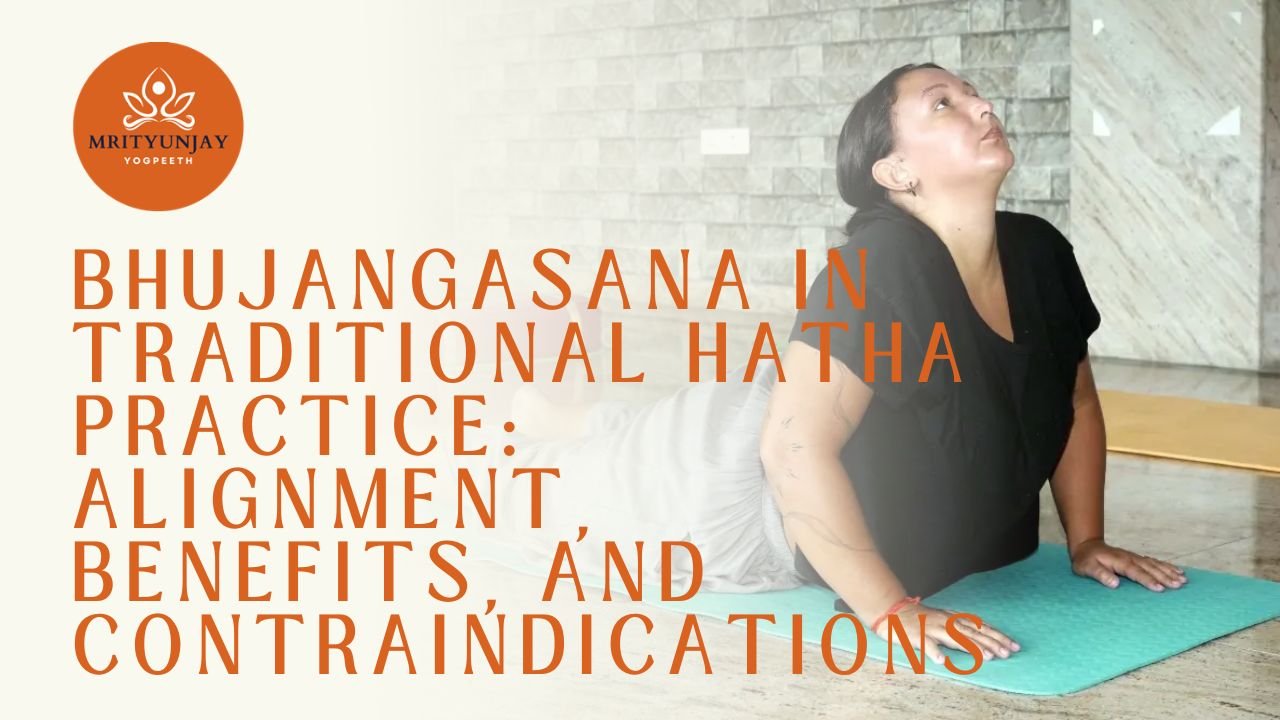
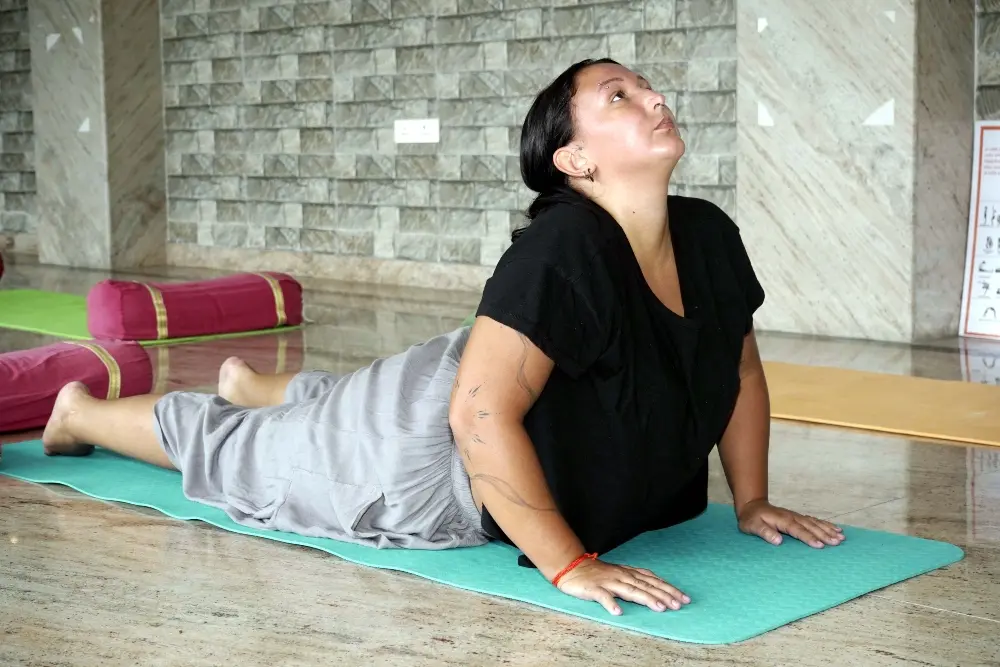
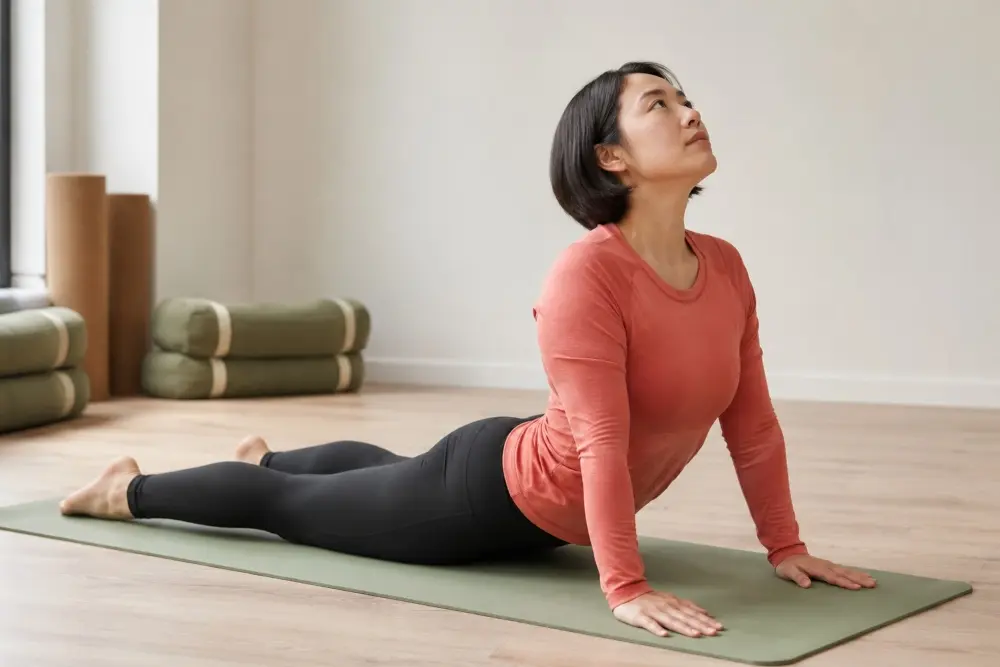
Bhujangasana is performed lying face down. The feet and lower body remain on the ground while the upper spine extends and the chest rises. The silhouette resembles a cobra raising its hood.
It is often taught in three related forms:
- Baby Cobra: low lift, elbows bent, little pressure through the palms;
- Classical or moderate Cobra: a higher lift with the pelvis and lower body grounded; and
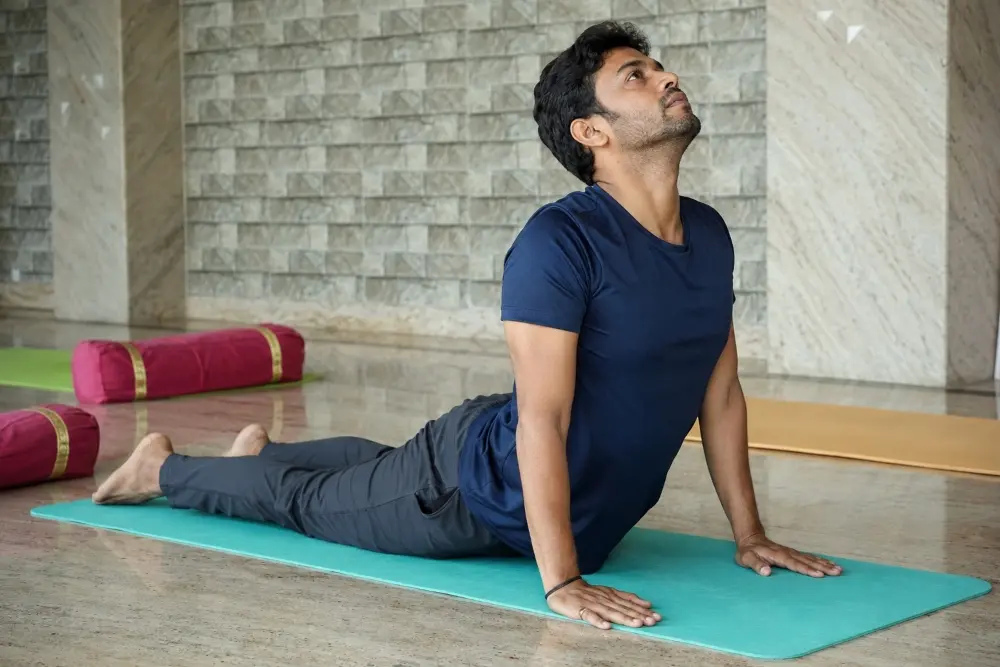
- High Cobra: a deeper backbend in which the arms may approach straight, but only if the extension is distributed comfortably and the pelvis remains grounded.
These are not achievement levels. A lower Cobra may produce a clearer, safer and more integrated action than a high pose. The useful version is the one in which the practitioner can breathe steadily and leave without pain.
Bhujangasana in traditional Hatha practice
The textual source
Bhujangasana appears in the Gheraṇḍa Saṃhitā, a premodern Sanskrit manual commonly associated with the Hatha yoga corpus. In the GRETIL Sanskrit text of verses 2.42–43, the practitioner places the body from the toes to the navel on the ground, supports the ground with the palms and raises the head like a serpent.
The next verse says that the practice increases dehāgni—the body’s fire—destroys disease and awakens bhujagī, the serpent-like goddess or kundalini. These are traditional textual claims, embedded in a premodern yogic model of body, vitality and liberation. They should be represented accurately as tradition, not converted into guarantees that Cobra cures digestive, hormonal, respiratory or spinal disease.
The wider purpose of asana
The Gheraṇḍa Saṃhitā presents a seven-part discipline in which cleansing, posture, mudra, sensory withdrawal, breath regulation, meditation and absorption contribute to the transformation of the practitioner. In this framework, asana is not merely stretching or fitness. It cultivates bodily firmness and prepares the practitioner for subtler work.
Bhujangasana’s serpent image also resonates with the text’s subtle-body language. A traditional practitioner may therefore approach the posture as an integration of:
- a stable physical base;
- disciplined but unforced effort;
- coordinated breath;
- inward attention; and
- preparation for pranayama, concentration or meditation.
What the classical description does—and does not—specify
The old instructions are brief. It identifies the shape and ground contact, but does not prescribe the modern details commonly heard in studios: exact hand position, precise foot distance, shoulder-blade cues, a fixed gaze, a numbered breath count or a universal degree of elbow extension.
Modern alignment language is therefore an interpretive teaching method, informed by anatomy, pedagogy and the needs of present-day students. Different Hatha lineages may teach the pose differently without one variation owning the entire tradition.
The central alignment principle
Bhujangasana should feel like a long, distributed arc, not a hinge driven into the lower back.
The pose combines:
- spinal extension;
- hip extension or maintenance of the front-hip line;
- shoulder extension and scapular control;
- elbow flexion or extension depending on height;
- wrist extension when the palms bear weight; and
- anterior trunk lengthening.
The lumbar spine naturally extends more readily than the thoracic spine. If the practitioner simply pushes hard through the hands, the movement may concentrate at the lower back while the upper chest and shoulders remain poorly organized. The remedy is not to flatten the lumbar curve; it is to reduce height, lengthen forward through the crown and sternum, activate the posterior chain without gripping, and let the upper trunk participate.
How to practise Bhujangasana step by step
1. Prepare the surface and your body
Use a stable, non-slip mat. Avoid practising immediately after a large meal because the abdomen is compressed against the floor. Begin with gentle shoulder movement, Cat–Cow, a low Sphinx or another preparation appropriate to your body.
If lying prone is painful or unsuitable, use a standing or seated alternative rather than forcing the setup.
2. Establish the prone foundation
Lie on the abdomen with the legs extended back. Place the tops of the feet on the mat. Start with the legs parallel and about hip-width apart; a teacher may invite a narrower position if it is comfortable for the hips, sacrum and lower back.
Reach back through the toes while lengthening forward through the crown of the head. Gently engage the legs so the knees face down and the thighs feel organized. Avoid squeezing the buttocks as hard as possible; use enough posterior support to stabilize the pelvis without creating a cramp or jamming the sacrum.
3. Place the hands deliberately
Place the palms beside the lower ribs or just behind the shoulder line, fingers facing generally forward. Keep the forearms roughly vertical in a low Cobra and draw the elbows back rather than flaring them wide.
Hand placement can vary with arm length, shoulder mobility and the intended height. Hands too far forward may encourage pushing and shoulder elevation; hands too far back may demand more wrist extension or spinal range than is available.
Spread the fingers and distribute pressure through the whole hand, especially the base of the index finger and thumb, without collapsing into the wrist.
4. Initiate the lift from the back body
On an inhalation, lengthen forward and begin to lift the head and upper chest using the spinal extensor and upper-back muscles. Keep the low ribs or more of the front trunk down in Baby Cobra.
Test your effort by briefly making the hands light. If the chest collapses immediately, you may be using the arms as the primary engine. Replace the hands and use them as support, not as a jack that forces height.
5. Organize the shoulders and chest
Broaden the collarbones. Guide the shoulders away from the ears and let the shoulder blades support the back of the rib cage without aggressively pinching them together.
Lift and lengthen the sternum forward. Keep the lower front ribs connected rather than thrusting them sharply ahead. The elbows may stay bent; their degree of bend follows the height of the torso and the body’s proportions.
6. Choose a neutral, comfortable neck
Look slightly forward and down at first. Lengthen the back of the neck and keep the base of the skull spacious. If the upper spine extends comfortably, the gaze may gradually move forward or slightly upward. Throwing the head back does not deepen the useful thoracic action and can irritate a sensitive neck.
7. Breathe without strain
Take one to five quiet breaths. Let the inhalation expand the side and back ribs as well as the upper chest. Let the exhalation maintain length and reduce unnecessary tension.
Do not hold the breath to imitate a shape. Breath retention belongs to specific practices and should not be added casually, particularly by beginners or people with cardiovascular, respiratory or pregnancy-related considerations.
8. Exit with control
On an exhalation, bend the elbows as needed and lower the chest, ribs and forehead without dropping. Turn the head to one side or rest the forehead on stacked hands if comfortable. Notice the effect before repeating.
For many practitioners, two or three deliberate repetitions are more useful than a long, fatigued hold.
Alignment from feet to crown
| Region | Useful action | Common error | Better cue |
|---|---|---|---|
| Feet and legs | Reach back through toes; keep legs active and parallel | Feet roll out; legs are passive | “Lengthen back through all ten toes” |
| Pelvis | Keep pubic region and front pelvis grounded comfortably | Pelvis lifts or lower back compresses | “Press down gently and lengthen forward” |
| Abdomen and ribs | Maintain length through front body; choose height that allows breath | Belly is braced rigidly or low ribs thrust | “Lift the sternum, not only the chin” |
| Hands and wrists | Spread pressure through the palm; use hands as support | Heel of hand bears all weight | “Root the index-finger base and keep the hand broad” |
| Elbows | Point generally back; bend as needed | Elbows flare or lock to chase height | “Let arm shape follow spinal capacity” |
| Shoulders | Broaden collarbones; shoulders move away from ears | Shoulders shrug and chest collapses | “Create space between ears and shoulders” |
| Neck and gaze | Continue the curve of the upper spine | Head drops back independently | “Keep the back of the neck long” |
| Breath | Quiet, continuous and unforced | Breath is held or becomes strained | “Lower the pose until breathing is easy” |
Breathing in a traditional Hatha context
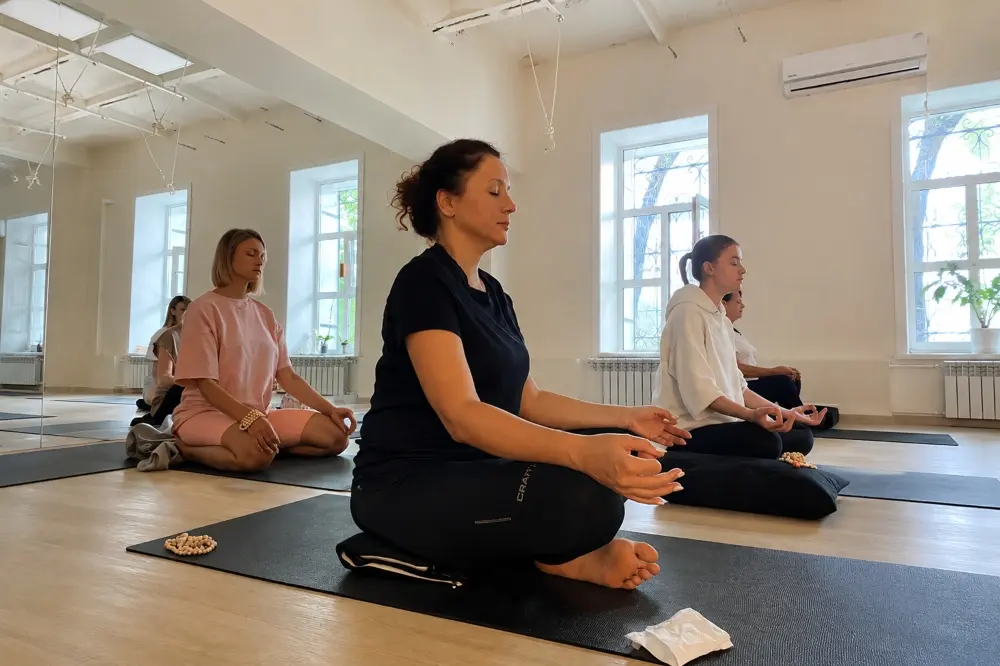
Modern classes commonly coordinate the ascent with inhalation and the descent with exhalation. This is mechanically intuitive: inhalation can accompany chest expansion, while exhalation can support a controlled return.
Traditional Hatha practice, however, is broader than matching one movement to one breath. Depending on lineage and stage of training, asana may prepare the body for pranayama or be held with attentive natural breathing. Avoid adding forceful breathing, prolonged retention or energetic locks solely because a posture is called “traditional.” Those techniques have their own methods, prerequisites and contraindications.
A safe baseline is:
- inhale to lengthen and rise;
- breathe naturally while holding;
- exhale to lower; and
- keep the face, throat and jaw quiet.
If breath becomes jerky, shallow or compelled, reduce the height or leave the pose.
What muscles work in Cobra Pose?
Bhujangasana is not only a passive stretch. It requires coordinated activity through the posterior body and shoulder girdle.
A small surface-electromyography study of postures within Surya Namaskar reported activity of the erector spinae, lower trapezius and latissimus dorsi during Bhujangasana, with higher muscle activity during transitions than during the held pose. The study helps describe muscular demand, but it does not prove that Cobra alone prevents or treats back pain.
Depending on form and effort, the posture may involve:
- spinal extensors maintaining the backbend;
- lower trapezius and other scapular muscles organizing the shoulder blades;
- latissimus dorsi contributing to shoulder and trunk control;
- gluteal and posterior thigh muscles supporting the pelvis and legs;
- triceps contributing more as the elbows extend; and
- abdominal and anterior hip tissues lengthening across the front body.
Anatomy differs among people. Bone shape, spinal curves, tissue mobility, pain history and proportions affect how high a comfortable Cobra will be.
Benefits: what tradition says and what evidence supports
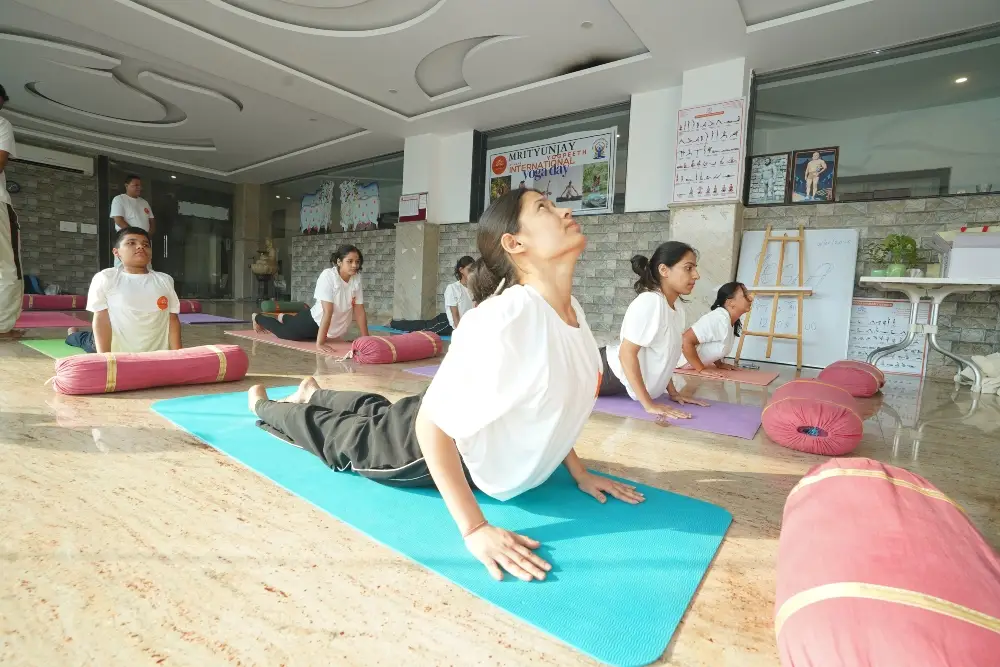
Bhujangasana may support spinal extension, back-muscle endurance, mobility, and mindful breathing, while traditional claims should remain within their spiritual context and not be presented as medical facts.
Traditional benefits
The Gheraṇḍa Saṃhitā associates Bhujangasana with an increase in bodily fire, removal of disease and awakening of serpent power. Within traditional practice, “fire” may be understood in relation to vitality, transformation or digestion, and kundalini belongs to a subtle-body and spiritual framework.
Present these claims as part of the text’s worldview. Statements such as “detoxifies organs,” “cures all diseases,” “heals infertility,” “burns belly fat” or “awakens kundalini in everyone” are not responsible for modern health claims.
Reasonable movement and practice benefits
When suited to the practitioner and taught well, Bhujangasana can:
- practise active spinal extension;
- strengthen endurance and coordination in back and scapular muscles;
- lengthen the anterior trunk and hip region;
- counterbalance prolonged flexed postures as part of a varied movement practice;
- develop awareness of how the pelvis, ribs, shoulders and neck relate;
- coordinate movement with calm breathing; and
- prepare for other prone backbends or selected Hatha sequences.
These are plausible practice outcomes, not guaranteed medical effects. The dose, variation and response matter.
What research says about yoga and low-back pain
Research has found that multi-component yoga programmes may offer small to moderate improvements in pain or function for some people with chronic non-specific low-back pain. A 2020 systematic review and meta-analysis reported evidence ranging from very low to moderate quality and found yoga broadly comparable with other exercise or physical-therapy exercise for pain and disability. A large randomized trial comparing yoga, stretching and a self-care book found better function and symptoms for yoga than the self-care book, while yoga was not clearly superior to conventional stretching.
The critical limitation is that these interventions combine multiple postures, breathing, relaxation, education, adaptation and teacher contact. They do not establish that Bhujangasana by itself treats a slipped disc, sciatica, chronic pain or another diagnosis.
Back pain also responds differently to different directions of movement. Extension may feel relieving for one person and aggravating for another. If you use Cobra for pain, it should be selected and progressed according to an individual assessment—not a generic promise.
Stress, breathing and wellbeing
Yoga research often evaluates whole programmes that include attention, breathing, relaxation and social participation. Any calming effect of a thoughtfully taught Cobra may come from the wider practice, not from a unique biochemical property of the posture. Do not claim that the pose alone treats anxiety, depression, asthma or cardiovascular disease.
Contraindications and precautions
“Contraindication” is often used too loosely in yoga writing. Some situations call for avoiding the posture, some require medical clearance, and others simply require a lower variation. The appropriate decision depends on diagnosis, symptoms, healing stage, professional advice and the exact form of Cobra.
Do not practise and seek prompt assessment when
- pain follows a serious accident or significant trauma;
- back pain is accompanied by loss of feeling around the genitals or anus;
- there are new bladder or bowel changes;
- pain, tingling, weakness or numbness affects both legs;
- there is sudden severe or rapidly worsening pain;
- fever, unexplained weight loss or feeling generally unwell accompanies spinal pain; or
- the posture causes chest pain, faintness, new neurological symptoms or severe breathlessness.
These are not “alignment problems.” The NHS back-pain guidance lists several of these as reasons for urgent or emergency assessment.
Avoid the standard prone pose until appropriately cleared
- Recent abdominal, spinal, chest, shoulder or wrist surgery: healing tissue and surgical instructions take precedence. Obtain clearance from the treating team.
- Acute fracture or significant acute injury: do not load or stretch an injured area without assessment.
- Pregnancy when prone lying is uncomfortable or unsuitable: use a standing, seated or side-lying alternative and consult an obstetric professional or prenatal specialist. ACOG recommends pregnancy-specific modification and discussing activity with an obstetric clinician.
- A clinician’s restriction on spinal extension or hand weight-bearing: follow the reasoned restriction until reviewed.
- Open wounds, painful abdominal pressure or another condition made worse by lying on the abdomen: choose a non-prone alternative.
Obtain individualized guidance or modify carefully when
- there is current or recurrent low-back pain, radiating leg pain or a diagnosed disc condition;
- there is spondylolisthesis, spinal stenosis, inflammatory spinal disease or significant scoliosis;
- osteoporosis or fracture risk is present;
- neck pain, cervical radiculopathy, dizziness or headaches are provoked by neck position;
- wrist, hand, elbow or shoulder pain is aggravated by weight-bearing;
- there is an abdominal hernia or a painful abdominal condition;
- there is significant cardiopulmonary disease, uncontrolled blood pressure or a reason to avoid breath retention; or
- the practitioner is older, deconditioned or returning after a long break.
The U.S. National Center for Complementary and Integrative Health considers yoga generally safe for healthy people when performed properly under qualified guidance, but notes that injuries occur and that older adults may need additional caution. A systematic review of randomized trials found serious yoga-related adverse events uncommon, while adverse-event reporting across studies was imperfect.
Sensations that mean “come out now”
Leave the pose if you feel:
- sharp, catching or pinching pain;
- pain radiating into an arm, buttock or leg;
- new numbness, tingling or weakness;
- pressure concentrated in one spinal point;
- wrist, elbow or shoulder pain that increases with loading;
- dizziness, nausea, visual disturbance or faintness;
- inability to breathe comfortably; or
- abdominal or pelvic pressure that feels wrong.
A muscular effort or mild, broad stretch may be acceptable; pain is not a requirement for progress. The NHS advises stopping back exercises if pain worsens and seeking professional advice.
Modifications and alternatives
Baby Cobra
Keep the chest low, elbows bent and hands light. Lift mainly with the back muscles for one to three breaths. This reduces the temptation to push into maximal extension and is a useful starting point for learning control.
Sphinx Pose
Place the forearms on the floor, usually with elbows near or slightly forward of the shoulders. Sphinx removes wrist extension and can make the position easier to sustain, although it is not automatically suitable for every lower back. Move the elbows farther forward or lower the chest if the lumbar area feels compressed.
Cobra with hands farther forward
Move the hands slightly forward to reduce the height and demand for wrist and spinal range. Maintain whole-hand contact and keep the shoulders organized.
Fingertip or block-supported Cobra
In some teaching contexts, fingertips or stable blocks beside the ribs can help reduce palm loading and encourage the back body to initiate the lift. This requires sufficient hand control and a non-slip setup; it is not appropriate for painful fingers or unstable supports.
Standing Cobra at a wall
Stand facing a wall with hands at chest height. Press lightly into the wall while lifting the sternum and extending the upper spine without throwing the head back. This removes prone abdominal pressure and makes the range easy to control.
Seated thoracic extension
Sit on a stable chair, support the hands on the thighs or behind the head, and extend gently through the upper back while keeping the lower ribs organized. This can be useful when floor transfer or prone lying is unsuitable.
Locust preparation
With arms beside the body and palms facing in, lift the head and upper chest a small amount without using the hands. This teaches active posterior support, but it is still a prone extension and shares some precautions.
Common mistakes and how to correct them
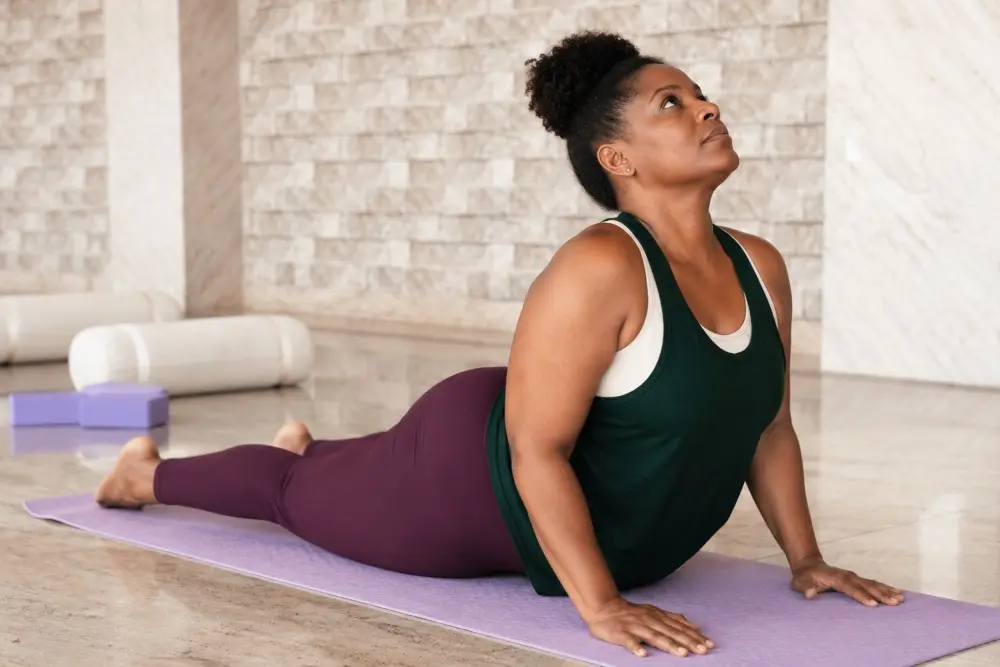
Mistake 1: pushing to straight arms
Why it happens: Straight arms look like the “full pose.”
Correction: Bend the elbows and lower until the chest can lengthen forward, the pelvis stays grounded and the breath remains easy. Arm straightness is optional.
Mistake 2: hinging only in the lower back
Why it happens: The lumbar spine moves more readily than the thoracic spine.
Correction: Reduce height, engage the legs, lengthen the sternum forward and invite upper-back participation. A smaller arc distributed through more of the spine is usually preferable.
Mistake 3: lifting the pelvis
Why it happens: The practitioner is moving toward Upward-Facing Dog or using excessive arm force.
Correction: Keep the front pelvis grounded. If the thighs and pelvis lift, name and teach the posture as a different shape rather than calling it Cobra.
Mistake 4: shrugging the shoulders
Why it happens: The hands push down while the chest remains collapsed.
Correction: Broaden the collarbones, move the shoulders away from the ears and let the sternum travel forward before seeking height.
Mistake 5: throwing the head back
Why it happens: Upward gaze is mistaken for spinal extension.
Correction: Begin with a forward-and-down gaze. Let neck extension emerge only as a continuation of upper-spine movement.
Mistake 6: legs completely passive or gluteals clenched hard
Why it happens: Practitioners receive absolute cues such as “relax the buttocks” or “squeeze everything.”
Correction: Use balanced leg and gluteal activity to support the pelvis while retaining length and breath. The correct amount is individual.
Mistake 7: breath retention and facial strain
Why it happens: The pose is too high or effort is treated as intensity.
Correction: Lower until breathing is smooth; relax the jaw, tongue and eyes.
Bhujangasana, Sphinx and Upward-Facing Dog compared
| Feature | Baby or classical Cobra | Sphinx Pose | Upward-Facing Dog |
|---|---|---|---|
| Arm position | Elbows bent or partly extended | Forearms grounded | Arms generally straight |
| Lower-body contact | Pelvis and legs remain grounded | Pelvis and legs remain grounded | Thighs and pelvis lift from floor |
| Wrist load | Variable; can be meaningful | Minimal wrist extension | Greater hand and wrist loading |
| Typical use | Controlled spinal extension and back-body action | Supported, lower or sustained extension | Stronger transition or held backbend |
| Key caution | Do not force height into lumbar spine | Not automatically pain-free for lumbar conditions | Requires more shoulder, wrist, trunk and leg capacity |
These postures are related but not interchangeable. In a flow class, moving from knees–chest–chin or Chaturanga into Upward-Facing Dog is a different mechanical task from entering a deliberate Hatha Cobra from prone.
How long should you hold Bhujangasana?
There is no universal therapeutic dose. For a healthy beginner, a conservative starting point is:
- two or three repetitions;
- one to three natural breaths per repetition;
- a low or moderate height; and
- rest between repetitions.
An experienced practitioner may hold longer within a coherent sequence, provided breath and alignment remain steady. More height, duration or repetitions are not automatically better. End the set before technique deteriorates.
When and how to include Cobra in a Hatha sequence
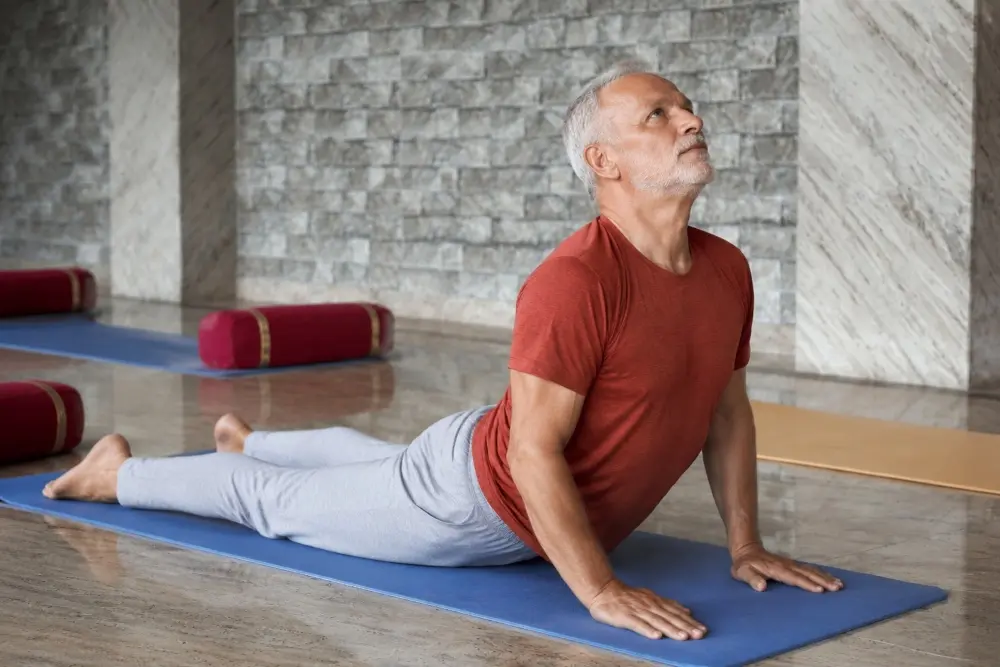
Bhujangasana can be thoughtfully placed within Hatha sequences, with specific preparation, mindful transitions, appropriate counterposes, and sequencing adapted to individual needs and lineage.
Before Bhujangasana
Prepare the relevant areas rather than performing a generic warm-up:
- shoulder circles or scapular movement;
- Cat–Cow in a comfortable range;
- low Sphinx with active length;
- prone leg activation;
- a gentle Locust preparation; or
- a standing chest-opening movement.
After Bhujangasana
Pause prone and observe. A neutral rest, gentle Child’s Pose or easy spinal movement may feel appropriate, but a deep counterpose is not mandatory. Avoid snapping immediately from a strong backbend into a maximal forward bend.
In a traditional practice arc
Bhujangasana may sit among other strengthening and backbending postures before pranayama, mudra or seated work. The exact order depends on lineage, purpose and practitioner. A traditional label does not justify a fixed universal sequence.
Teaching Bhujangasana responsibly
Responsible teaching emphasizes screening, choice, consent, observation, and staying within professional scope rather than forcing alignment or making medical claims.
Ask before prescribing
A teacher should ask about pregnancy, surgery, osteoporosis, acute injury, current pain and relevant clinical advice. Do not diagnose the student or promise a cure.
Demonstrate options, not a hierarchy
Show Baby Cobra, Sphinx and non-prone alternatives as equally legitimate choices. Avoid language such as “beginner version” if it implies that a deeper spinal angle is the goal.
Use consent-based assistance
Do not press a student’s shoulders back or force the spine deeper. Obtain specific consent before touch and use verbal or visual cues first. Manual adjustment cannot reveal what a student’s joints or nerves are experiencing.
Observe function
Look for breath holding, shoulder elevation, hand collapse, pelvic lifting, asymmetric movement and a painful facial response. Ask what the student feels and where. A beautiful silhouette is not proof of a useful experience.
Stay within scope
A yoga teacher can offer movement options and refer onward. A teacher should not tell a student that Cobra will repair a disc, cure sciatica, reverse infertility, stimulate a named organ or replace medical care.
Frequently asked questions
1. Is Bhujangasana the same as Cobra Pose?
Yes. Bhujangasana is commonly translated as Cobra Pose or Serpent Pose. The Sanskrit bhujaṅga means serpent or snake, and āsana means posture.
2. Is Bhujangasana a traditional Hatha yoga pose?
It is described in the Gheraṇḍa Saṃhitā 2.42–43, a premodern text associated with the Hatha yoga corpus. The modern studio form and detailed alignment cues reflect later teaching developments as well as lineage-specific interpretation.
3. Is Cobra Pose in the Hatha Yoga Pradipika?
Bhujangasana is not among the named postures described in the commonly received Haṭha Yoga Pradīpikā list. Its clear classical description is in the later Gheraṇḍa Saṃhitā. “Traditional Hatha” is broader than one book.
4. Should the arms be straight?
Not necessarily. Bent elbows are normal in Baby and moderate Cobra. Straighten only to the degree that the chest remains broad, the spine feels evenly organized, the pelvis stays grounded and breathing remains comfortable.
5. Should the legs be together or hip-width apart?
Both appear in modern teaching. Hip-width often gives a stable, accessible starting point. A narrower position may suit some bodies and lineages. Choose the placement that permits symmetrical leg action and a comfortable sacrum and lower back.
6. Should I squeeze the buttocks?
Use the gluteal muscles enough to support hip extension and pelvic stability, but avoid maximal gripping if it creates compression or cramps. The useful effort varies by person and pose height.
7. Is Bhujangasana good for lower-back pain?
It may feel helpful for some people and aggravating for others. Evidence supports some multi-component yoga programmes for chronic non-specific low-back pain, not Cobra as a universal treatment. Seek assessment for persistent, severe, radiating or neurologically accompanied pain.
8. Can Cobra fix a slipped or herniated disc?
No generic posture can be promised to “fix” a disc. Some rehabilitation approaches use carefully selected extension movements, but suitability depends on symptoms and assessment. Do not self-prescribe deep Cobra for radiating pain, numbness or weakness.
9. Can I practise Bhujangasana during pregnancy?
Once prone lying causes abdominal pressure or is no longer comfortable, use a standing or seated alternative. Pregnancy exercise advice is individualized; discuss it with an obstetric professional and a qualified prenatal teacher. Avoid hot yoga and other practices specifically discouraged by your clinician.
10. What if my wrists hurt?
Reduce hand pressure, move the hands forward, use a low Baby Cobra, try Sphinx, or choose a wall variation. Stop if pain persists. Wrist pain can arise from several conditions and should not be pushed through.
11. Where should I look?
Start slightly forward and down so the neck remains long. Move the gaze only as far upward as the upper spine can support without pinching, dizziness or strain.
12. Can Bhujangasana reduce belly fat?
There is no credible evidence that one posture selectively burns abdominal fat. Body composition changes depend on many factors, including overall activity, nutrition, sleep, health and genetics.
13. Does Cobra improve digestion or stimulate abdominal organs?
The traditional text speaks of increasing bodily fire. Modern claims that the pose treats constipation, ulcers, liver disease or another digestive condition are not established by pose-specific clinical evidence. Abdominal pressure may be uncomfortable or inappropriate for some conditions.
14. Is Bhujangasana suitable every day?
Some healthy practitioners can use a gentle version regularly, while others need recovery or a different movement balance. Frequency should reflect response, total practice load and health status. Persistent soreness or worsening symptoms are reasons to reduce or stop and seek guidance.
A safe-practice checklist
A practical safety checklist for Bhujangasana helps practitioners assess readiness, maintain controlled alignment and breathing, recognize warning signs, and respond appropriately after the pose.
Before the pose:
- I have no red-flag symptoms or medical restriction that makes this inappropriate.
- Prone lying and hand placement are comfortable.
- I can choose a lower or non-prone version without feeling that I have failed.
During the pose:
- My legs and pelvis provide a stable base.
- My chest travels forward and up rather than only upward.
- My shoulders are not crowding my ears.
- My neck continues on the spinal line.
- I can breathe naturally.
- I feel no sharp, radiating, neurological or escalating pain.
After the pose:
- I lower with control.
- Symptoms are unchanged or better, not worse.
- I can move and breathe normally.
- Any concerning response is documented and discussed with an appropriate professional.
Your next practice
Approach Bhujangasana as an inquiry rather than a performance. Begin with three low Cobras. On each repetition, keep the hands progressively lighter and notice whether the chest can lengthen forward through back-body effort. Stop at the first height where the shoulders stay broad, the pelvis remains grounded and the breath is quiet.
Then rest and ask:
- Where did the movement occur?
- Could I breathe into the side and back ribs?
- Did one area feel compressed?
- Did the second or third repetition become clearer—or merely higher?
- How did my body feel one minute later?
Traditional Hatha practice values disciplined attention. In Bhujangasana, that attention matters more than the height of the cobra’s hood.