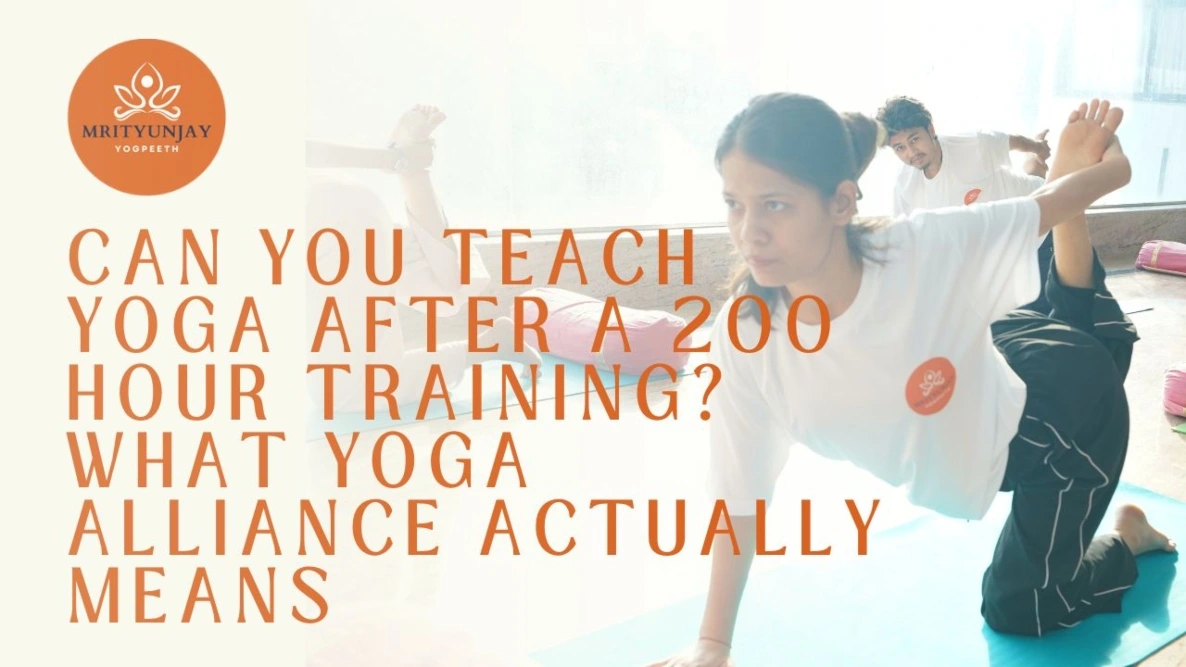
Yes, many graduates begin teaching general yoga classes after completing a suitable 200 hour yoga teacher training. But “200 hour certified,” “RYT 200,” legally allowed to work, insured, hired by a studio, and ready to teach a particular population are not the same thing. A 200 hour course is foundational education. Yoga Alliance registration is a voluntary professional credential based on completing an eligible training and accepting membership obligations. Neither replaces local law, an employer’s requirements, insurance conditions, specialist education, or sound professional judgment.
TL;DR
- A well-designed 200 hour teacher training is commonly the entry point for teaching general adult yoga, but course completion is not a universal licence to teach every person, style, or setting.
- A 200 hour certificate comes from the school. RYT 200 is a Yoga Alliance registration available to eligible graduates of an active Registered Yoga School (RYS 200) who apply, pay the relevant fees and accept ongoing membership obligations.
- “Yoga Alliance certified” is imprecise wording. Yoga Alliance registers qualifying teachers and schools; it does not personally observe and approve every class a teacher later delivers.
- RYT 200 is not a government teaching licence, medical licence, physiotherapy qualification, psychotherapy credential or yoga-therapy certification.
- No post-training teaching-hour minimum is listed for the ordinary RYT 200 pathway. Experience requirements apply to advanced or experienced designations such as E-RYT 200.
- Registration can improve portability and may satisfy a studio, insurer, gym, retreat or corporate client’s policy, but employers decide whom to hire and may request auditions, experience, first aid, background checks or specialist credentials.
- Readiness depends on demonstrated competence: sequencing, clear cueing, observation, accessible options, emergency procedures, ethical boundaries and the ability to say “I do not know.”
- Teach within the actual content and populations covered by your training. Pregnancy, children, significant illness or injury, trauma-sensitive work and yoga therapy require additional competence and may require specialist credentials.
- Do not diagnose, prescribe treatment, promise cures or present RYT 200 as proof of clinical expertise. Yoga Alliance explicitly says its school standards do not credential yoga therapy.
- Obtain appropriate professional/public liability insurance and confirm that the policy covers every location, online class, style, population and business activity you offer.
- Build experience gradually: assist, observe, teach peers, offer a short beginner series, obtain feedback, keep class plans and incident records, and work with a mentor.
- Your first qualification is the beginning of professional development, not the end of it.
The terms people confuse
| Term | What it normally means | What it does not prove |
|---|---|---|
| 200 hour yoga teacher training | A school programme described as containing 200 instructional hours | That Yoga Alliance recognizes it, that the graduate registered, or that every graduate has equal competence |
| RYS 200 | A school with Yoga Alliance’s Registered Yoga School credential for a 200 hour programme | Government accreditation, guaranteed teaching quality, or automatic RYT status for every trainee |
| 200 hour certificate | The school’s evidence that a trainee completed or graduated from its programme | Active Yoga Alliance membership or a legal licence |
| RYT 200 | An individual registered with Yoga Alliance after an eligible RYS 200 training and application | Experienced-teacher status, specialist competence, employment or clinical authority |
| E-RYT 200 | An experienced Yoga Alliance designation with post-training time and teaching-hour requirements | Competence in every yoga style or specialist population |
| RYT 500 | A teacher who met Yoga Alliance’s 500-hour training pathway and other applicable requirements | Yoga-therapy, medical or mental-health licensure |
| RCYT / RPYT | Yoga Alliance specialty designations for children’s or prenatal teaching, with specified training and experience | A substitute for all safeguarding, clinical or local requirements |
| C-IAYT | An individual yoga-therapist certification from the International Association of Yoga Therapists | A Yoga Alliance RYT designation or a government healthcare licence |
Use the exact name of the organization and credential. Several organizations use similar “Yoga Alliance” wording, and their standards are not interchangeable.
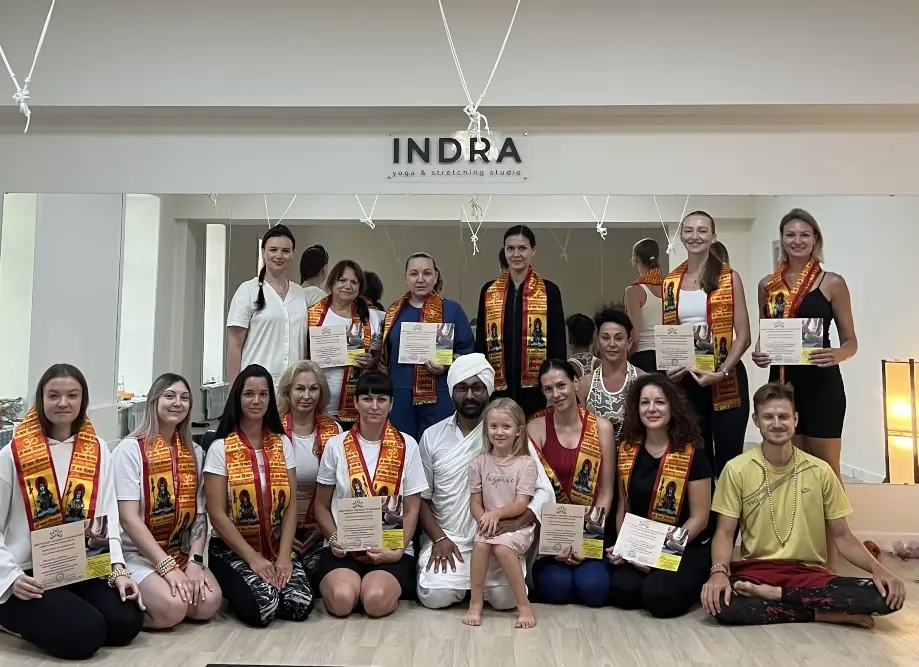
What is a 200 hour yoga teacher training?
Yoga Alliance describes RYS 200 as foundational training for new teachers. Its current school overview groups the core curriculum into four educational categories:
- Techniques, Training and Practice;
- Anatomy and Physiology;
- Yoga Humanities; and
- Professional Essentials.
An individual school’s emphasis can vary substantially. One programme may prioritize traditional Hatha practice and philosophy; another may focus on modern postural yoga, vinyasa sequencing or studio teaching. Two certificates with the same number of hours can represent different admissions standards, faculty contact, teaching practice, assessment and feedback.
Yoga Alliance’s school guidance says an RYS should assess trainees before issuing a certificate and should not graduate a trainee simply for completing hours if the person cannot demonstrate proficiency in the material taught. That distinction matters: attendance is not the same as demonstrated teaching competence.
Questions your training should answer
By graduation, you should know:
- what style and level you were trained to teach;
- which populations the curriculum did and did not address;
- how much real teaching, observation, and feedback you completed;
- what assessment standard you passed;
- how to create a coherent class with a clear purpose;
- how to offer options without diagnosing students;
- how the school approaches touch and consent;
- how to respond to pain, illness, distress or an emergency;
- when to stop, modify, refer or decline; and
- how to access mentorship after graduation.
If these are unclear, ask the school for its written curriculum, assessment records and graduate scope.
What does RYS 200 mean?
RYS means Registered Yoga School. An active RYS 200 has registered an eligible 200 hour teacher-training programme with Yoga Alliance and agreed to its standards and policies.
This is useful evidence about the programme’s framework. It does not mean:
- a government education authority accredited the qualification;
- Yoga Alliance employed the faculty;
- every graduate is automatically an RYT;
- every school teaches the same lineage or method;
- every graduate is equally ready for every class; or
- Yoga Alliance assumes responsibility for the teacher’s future work.
Before enrolling, verify the school in Yoga Alliance’s current directory and confirm that the exact programme—not merely a similarly named school—supports the credential you want. Ask what happens if its registration status changes before graduation.
What does RYT 200 mean?
RYT means Registered Yoga Teacher. Under Yoga Alliance’s current published route, a teacher can obtain RYT 200 after completing a 200 hour training registered with Yoga Alliance and applying for the credential. Yoga Alliance’s RYT overview currently lists the training certificate, programme dates, applicable teaching log, application fee, and membership dues as application materials or costs.
The important distinction is:
- the school graduates you;
- you apply to Yoga Alliance; and
- Yoga Alliance registers you if you satisfy its requirements.
Completion does not silently create active RYT 200 status. A teacher who has not applied, whose membership has lapsed, or whose training was not an eligible RYS 200 programme should not present themselves as currently registered.
Is teaching experience required for RYT 200?
Yoga Alliance’s current RYT 200 description does not list a post-graduation teaching-hour minimum for the entry credential. This differs from E-RYT 200, for which Yoga Alliance currently describes at least two years after training and 1,000 post-training teaching hours.
That does not mean a new graduate is experienced. It means RYT 200 is a foundational registration, not an experienced-teacher designation.
Does Yoga Alliance certify yoga teachers?
In casual speech, many people say “Yoga Alliance certified.” A more precise description is:
- “I completed a 200 hour teacher training with [school]”; and, if true,
- “I am currently registered with Yoga Alliance as an RYT 200.”
Yoga Alliance describes itself as a member-based nonprofit association and credentialing organization. It maintains standards, registers qualifying providers, and binds members to policies. The school’s certificate and Yoga Alliance’s individual registration are distinct.
Avoid marketing that implies:
- government licensure;
- medical or therapeutic authorization;
- approval of outcomes for a named condition;
- mastery of a lineage you did not study; or
- active registration when your status is not current.
Honest credential language protects students and makes your professional profile more credible.
Is Yoga Alliance registration legally required to teach?
There is no single worldwide rule. Yoga teaching law, business registration, taxes, consumer obligations, safeguarding, employment, venue use and insurance vary by country and sometimes by state, province or municipality.
Yoga Alliance registration is generally a voluntary private credential, not a universal government licence. But it may become practically required because:
- studio or gym requires RYT status;
- insurer limits eligibility or coverage;
- retreat operator requires particular documentation;
- corporate client has vendor standards;
- school or care setting requires safeguarding/background checks;
- visa or work arrangement requires evidence of training; or
- The local regulator classifies the activity in a particular way.
Before teaching, check official local sources and obtain professional advice where needed. Yoga Alliance’s Code of Conduct requires members to follow applicable law; membership does not override it.

Can a studio hire you immediately after 200 hours?
Yes, a studio may hire a new graduate. It may also decide that the certificate alone is insufficient. Hiring is a separate decision based on the role and the studio’s risk standards.
A responsible employer may request:
- an application and interview;
- a live audition or recorded sample;
- observation or assistant teaching;
- references from trainers;
- current RYT status;
- professional liability insurance;
- first-aid/CPR/AED training;
- background or safeguarding checks;
- a minimum personal-practice or teaching history;
- specialist education for the advertised class; and
- employee or contractor documentation.
An RYT directory listing can help a studio verify a registration. It does not require the studio to hire the registrant or replace its own assessment.
Are you ready to teach? Use this competence check
Rate yourself with evidence, not confidence alone.
1. Class purpose and scope
- Can you state who the class is for and who should choose another service?
- Is the style, pace and level within your actual training?
- Can you explain the intended experience without promising a medical outcome?
2. Sequencing
- Does the sequence have a safe, intelligible progression?
- Are demands introduced before they are intensified?
- Are transitions realistic for the stated group?
- Is there time for arrival, rest, and integration?
- Can you remove a pose without collapsing the plan?
3. Communication
- Can students understand the essential action without watching you continuously?
- Can you cue breath without coercion or breath retention unsuitable for the group?
- Can you avoid absolute statements about one “correct” body shape?
- Can you teach without filling every quiet moment?
4. Observation and adaptation
- Can you scan the room while speaking?
- Can you recognize effort, confusion, pain behaviour or distress?
- Can you offer a simpler option that preserves agency and dignity?
- Can you stop a planned activity when conditions change?
5. Boundaries and referrals
- Can you respond when asked to diagnose pain?
- Can you avoid nutrition, mental-health, or medical advice outside your credentials?
- Can you refer a student without shame or alarm?
- Can you distinguish a general yoga class from individualized therapy?
6. Emergency and operations
- Do you know the venue’s emergency plan and local emergency number?
- Can you access a phone, exits, first-aid equipment and the venue address?
- Do you know how to document an incident?
- Are your registration, payment, privacy and cancellation practices clear?
If several answers are no, seek supervised practice and training before leading the class alone.
What should a new 200 hour graduate teach first?
Begin with the narrowest honest offer that matches your education. Examples may include:
- a general beginner class for adults who can self-select participation;
- a foundational Hatha or vinyasa class in the method you trained;
- a short breath-and-movement class without therapeutic claims;
- a community class under a mentor or studio manager;
- an assistant role in a mixed-level class; or
- private sessions for generally healthy adults, provided your training, insurance and intake process cover one-to-one work.
“Beginner” is not automatically low risk. Beginners may not recognize limits, understand yoga language or know when a sensation is concerning. Teach fewer elements well, leave time to observe and provide real alternatives.
A sensible first-class progression
- Observe several classes in the setting.
- Teach the plan to peers and ask for specific feedback.
- Rehearse timing, names, transitions and emergency interruption.
- Lead a short segment for a mentor.
- Co-teach or assist a full class.
- Teach a small, clearly described class.
- Debrief, record lessons, and revise before repeating it.
Repetition is valuable. Teaching one thoughtful sequence several times often develops more skill than creating a new complicated sequence every week.
What should you not teach on an ordinary RYT 200 alone?
A foundational credential should not be used to imply competence you do not possess.
Yoga therapy or treatment
Yoga Alliance’s yoga-therapy policy says its Registered Yoga School standards do not credential yoga-therapy techniques, including diagnosis or treatment of physical or mental injury or illness. An RYS/RYT designation alone should not be presented as a yoga-therapist qualification.
The International Association of Yoga Therapists has a separate C-IAYT certification route for graduates of accredited yoga-therapy programmes and other qualified pathways. IAYT describes this as a distinct professional certification with education, ethics, scope and ongoing requirements.
Prenatal and postnatal yoga
Pregnancy involves population-specific anatomy, risk screening, modifications and referral decisions. Yoga Alliance offers a separate RPYT pathway based on prenatal training and post-training teaching experience. An ordinary 200 hour curriculum may include some pregnancy discussion, but that is not equivalent to specialist competence.
Children’s yoga
Teaching children requires age-appropriate methods, safeguarding, consent, group management and knowledge of the setting’s legal duties. Yoga Alliance offers an RCYT pathway with specialty training and experience requirements. General adult teaching skills do not automatically transfer.
Significant injury, illness or complex mental-health needs
A general teacher can welcome many people through accessible choices, but should not diagnose, rehabilitate, or treat. Coordinate with appropriately licensed or credentialed professionals when individualized care is needed. Never tell a student to stop prescribed treatment.
Advanced techniques outside your training
Do not teach forceful breath practices, long retentions, inversions, extreme ranges, heated protocols, hands-on adjustment systems or meditation methods merely because you have practised them. Personal familiarity is not the same as teaching competence.
What does “scope of practice” mean?
Scope of practice is the boundary of services you are prepared and permitted to provide. It is shaped by:
- your documented education;
- assessed competence;
- teaching and mentorship experience;
- local law and professional rules;
- employer and venue policies;
- insurance wording;
- the population and setting; and
- the claims you make.
Yoga Alliance’s Scope of Practice instructs members not to advise or teach in areas without appropriate credentials and competence, and not to use Yoga Alliance credentials to imply competency in fields outside its yoga scope.
Safe language when a student asks for medical advice
You can say:
“I can’t diagnose that or tell you whether this practice is medically appropriate. Please ask a qualified healthcare professional. If you choose to remain, you are welcome to rest or select a comfortable option, and we can avoid the movement that prompted the concern.”
Do not use a waiver to justify working beyond competence. A signed form does not convert unqualified advice into safe professional practice.
Ethics matter as much as alignment
Yoga Alliance’s Ethical Commitment combines its Code of Conduct, Scope of Practice and equity responsibility. For a new teacher, this has practical consequences.
Consent-based touch
- Explain the nature and purpose of touch before seeking agreement.
- Make refusal easy and consequence-free.
- Do not treat prior consent as permanent consent.
- Avoid surprise touch, coercive “corrections,” or intimate contact.
- Respect trauma history without requiring disclosure.
- Follow the stricter rule when the venue or population requires it.
Verbal or demonstrative instruction is often sufficient. Hands-on assistance is an optional teaching tool, not proof of expertise.
Honest communications
- Describe your training and experience accurately.
- Do not promise cures, detoxification or guaranteed outcomes.
- Credit traditions, teachers and sources.
- Do not invent Sanskrit, anatomy or historical certainty.
- Distinguish personal belief, lineage teaching and research evidence.
- Disclose relevant financial relationships.
Power and boundaries
Teachers hold positional influence even in informal spaces. Maintain professional boundaries around romance, sexuality, money, confidentiality, messaging, photography and social media. Have a complaint route that does not require students to confront the teacher privately.
Do you need liability insurance?
Often, yes—and sometimes the venue will require your own policy. Do not assume a studio’s policy covers employees, contractors, substitutes, private work, online teaching, or off-site events.
Ask the insurer in writing whether coverage includes:
- professional instruction and public/general liability;
- each yoga style and technique you teach;
- hands-on assists;
- private, group, online and recorded classes;
- home, rented, outdoor, retreat and international locations;
- prenatal, children’s or other specialist populations;
- props and equipment;
- workshops and teacher education;
- defence costs and incident reporting; and
- your business structure and contractor status.
Read exclusions, territorial limits, claims basis, retroactive dates and minimum safety requirements. A membership discount is not evidence that a particular policy fits your work.
Should yoga teachers have first-aid and CPR training?
It is prudent and may be required by an employer, an insurer, or a venue. Select recognized training appropriate to your location and setting, keep it current, and practise the venue’s emergency process. The American Red Cross, for example, notes that workplace-eligible CPR certification may require an in-person skills assessment and that its certification has a renewal period.
First-aid training does not make a yoga teacher a clinician. It prepares you to recognize and respond to emergencies while professional help is contacted.
What paperwork should you have before teaching?
Requirements vary, but a professional setup commonly includes:
- training certificate and current credential evidence;
- insurance certificate;
- first-aid/CPR evidence where relevant;
- written employee or contractor agreement;
- class description and eligibility limits;
- proportionate health/intake questions for private or specialist work;
- informed-consent and privacy information;
- cancellation, payment and refund terms;
- touch/photography consent process;
- emergency and incident plan;
- attendance, payment and tax records; and
- secure incident documentation and retention rules.
Collect only information you need, restrict access and do not discuss a student’s health in public. Legal templates should be adapted by a qualified professional in the relevant jurisdiction.
How to find your first yoga teaching job
Build a truthful teaching profile
Include:
- exact training school, programme and completion date;
- active RYT designation only if registered and current;
- style and populations actually covered;
- teaching practicum and post-training experience;
- first-aid, specialist and relevant professional credentials;
- languages and accessibility experience; and
- clear availability and location.
Avoid a long collection of weekend certificates without explaining competence or experience.
Prepare an audition class
Create a 20- to 30-minute segment that shows:
- a clear beginning, development and close;
- plain-language cueing;
- observation rather than constant demonstration;
- at least one genuine alternative;
- timing and room management;
- non-coercive tone; and
- a safe response when the plan changes.
The audition is not a performance of your hardest poses. It is evidence that students can understand you and retain agency.
Ask the studio questions too.
- Who is the class designed for?
- How are teacher auditions and reviews handled?
- Is there an emergency procedure and incident form?
- Who owns student health information?
- What insurance covers the venue and what must I carry?
- Am I an employee or contractor, and what does that mean locally?
- How are substitutes, cancellations and minimum attendance handled?
- Does the studio require or prohibit hands-on assists?
- Who supports a teacher after a difficult class or complaint?
A studio that cannot explain safety, employment, or reporting arrangements is transferring uncertainty to the teacher.
A 90-day plan after graduation
Days 1-30: consolidate
- Review your final feedback and identify three gaps.
- Write two simple class plans within your trained method.
- Observe skilled teachers and note decisions, not only poses.
- Practise concise cueing and silence.
- Complete first-aid/CPR preparation if needed.
- Confirm insurance and local business requirements.
- Ask an experienced teacher to mentor or observe you.
Days 31-60: teach with support
- Teach peers or a small community group under clear terms.
- Assist or co-teach when possible.
- Repeat the same sequence and refine it.
- Request feedback about clarity, pace, agency, and accessibility.
- Keep a teaching log and post-class reflection.
- Practice responding to common out-of-scope questions.
Days 61-90: establish a narrow professional offer
- Audition for one suitable class or launch a short beginner series.
- Publish accurate credentials and class boundaries.
- Test registration, payment, emergency and incident processes.
- Schedule supervision or mentoring.
- Select continuing education based on observed need, not marketing pressure.
- Review whether your class description matches who actually attends.
Progress does not require rushing into advanced populations. Reliability grows through repeated, reviewed teaching.
How to choose continuing education after 200 hours
Choose education from the problems you can now see.
Priorities often include:
- applied anatomy without diagnostic overreach;
- accessible teaching and disability inclusion;
- consent, touch and trauma awareness;
- sequencing and teaching methodology;
- pranayama and meditation safety;
- philosophy, Sanskrit and lineage study with qualified teachers;
- business, privacy and employment basics;
- specialist pathways for children or pregnancy; and
- supervised teaching or mentoring.
Ask of every course:
- What prior competence does it assume?
- What can graduates responsibly do afterwards?
- Is there live observation, practice and feedback?
- Who teaches it and what supports their claims?
- Does an organization recognize the hours if that matters to you?
- Is assessment meaningful?
More certificates are not always the answer. Direct mentorship and deliberate teaching practice may address a gap better than another broad survey course.
When should you pursue 300 or 500 more hours?
Additional training can be valuable when it deepens a coherent method, provides specialist competence, or supports a role you genuinely want. It should not be used to avoid practising foundational teaching skills.
Consider advanced training when:
- you can identify specific limitations in your current teaching;
- the faculty has appropriate depth and offers feedback;
- the curriculum adds more than repeated introductory material;
- the training supports your intended students and setting;
- you understand the total time, cost, and credential route; and
- you will have opportunities to integrate the learning.
An RYT 500 credential can communicate advanced training. It still does not establish clinical authority or universal expertise.
Red flags in a 200-hour teacher training
- The school guarantees a job, income, confidence or mastery.
- Graduation depends only on payment and attendance.
- There is little observed teaching practice or individual feedback.
- The lead trainer’s identity or qualifications are unclear.
- The programme markets ordinary RYT training as yoga therapy.
- Anatomy is taught through unsupported diagnosis or cure claims.
- Touch is practised without explicit consent education.
- Questions and dissent are framed as lack of spiritual commitment.
- The school cannot explain complaints, safeguarding or faculty conduct.
- It uses “Yoga Alliance approved” vaguely without a verifiable active programme.
- It promises that one certificate lets you teach pregnancy, children, trauma, disease and advanced techniques.
- It pressures trainees into unpaid labour, relationships or purchases.
- It discourages medical care or presents the trainer as the final authority.
Verify current registration in the official directory, speak with recent graduates, and read the cancellation/refund terms before paying.
Frequently asked questions
1. Can I call myself a yoga teacher after 200 hours?
If you completed the training and local rules allow the work, you can accurately describe yourself as a graduate yoga teacher. Use RYT 200 only if you hold that active Yoga Alliance registration. Avoid suggesting experience or specialty credentials you do not have.
2. Can I teach before registering with Yoga Alliance?
Possibly. Yoga Alliance registration is not a universal legal licence. A school certificate may be sufficient for some venues, while others require active RYT status. Check local law, the employer, and your insurer.
3. Is RYT 200 the same as a teaching certificate?
No. The school issues the training certificate. RYT 200 is the individual’s Yoga Alliance registration based on an eligible certificate and application.
4. Do I need teaching hours before RYT 200?
Yoga Alliance’s current ordinary RYT 200 route does not list post-training teaching hours. Experienced and specialty designations have different requirements.
5. Does an online 200 hour training count?
It can if the programme and school meet Yoga Alliance’s current requirements and your certificate is eligible. Confirm the exact active programme in the official directory. Separately assess whether the format provides enough observed practice, live feedback and skills assessment for you.
6. Can I teach yoga online after 200 hours?
Potentially, if your competence, insurance, platform, privacy process and local rules cover online teaching. Online classes create additional limits: you may not see students clearly, cannot control their environment, and need a remote emergency plan. State these limitations and teach within a suitable scope.
7. Can I teach private clients?
Yes, in many settings, but one-to-one teaching can create greater expectations of personalized or therapeutic advice. Use clear intake, consent, and scope language, remain within training, and refer to clinical questions.
8. Can I teach pregnant students in a general class?
A pregnant person may attend a general class, but the teacher needs appropriate competence to respond safely and avoid pretending that generic modifications fit every pregnancy. If you have not received sufficient prenatal education, be transparent, provide non-coercive choices, and refer to a qualified prenatal teacher or healthcare professional as appropriate.
9. Can an RYT 200 teach yoga therapy?
Not on that credential alone. Yoga Alliance explicitly says its RYS/RYT standards do not credential yoga therapy or diagnosis/treatment. Appropriate additional education and credentials are required.
10. Does RYT 200 expire?
The school’s graduation certificate and an active Yoga Alliance registration are different. Yoga Alliance currently requires members to maintain membership obligations, continuing education, and annual dues for uninterrupted credential status. Check the current official account guidance before making renewal decisions.
11. Is Yoga Alliance registration worth it?
It may be valuable when employers, insurers, or students recognize it, when directory visibility matters, or when you want its membership framework and resources. It may be less important in a setting that recognizes another lineage or national credential. Decide from your market and professional needs—not from the belief that it is a universal licence.
12. Can I make a full-time living after a 200-hour course?
The credential creates no income guarantee. Sustainable teaching depends on demand, class quality, retention, rates, employment status, schedule, business costs and complementary skills. Many new teachers begin part-time while building experience.
13. What if I finished 200 hours but do not feel ready?
Do not interpret hesitation as failure. Ask for feedback, assist, teach shorter segments, work with a mentor, and address specific gaps. Readiness is not a switch that turns on at hour 200.
Your next step
Before advertising your first class, create a one-page teaching-scope statement:
- exact training and active credentials;
- styles and levels you can responsibly teach;
- intended population and setting;
- topics and populations you will not teach yet;
- insurance and first-aid status;
- consent and touch policy;
- emergency and incident process;
- referral contacts; and
- mentor or supervisor.
Then teach one 30-minute class to a small group while an experienced teacher observes. Ask them to score only five things: clarity, sequencing, observation, student agency and scope. Correct the weakest area before adding complexity. This is a more meaningful bridge into teaching than changing your social-media bio the day your certificate arrives.