TL;DR
A residential 200 hour Yoga Teacher Training in Rishikesh involves living on campus for a fixed 22 days, following a structured daily schedule covering asana, pranayama, meditation, philosophy, anatomy, and teaching methodology. Students receive sattvic meals, supervised practicum sessions, and instructor feedback throughout. Graduates from Registered Yoga Schools become eligible for RYT 200 certification with Yoga Alliance after completion, and at Mrityunjay Yogpeeth, graduates can also receive a Ministry of AYUSH / YCB certificate from the same course.
Residential vs Non-Residential 200 Hour Yoga Teacher Training
| Factor | Residential Training | Non-Residential Training |
| Purpose | Full immersion in daily practice, philosophy, and supervised teaching | Structured learning that fits around an existing routine |
| Suitable For | Career-changers, dedicated practitioners, international students | Local students balancing work, family, or other commitments |
| Difficulty Level | Physically and mentally demanding due to early mornings and full-day schedule | Moderate; self-paced and less intensive day-to-day |
| Duration | Typically 22 consecutive days | Spread over several weeks or months |
| Daily Structure | Fixed schedule: asana, pranayama, philosophy, anatomy, and practicum in one location | Flexible timing; sessions attended around personal or work commitments |
| Accommodation & Meals | On-campus stay with sattvic meals included | Not applicable; students manage their own living arrangements |
| Benefits | Deeper practice consistency, community learning, distraction-free environment | Lower disruption to daily life, reduced travel and accommodation costs |
| Limitations | Requires time off work, travel, and adjustment to a fixed routine | Less immersive; may require stronger self-discipline to stay consistent |
| Best Use Case | Students planning to teach professionally or seeking a structured lifestyle reset | Students testing interest in Yoga Teacher Training before committing further |
Introduction
A residential 200 hour Yoga Teacher Training (YTT) in Rishikesh is an immersive programme where students live on campus while completing structured training in asana, pranayama, meditation, yoga philosophy, anatomy, teaching methodology, and supervised teaching practice. Accommodation, meals, and daily learning take place within the same environment, allowing students to focus entirely on their training.
This guide explains what to expect from a residential programme, including the daily schedule, accommodation, curriculum, assessment, certification, and practical aspects of student life. It is intended to help prospective students determine whether a residential format aligns with their learning preferences and professional goals.
What Makes a Training "Residential"?
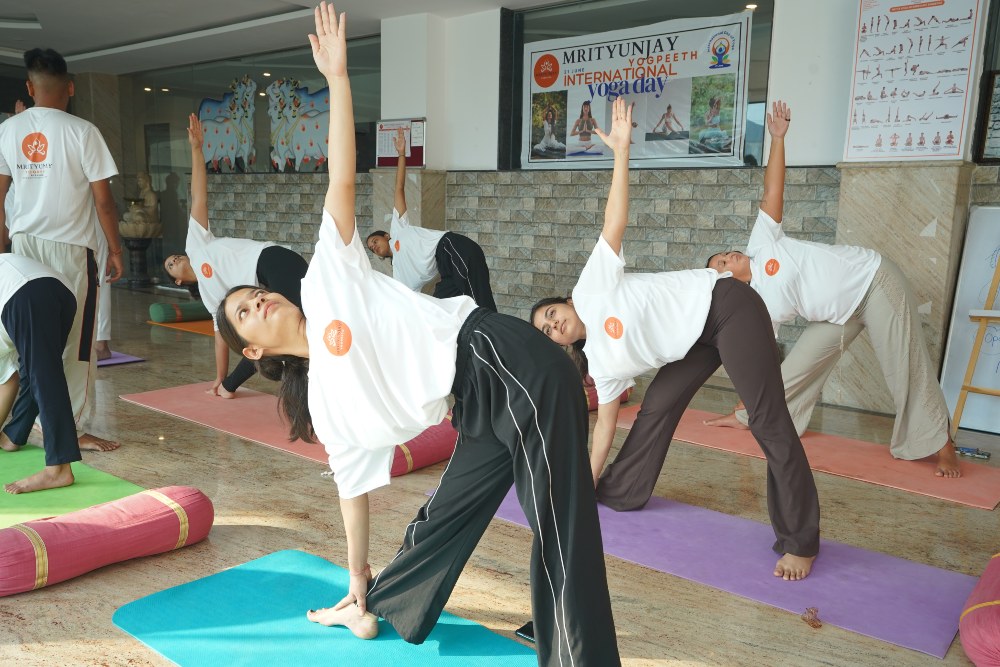
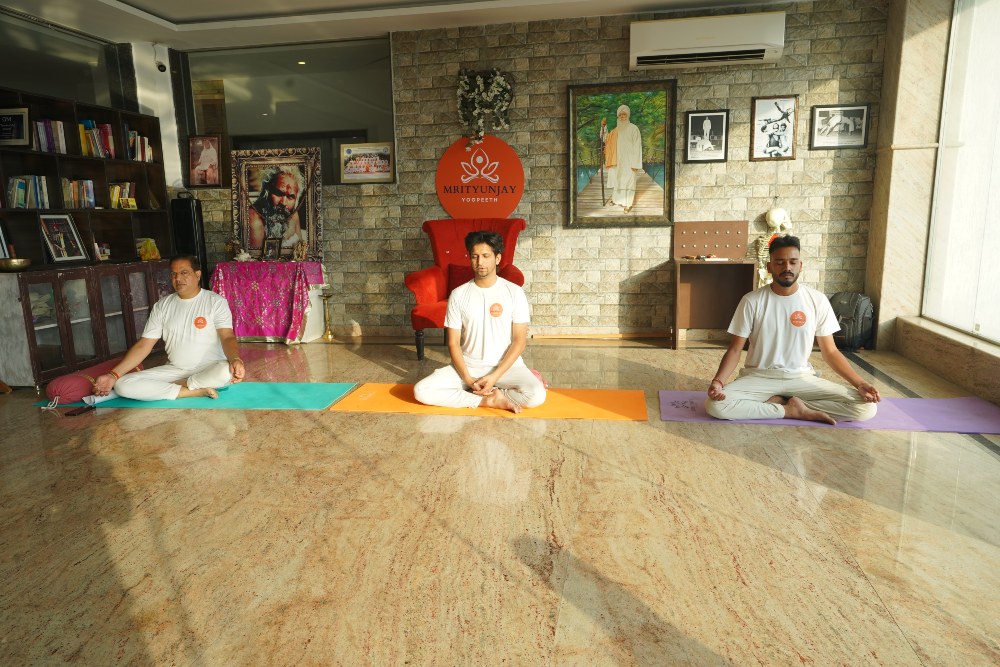
A residential yoga teacher training means students live on campus for the full duration of the course. At Mrityunjay Yogpeeth, this is a fixed 22-day cycle (21 nights), with every batch checking in on the 2nd of the month and checking out on the 23rd – not a variable window, but a consistent, repeatable schedule students can plan to travel around.
Based on the Gurukul system — It is small, where marginalization happens with the teacher directly being able to live and study with his students, so in that sense a student lives unlike an ordinary visit. This is what modern residential Yoga Teacher Training programmes embody in a contained educational setting through integrated and theory-based practice and communal living.
This translates into a self-contained ashram setting on a large property in Rishikesh, positioned to give students walking access to the Ganga riverbank alongside their daily schedule. What that looks like in practice:
- On-campus accommodation – shared twin-sharing rooms or private single rooms, both simply furnished with attached bathrooms and 24/7 hot water, so comfort doesn’t compete with the discipline of early mornings.
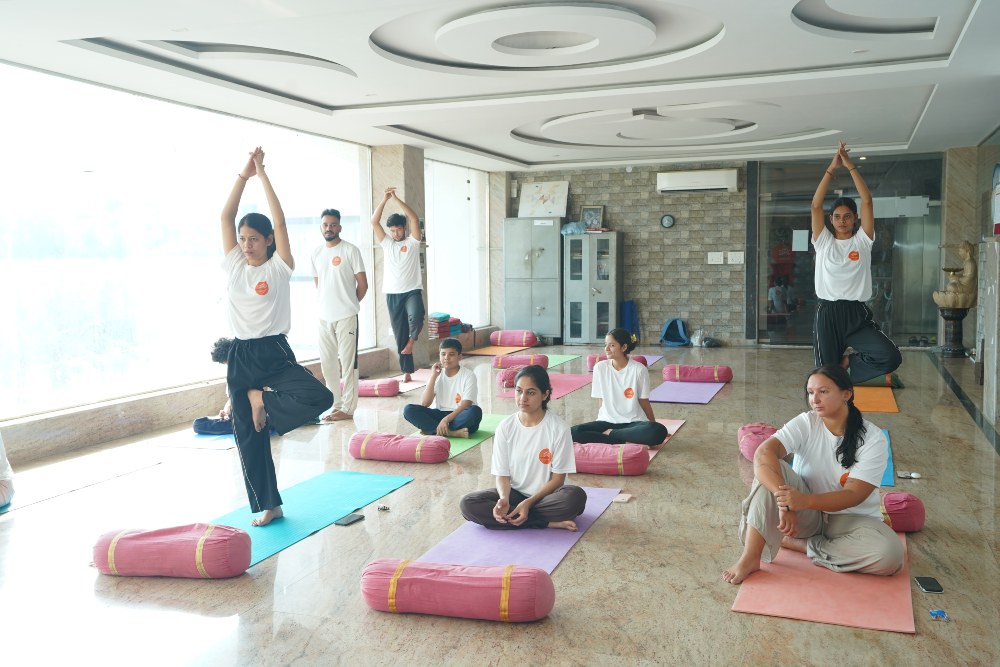
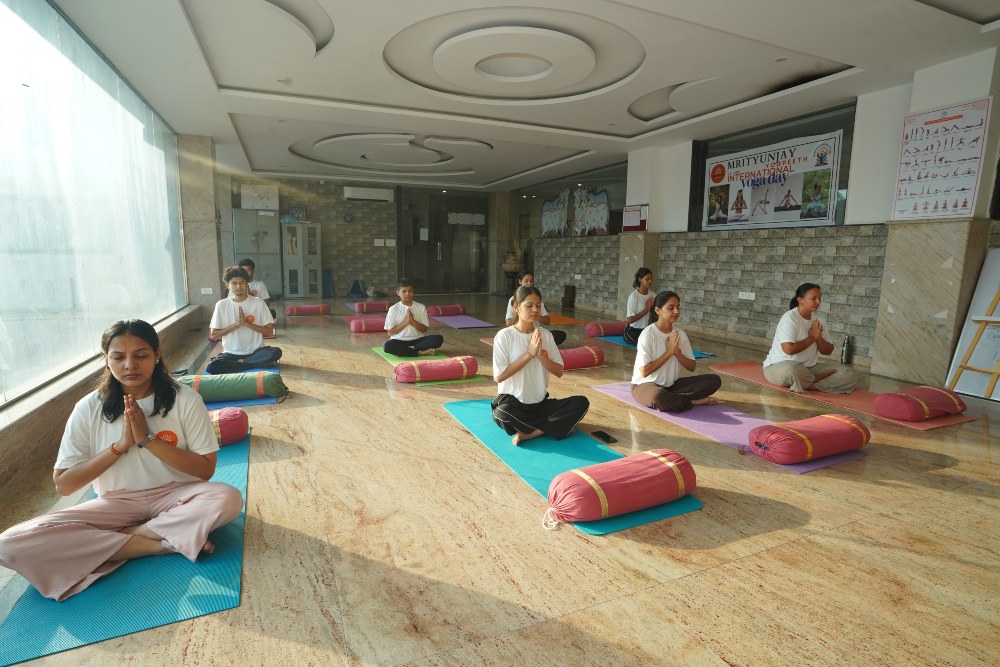
- Dedicated practice spaces – a spacious yoga hall and a separate meditation space, meaning asana, pranayama, and meditation sessions each have a proper setting rather than sharing one multipurpose room.
- Meals served on-site – sattvic vegetarian food prepared and served at fixed times as part of the daily rhythm, rather than students sourcing their own meals off-campus.
- Quiet, natural surroundings – a peaceful garden area and tree-lined grounds intended for reflection, self-study, or informal practice between scheduled sessions.
- Basic connectivity without distraction – high-speed Wi-Fi in common areas, so students can stay in touch with home without disrupting the structure of the programme.
- Proximity to the river – direct or walking-distance access to the Ganga, used for outdoor practice, meditation, and evening Aarti, which is difficult to replicate in a studio-based or commuter programme.
The underlying idea is the same one behind the Gurukul model: when practice, study, food, rest, and guidance all happen in one place, students build consistency far faster than they would fitting sessions around an outside schedule.
A Typical Day: Sample Schedule
Below is a representative daily structure. Exact timings vary by school and season.
| Time | Activity |
| 5:30 AM | Wake Up |
| 6:00 AM | Herbal Tea |
| 6:30 AM | Shatkarma / Pranayama |
| 7:00 AM | Asana Practice (Hatha/Vinyasa) |
| 8:30 AM | Breakfast |
| 9:30 AM | Yoga Anatomy |
| 11:00 AM | Yoga Philosophy |
| 12:30 PM | Lunch |
| 3:00 PM | Teaching Methodology |
| 4:00 PM | Asana Practice (Ashtanga) |
| 6:00 PM | Meditation / Mantra Chanting |
| 7:00 PM | Dinner |
| 8:00 PM | Self-Study / Group Discussion |
| 9:00 PM | Lights Out |
The day includes two dedicated asana sessions – Hatha/Vinyasa in the morning and Ashtanga in the late afternoon – bookended by anatomy and philosophy study in between. As students progress through the 22 days, greater emphasis shifts toward teaching practice, class sequencing, observation, and constructive instructor feedback.
Accommodation Arrangements
Residential training centres usually offer a small number of room configurations rather than hotel-style variety. Common options include:
- Shared twin-sharing rooms
- Private single rooms (often at additional cost)
- Simple, functional furnishings suited to early rising and quiet study
- On-site or walking-distance access to the Ganga riverbank, common in Rishikesh-based schools
Because group sizes are usually kept small in traditional training models, accommodation tends to prioritise a quiet, distraction-free environment over hotel-style amenities.
Food and Daily Nutrition
Most residential schools serve a sattvic diet, a vegetarian approach to food rooted in Ayurvedic and classical Yogic dietary principles. Sattvic food is typically:
- Freshly prepared, avoiding processed ingredients
- Free from onion and garlic in many traditional kitchens
- Balanced across grains, legumes, vegetables, and dairy
- Served at fixed times to support digestive rhythm
Sattvic food, which Ayurveda calls, is also said to support purity of aspect and calm too, but that won’t be a clinical claim; ancient nutritional philosophy explained. Those with certain dietary restrictions will need to seek meal availability from the school ahead of time.
Residential schools are also following the sattvic diet, but to some extent, a different meal plan will be followed. When enrolling, students with allergies or meal requirements should go over this with the school.
Classroom Curriculum: What Gets Taught
A 200-hour syllabus follows a defined structure set by Yoga Alliance, the primary accrediting body for yoga teacher education. Under its current Elevated Standards, a Registered Yoga School must deliver at least 200 hours across four core categories, with remaining hours allocated at the school’s discretion: Techniques, Training and Practice requires 75 hours, Anatomy and Physiology requires 30 hours, Yoga Humanities requires 30 hours, and Professional Essentials requires 50 hours, with the remaining 15 hours allocated by the school across those categories.
Mrityunjay Yogpeeth organizes its curriculum into five practical categories mapped to these requirements.
1. Techniques, Training, and Practice
The physical and experiential core of the training.
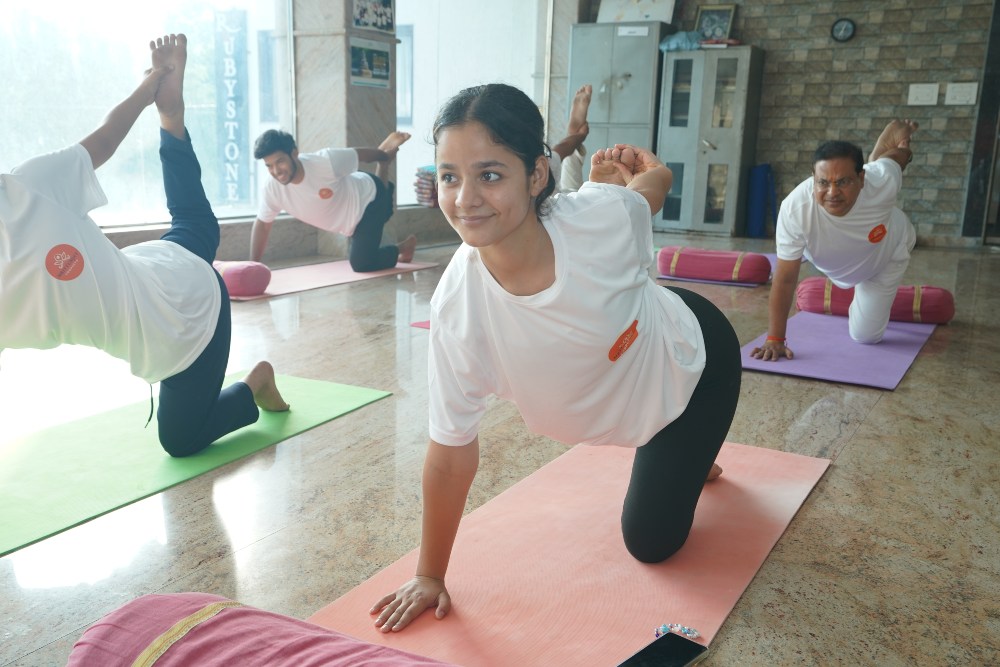
- Asana alignment: Hatha and Ashtanga Vinyasa postures form the core, with elements of Yin and Restorative yoga woven in for balance and recovery – entry, alignment cues, and safe modifications are covered across all three styles.
- Pranayama: Nadi Shodhana, Kapalabhati, Bhastrika, and Ujjayi, taught progressively.
- Meditation and mantra chanting: Guided sitting practice and traditional chanting, building the ability to hold space for future students.
- Shatkarma (cleansing practices): Traditional techniques such as Neti and Kapalabhati, taught with attention to correct technique and contraindications.
This category carries the largest share of hours because it’s the foundation everything else builds on.
2. Teaching Methodology
Where practice turns into a teachable skill.
- Class sequencing: Structuring a class arc – warm-up, peak posture, counter-poses, closing.
- Verbal cueing: Clear, safe instructions that don’t rely on demonstration alone.
- Demonstration and adjustment: Safe posture demonstration and consent-based hands-on assists.
- Observation skills: Spotting misalignment or strain before it becomes an injury.
- Supervised practice classes: Trainees teach segments to peers and receive direct instructor feedback.
3. Anatomy and Physiology
Taught through the lens of teaching safely, not memorization.
- Musculoskeletal system: Major muscle groups and joint mechanics as engaged in specific postures.
- Breath mechanics: The physiology behind pranayama practice.
- Injury-aware teaching: Recognizing common contraindications (knee, spine, shoulder) and offering safe modifications.
The goal is a new teacher who can recognize when a posture needs modifying, and why.
4. Yoga Philosophy, Lifestyle, and Ethics
Grounds the physical practice in its original context.
- Patanjali’s Yoga Sutras: The foundational text underlying classical yoga philosophy.
- The Eight Limbs of Yoga: Yama, Niyama, Asana, Pranayama, Pratyahara, Dharana, Dhyana, and Samadhi – positioning asana as one part of a larger system.
- Yogic lifestyle and ethics: Diet, daily routine (dinacharya), and the ethical responsibilities of holding space as a teacher.
5. Practicum
Where the previous four categories converge into supervised, real teaching experience.
- Live-taught segments: Trainees plan and deliver class time under direct instructor observation.
- Structured feedback: Individual notes on cueing, pacing, sequencing, and presence.
- Peer feedback: Students observe and critique each other, building skills they’ll need teaching independently.
By the end, most students have led several full or partial classes – not just practiced yoga for 200 hours, but taught it.
Residential vs Non-Residential 200 Hour Training
| Factor | Residential Training | Non-Residential Training |
| Purpose | Full immersion in practice and study | Flexible learning around existing routine |
| Suitable For | Career-changers, dedicated practitioners, international students | Local students balancing work or family |
| Difficulty Level | Physically and mentally demanding due to early hours | Moderate, self-paced |
| Duration | Typically 22 consecutive days | Spread over weeks or months |
| Benefits | Deeper practice consistency, community learning, distraction-free environment | Lower disruption to daily life, lower travel costs |
| Limitations | Requires time off work, travel, and adjustment to a fixed routine | Less immersive, may require stronger self-discipline |
| Best Use Case | Students planning to teach professionally or seeking a lifestyle reset | Students testing interest in teacher training before committing further |
Neither format is inherently superior. The right choice depends on the student’s schedule, learning preference, and career intent.
Common Mistakes Students Make
Selecting a Residential Yoga Teacher Training Course is not just about comparing course fees or location. Knowing the training procedure, daily schedule, certification, and syllabus can help you stay away from costly pitfalls and also have a gratifying educational curriculum.
- Assuming residential training focuses only on physical yoga practice
A full Yoga Teacher Training Course includes yoga philosophy, anatomy and physiology, pranayama, meditation, teaching methodology, ethics, and practical teaching skills.
- Not verifying the school’s accreditation
If you plan to apply for Yoga Alliance registration based on your Teacher Training course, confirm the yoga school is a Registered Yoga School (RYS) before enrollment; otherwise verify which accreditation applies to your desired certification.
- Underestimating the daily schedule
Residential yoga programmes typically begin early in the morning and follow a structured routine that includes practice sessions, lectures, self-study, and teaching practice. Preparing for this schedule helps students adapt more comfortably.
- Overlooking dietary requirements
Sattvic vegetarian meals are usually served at residential yoga schools. If you have any allergies, medical conditions, or dietary restrictions, please inform the school before registering.
- Choosing a yoga school based only on price
Tuition fees shouldn’t be your only consideration. Decide on a few of the factors like faculty experience, curriculum, batch size, accreditation, and whether the programme offers student-oriented support & practical teaching lessons to choose a programme that will help you grow a lot in the future as per your desire to be a teacher.
What a Genuinely Good Retreat Includes
Before booking, it helps to know what separates a well-run program from a glorified vacation package with a yoga mat thrown in.
- Certified, experienced teachers. Look for Yoga Alliance – certified instructors with real teaching hours, not just a certificate on a wall.
- A structured daily rhythm. Sunrise meditation, morning asana, pranayama, philosophy or mindfulness sessions, and evening practice should all have a place in the schedule – not just a single yoga class a day.
- Sattvic, vegetarian meals. Food is part of the practice in Rishikesh, not an afterthought. Meals should be fresh, plant-based, and free of processed ingredients or stimulants.
- Access to the river and the mountains. Outdoor practice by the Ganges, sunrise excursions to nearby temples, and quiet time in nature are what separate an authentic retreat from an indoor studio experience with better marketing.
- Room for stillness. A packed schedule with zero downtime isn’t a retreat – it’s a bootcamp. Good programs build in rest, personal reflection, and unstructured time.
Who Actually Benefits From These Retreats
You don’t need years of practice or a flexible spine to join. Most people who attend yoga retreats in Rishikesh are complete beginners or intermediate practitioners looking to build consistency rather than advanced yogis perfecting inversions. If you’re dealing with chronic stress, recovering from a demanding work cycle, processing a major life transition, or simply craving stillness that your routine doesn’t offer, a retreat setting gives you the structure and accountability that’s nearly impossible to replicate solo.
This environment supports mostly solo travelers – the ones who fare best. Just like classes, togetherness is forced during shared meals and excursions: when you want solitude but need others around.
Who Tends to Benefit Most
Residential yoga teacher training benefits professionals, students, and experienced practitioners seeking certification through structured learning, guided practice, and holistic personal growth.
Working professionals often use residential training as a structured break from routine, combining career transition with focused study.
University students frequently choose residential formats during semester breaks, since the fixed schedule suits an academic mindset.
Experienced practitioners seeking to formalise years of personal practice into a teaching credential often prefer the depth offered by daily supervised practicum sessions.
Senior practitioners should discuss any physical limitations with the school beforehand, as some sessions involve extended floor-based practice.
Yoga may support overall wellbeing but should not replace professional medical advice, diagnosis, or treatment. Individuals with medical conditions should consult a qualified healthcare professional before beginning a Yoga practice.
How Students Are Assessed
Assessment isn’t a single test at the end – it runs through the full 22 days. Attendance is the first hurdle: at least 90% attendance is compulsory before you’re even eligible for final evaluation, so skipping sessions isn’t a minor slip, it can cost you your certificate.
Toward the final stretch, your practical skills get tested directly – a written paper alongside a practical exam covering asana, pranayama, and meditation. Both are combined into one overall result, so a strong practice alone isn’t enough; you need to show you understand the theory behind it too. Teaching itself is part of the training rather than a separate test, since supervised practice-teaching sessions run throughout the course, with instructors giving direct feedback on how you cue, sequence, and hold a class.
If you miss a class because you’re ill or have an emergency, teachers will help you catch up – but the school makes it clear that discipline is central to the program: too many absences, or ignoring the code of conduct can see you dismissed without refund. Graduates who meet the attendance minimum and complete both the written and practical components receive 200-hour Yoga Alliance–certified teacher training completion.
What Makes Rishikesh Different From Any Other Yoga Destination
Bali has beaches. Thailand has the islands. But Rishikesh has something neither can replicate: it’s the place where yoga itself was shaped into the modern practice millions of people do today. The town sits where the Ganges rushes out of the Himalayan foothills, and that setting isn’t just scenic – it’s functional. Cooler mountain air, riverside ghats built specifically for meditation, and a culture where sunrise practice is a community event rather than a niche activity all combine to create something you can’t fake in a studio back home.
This is also why yoga retreats in Rishikesh tend to go deeper than a typical spa getaway. You’re not just doing vinyasa flows between spa treatments; you’re often studying philosophy, pranayama, and meditation from teachers who trained in the same lineages that shaped global yoga culture.
Certification Outcomes
On successful completion, students at Mrityunjay Yogpeeth receive:
- Yoga Alliance USA certification, making graduates eligible to register as an RYT 200 with Yoga Alliance internationally. Registration itself is a separate process completed after graduation.
- A Ministry of AYUSH (YCB) certificate from the same course, provided at enrollment (if applied for initially) — Mrityunjay Yogpeeth is positioned as one of the few Rishikesh-based schools offering both certifications from a single 200-hour program, rather than requiring a separate YCB course.
- Foundational qualification to teach group or private Hatha, Ashtanga, or Vinyasa classes.
- A basis for further study toward RYT 300 or RYT 500 credentials.
Frequently Asked Questions
1. How long does a residential 200-hour Yoga Teacher Training in Rishikesh take?
Most residential 200-hour Yoga Teacher Training Courses (YTTCs) in Rishikesh are completed within 22 days. The duration depends on the school’s curriculum, daily training hours, rest days, and practical teaching sessions. Students follow a structured residential schedule that combines yoga practice, theory classes, meditation, and self-study throughout the programme.
2. Do I need previous yoga experience to join a 200-hour Yoga Teacher Training?
No formal certification or teaching experience is required. However, having a regular personal yoga practice and a genuine interest in learning can make it easier to adapt to the physical practice, philosophy, anatomy, and teaching methodology covered during the course. Most schools welcome beginners who are committed to learning.
3. Is residential Yoga Teacher Training physically demanding?
Yes. Most programmes begin early in the morning and include several hours of daily practice alongside classroom learning. Students gradually adapt during the first week, although the experience varies according to individual fitness and previous Yoga experience.
4. Can international students join?
Yes. Many Yoga schools in Rishikesh welcome international students and provide English-language instruction. Entry requirements, visa arrangements, and accommodation policies should be confirmed directly with the school before enrolment.
5. Is attendance compulsory?
Most accredited Yoga Teacher Training programmes require students to maintain minimum attendance levels to complete the course successfully. Attendance policies vary between schools.
Conclusion
A residential 200 hour Yoga Teacher Training in Rishikesh offers an immersive learning environment where daily practice, philosophy, anatomy, and teaching methodology are integrated into a structured routine. Living on campus allows students to develop consistency, receive regular instructor guidance, and learn within a supportive community.
Before enrolling, review the curriculum, accreditation, faculty experience, accommodation, and course expectations to ensure the programme aligns with your learning objectives and long-term goals.
To review programme details and current intake dates, visit the 200 Hour Yoga Teacher Training page. Students interested in government-recognised study can review the YCB Certified Yoga Courses, and those wanting to verify accreditation can visit the Registered Yoga School page. For personalised guidance on which format suits your goals, contact Mrityunjay Yogpeeth directly.