TLDR
Yoga Alliance and YCB certify yoga teachers differently, and neither is universally “better.” Yoga Alliance is a private, US-based registry: schools get accredited (RYS), and graduates register credentials like RYT 200/500 simply by completing training hours – no exam required. It’s the go-to choice for teaching internationally in studios, retreats, and wellness resorts abroad. YCB, run by India’s Ministry of AYUSH, is a government certification requiring both a written exam and practical assessment, valid for five years with renewal.
It’s ideal for those targeting institutional, government, hospital, or school-based roles within India. Many aspiring teachers pursue both to stay flexible, especially if unsure whether their career will lean international or India-based.
Quick Comparison
| Factor | Yoga Alliance | YCB |
| Governing Body | Private, US-based non-profit | Ministry of AYUSH, Govt. of India |
| Assessment | No exam; course completion suffices | Written theory + practical exam |
| Duration | 200 / 300 / 500 hours | Level 1 (200h) to Level 3 (900h)+ |
| Best For | International studios, retreats, online teaching | Government, AYUSH, hospital, school roles in India |
| Renewal | Continuing education credits | Valid 5 years; workshop + reassessment |
| Recognition | Strong internationally | Officially recognized across India |
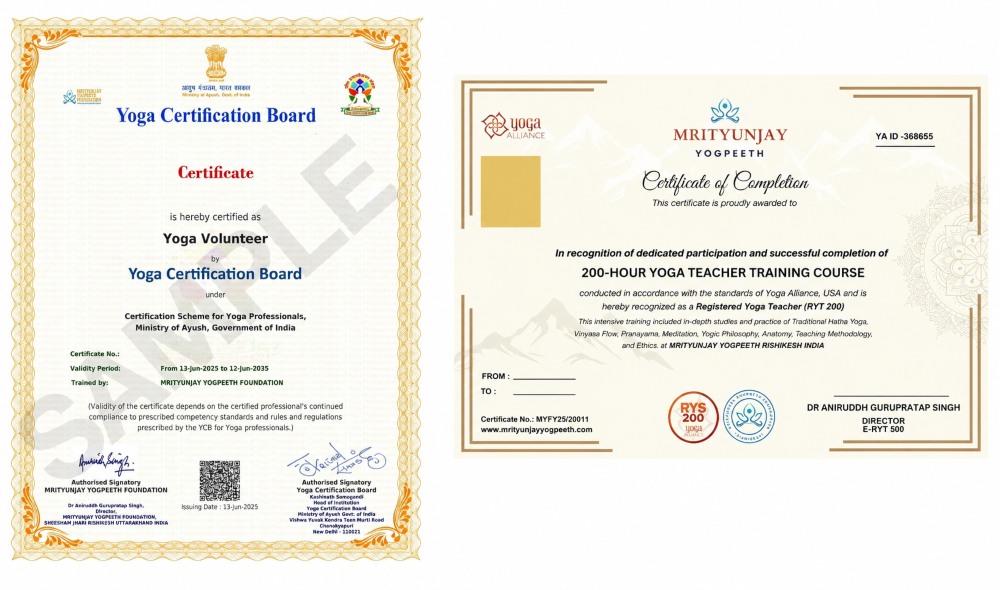
Introduction
Choosing between Yoga Alliance and YCB certification is one of the most common questions among aspiring yoga teachers in India. Both paths lead to a recognised credential, but they serve different purposes, follow different structures, and open different career doors.
Yoga Alliance is a private, US-based credentialing body widely recognised in international studios and wellness centres. YCB, or the Yoga Certification Board, is a government body under India’s Ministry of AYUSH that certifies yoga professionals through structured examinations.
Understanding the Yoga Alliance vs YCB certification distinction can help you select a training path that matches your career goals, whether that means teaching internationally, working within India’s government wellness ecosystem, or pursuing both credentials together.
What Is Yoga Alliance Certification?
Yoga Alliance is a non-profit membership organisation based in the United States. It does not certify individual teachers directly. Instead, it registers Yoga Teacher Training schools that meet its curriculum standards, and graduates of those schools can then register as teachers under credentials such as RYT 200, RYT 300, and RYT 500.
This model means Yoga Alliance functions more like a registry than an examining board. A school becomes a Registered Yoga School (RYS) once its syllabus, teaching hours, and faculty qualifications meet Yoga Alliance’s published standards. Graduates of that school are then eligible to register their own credentials, provided they completed the required contact hours.
Key characteristics of Yoga Alliance credentialing:
- It is a private organisation, not a government body
- Registration is based on completing hours at a Registered Yoga School (RYS)
- Yoga Alliance does not require a formal examination; completing a certified course is sufficient for registration
- It is widely accepted in Western yoga studios, wellness resorts, and international teaching contexts
- Continuing education hours are typically required to maintain active registration over time
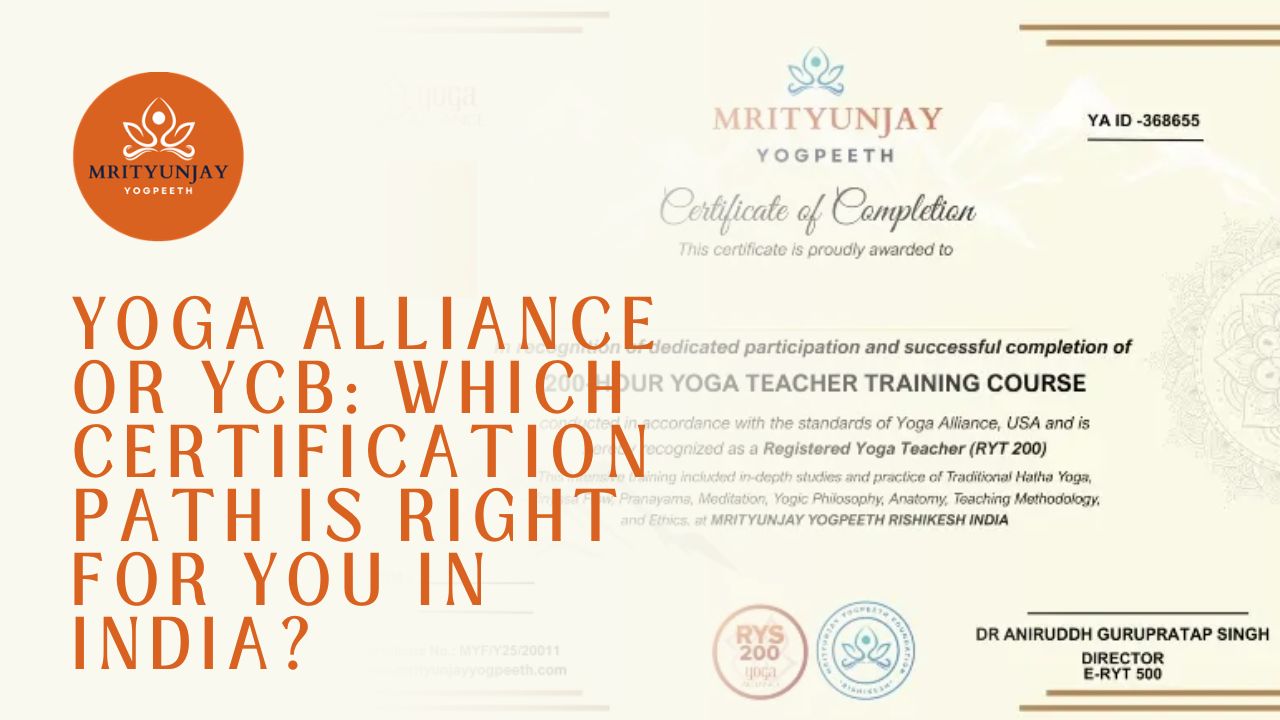
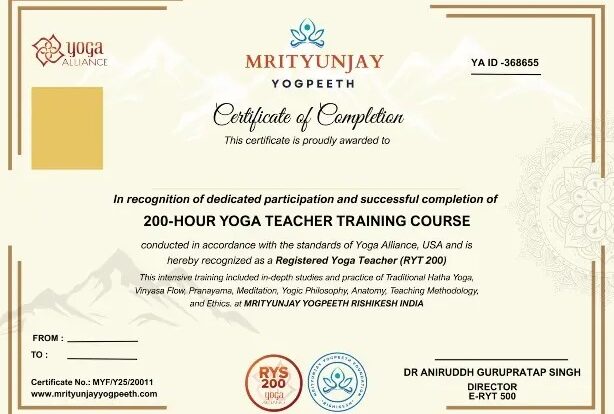
Mrityunjay Yogpeeth operates as a Yoga Alliance USA Registered Yoga School offering RYS 200, RYS 300, and RYS 500 programmes, which allow graduates to register with Yoga Alliance after completing training. These programmes are structured around classical teaching methodology combined with practical instruction, in keeping with the institution’s residential, small-batch training model.
What Is YCB Certification?
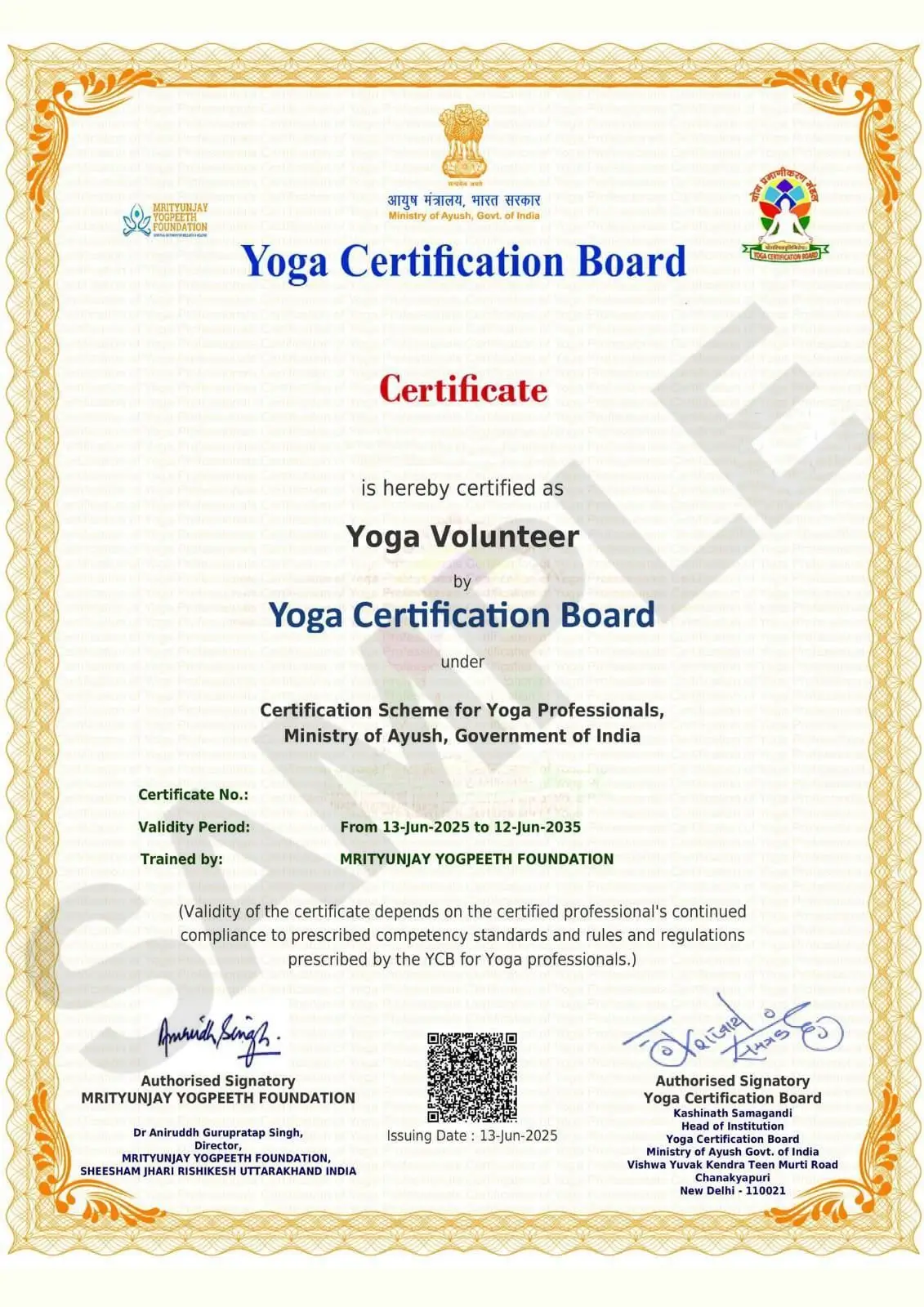
YCB was established in March 2018 under the Ministry of AYUSH, Central Government of India, to promote yoga as a career and raise education standards among yoga professionals. Unlike Yoga Alliance, YCB is a government body, and its certificates carry official recognition within India’s public institutions.
A few defining features:
- YCB operates under the Ministry of AYUSH (Ayurveda, Yoga, Naturopathy, Unani, Siddha, and Homeopathy)
- Candidates must clear both a written theory exam and a practical assessment
- The theory exam consists of multiple-choice questions marked on an OMR sheet, and the practical assessment evaluates each candidate individually
- YCB certificates are valid for five years, after which renewal requires a short continuing education workshop and assessment
- Certified professionals are listed in a publicly searchable national directory maintained on the official YCB portal
Unlike Yoga Alliance, Yoga Certification Board (YCB) offers a structured certification pathway with multiple levels, allowing practitioners to progress from foundational training to advanced teaching and therapeutic roles. The certification framework includes levels such as Yoga Protocol Instructor, Yoga Wellness Instructor, Yoga Teacher & Evaluator, Yoga Master, Yoga Therapist, and Therapeutic Yoga Consultant, each with defined eligibility requirements, curriculum, and professional responsibilities.
Because YCB certification is issued under India’s Ministry of AYUSH, it is particularly valuable for those seeking careers in government institutions, AYUSH wellness centres, schools, hospitals, and officially recognised yoga organisations. Choosing the appropriate certification level depends on your career goals, teaching experience, and whether you plan to work in community education, professional instruction, or yoga therapy.
Yoga Alliance vs YCB
| Factor | Yoga Alliance | YCB |
| Purpose | International teacher registration | Government-recognised certification |
| Governing Body | Private, US-based non-profit | Ministry of AYUSH, Government of India |
| Suitable For | Teachers targeting international studios and wellness centres | Teachers targeting government, institutional, or India-based roles |
| Assessment | No formal exam; course completion is sufficient | Written theory exam and practical assessment required |
| Duration | 200, 300, or 500 hours (RYS-based) | Level 1 (200 hours), Level 2 (500 hours), Level 3 (900 hours), and higher advanced levels |
| Recognition | Widely accepted internationally, especially in Western countries | Officially recognised across India’s studios, wellness centres, hospitals, schools, and corporate organisations, with growing global visibility |
| Renewal | Continuing education credits (per Yoga Alliance policy) | Valid for five years; renewal requires a workshop and assessment |
| Limitations | Does not carry Indian government recognition on its own | May be less familiar to Western studios unfamiliar with AYUSH credentials |
| Best Use Case | Teaching abroad, at international retreats, or in private studios | Working with AYUSH programmes, government wellness initiatives, schools, or hospitals in India |
This comparison reflects publicly available information from Yoga Alliance and YCB. Requirements can be updated by either body, so readers considering enrolment should confirm current details on Yoga Alliance’s official credentialing page and the YCB portal before making a final decision.
Who Should Choose Which Certification?
The right certification depends on where you want your yoga career to go. Your decision should align with your long-term goals – whether that means teaching internationally, working in India’s institutional wellness sector, specialising in yoga therapy, or building your own yoga business.
Working Professionals Planning to Teach Internationally
If your goal is to teach abroad, lead international retreats, or work with global yoga studios, Yoga Alliance certification is generally the stronger choice. It is widely recognised across the United States, Europe, Australia, and many parts of Southeast Asia, making it a familiar credential for studio owners and employers.
Best suited for:
- Teaching at international yoga studios and retreat centres
- Building a global yoga teaching career
- Offering online classes to an international audience
Yoga Teachers Seeking Government or Institutional Roles in India
If you plan to work within India’s organised wellness ecosystem, YCB certification is often the more relevant pathway. As it is supported by the Ministry of AYUSH, it can be advantageous for roles within government-backed wellness initiatives, hospitals, educational institutions, and AYUSH-affiliated centres.
Students Unsure About Their Long-Term Career Path
If you’re still exploring your career options, pursuing a training programme that supports both certification pathways can provide greater flexibility. This allows you to keep opportunities open for both international teaching and India-based professional roles without repeating foundational training later.
Senior Yoga Teachers Considering Advanced Specialisation
Experienced teachers interested in yoga therapy, assessment, or evaluator roles may benefit from YCB’s advanced certification levels. These specialised pathways focus on therapeutic and institutional applications beyond the standard Yoga Alliance teacher registration framework.
Yoga Studio Owners and Wellness Entrepreneurs
Your certification can also support your business positioning.
Consider Yoga Alliance if you want to:
- Attract international students and retreat participants
- Build a globally recognised yoga brand
- Expand your presence through online teacher training
For businesses focused on corporate wellness programmes, institutional partnerships, or government collaborations within India, YCB certification may offer greater relevance.
Athletes and Wellness Practitioners Transitioning into Teaching
Individuals moving from personal practice into professional teaching often begin with a Yoga Alliance-registered Teacher Training Course, as it provides a strong foundation in teaching methodology, class sequencing, anatomy, and ethics. Those who later pursue careers in therapeutic or institutional yoga can add YCB certification as their professional direction evolves.
Common Mistakes to Avoid
Choosing the right certification requires more than comparing course fees or training hours. Avoid these common mistakes to ensure your certification aligns with your long-term teaching goals.
| Mistake | Why It Matters |
| Assuming Yoga Alliance and YCB certify the same competencies | They follow different standards, assessment processes, and career pathways. Understanding these differences helps you choose the certification that best fits your goals. |
| Believing one certification is always better | Neither certification is universally superior. The right choice depends on whether you want to teach internationally, work in India’s wellness sector, or specialise in yoga therapy. |
| Ignoring certification and renewal requirements | Yoga Alliance Registered Yoga Teachers (RYTs) maintain registration through continuing education, while YCB certifications generally require renewal at prescribed intervals. Review these requirements before enrolling. |
| Not verifying the yoga school’s accreditation | Always confirm that your training institute is officially recognised by the certification body you intend to pursue. This helps ensure your qualification is valid and recognised. |
| Assuming course completion automatically grants YCB certification | Completing a teacher training programme is only one step. YCB certification also requires successfully passing the prescribed theory and practical examinations. |
| Choosing a certification based only on cost or convenience | Focus on your long-term teaching goals, preferred career pathway, and where you plan to teach instead of making your decision solely on price or course duration. |
Frequently Asked Questions
1. Is Yoga Alliance or YCB certification better for teaching yoga in India?
Neither is inherently better; YCB carries government recognition useful for institutional and AYUSH-linked roles in India, while Yoga Alliance is more widely recognised internationally.
2. Can I hold both Yoga Alliance and YCB certifications at the same time?
Yes. Many training schools offer programmes that allow students to pursue both credentials through the same training hours, where curricula align, gaining flexibility across both international and India-based opportunities.
3. Does Yoga Alliance require an examination?
No. Yoga Alliance does not require an examination; completing a certified course at a Registered Yoga School is sufficient for registration.
4. Does YCB require an examination?
Yes. YCB candidates must clear a written theory examination and a separate practical assessment before certification is issued, regardless of the number of training hours completed.
5. Which certification should a beginner choose?
This depends on career intent. Beginners planning to teach internationally often start with a Yoga Alliance-registered 200-hour course, while those targeting government or institutional roles in India may begin with YCB’s entry-level certifications.
Conclusion
Yoga Alliance and YCB serve different purposes within the yoga education landscape. Yoga Alliance offers a globally recognised registration pathway built on completed training hours, while YCB provides a government-backed, examination-based certification rooted in India’s official wellness framework. Neither replaces the other, and the right choice depends on where and how you intend to teach, rather than which credential appears more prestigious on paper.
Rather than asking which certification is better, consider where you want your yoga career to take you over the next five to ten years. Choosing a certification aligned with your long-term goals will provide greater value than selecting one based solely on popularity or course fees.
Choosing between Yoga Alliance and YCB certification is easier with guidance tailored to your goals. Explore the 200-Hour Yoga Teacher Training for the Yoga Alliance pathway, or review the YCB-Certified Yoga Courses for the government-recognised route. You can also browse the Yoga Teacher Training hub to compare all available programmes, or reach out to Mrityunjay Yogpeeth directly for personalised certification guidance suited to your career goals.